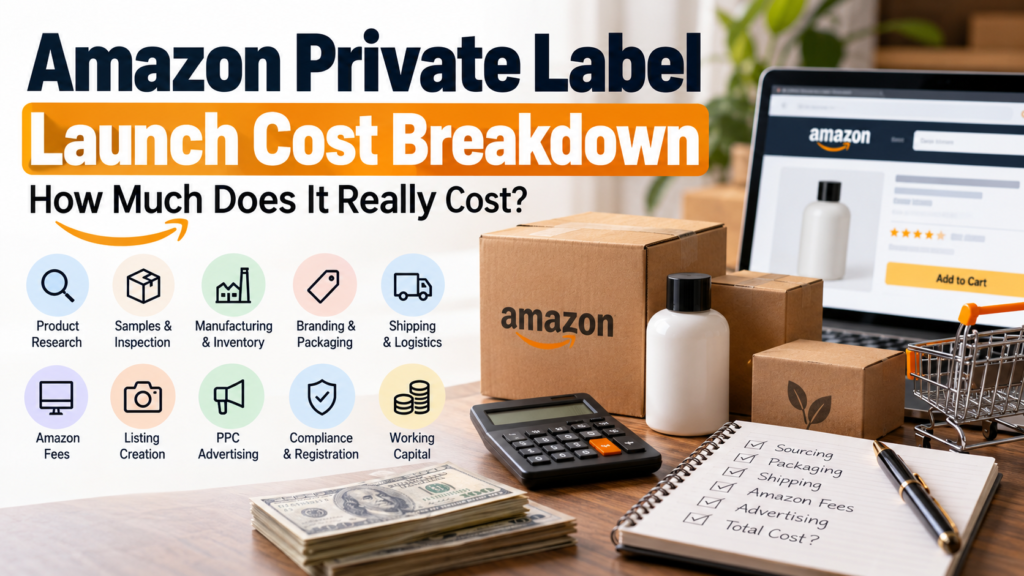
Launching a private label product on Amazon can be an effective way to build your own brand, but understanding the total investment required before placing your first order is essential. Product sourcing, manufacturing, packaging, shipping, Amazon fees, and advertising all contribute to your overall launch cost.
So, how much does it cost to launch a private label product on Amazon?
A small Amazon private label launch may cost between $2,000 and $5,000, while more competitive products can require $5,000 to $10,000 or more. Your actual investment depends on the product category, minimum order quantity, supplier pricing, shipping costs, and marketing strategy.
At HighRise Wholesale, we help sellers understand product sourcing, private labeling, and launch preparation so they can evaluate their investment before committing to inventory. Working with an experienced sourcing partner can also help simplify the process of coordinating suppliers, packaging, and marketplace requirements.
In this guide, we explain the major Amazon private label launch expenses, provide a practical budget example, and share ways to control costs without compromising product quality.
1. Product Research and Validation
Estimated cost: $0 to $300 or more
Product research is the foundation of a successful private label business. Before investing in inventory, you need to identify a product with sufficient demand, manageable competition, and the potential to generate a healthy profit margin.
Your research should include:
- Monthly sales estimates and search demand
- Competitor pricing and customer reviews
- Product differentiation opportunities
- Manufacturing and shipping costs
- Amazon referral and fulfillment fees
- Estimated advertising expenses
- Intellectual property and compliance risks
Free tools and marketplace research can help you get started, while paid research platforms may provide additional insights.
However, a product with high sales volume is not necessarily profitable. If competition drives prices down or advertising costs consume your margin, even a popular product can become difficult to scale.
HighRise Wholesale encourages sellers to evaluate the complete cost structure before selecting a product. The goal is to identify an opportunity that makes financial sense, not simply a product that appears popular.
2. Product Samples and Quality Inspection
Estimated cost: $50 to $300 or more
Ordering samples allows you to evaluate product quality, materials, functionality, packaging, and overall presentation before placing a bulk order.
Depending on the product and supplier, sample related expenses may include product samples, international courier charges, customization, and additional inspection or testing.
Compare samples from multiple suppliers when possible. Check the materials, durability, dimensions, finish, packaging, and consistency with your specifications.
Skipping quality checks to save money can create more expensive problems later, including customer complaints, refunds, negative reviews, and inventory that cannot be sold.
Before confirming a purchase, establish clear product specifications, acceptable defect levels, and procedures for handling defective units.
3. Manufacturing and Initial Inventory
Estimated cost: $800 to $3,000 or more
Initial inventory is often one of the largest expenses in an Amazon private label launch.
Your total manufacturing cost depends on the unit price, minimum order quantity, product complexity, and customization requirements.
For example, suppose you want to launch a kitchen accessory and order 500 units at $2 per unit.
500 units × $2 = $1,000
This gives you an initial inventory cost of $1,000, but it may not include custom packaging, logo printing, tooling, or other production expenses.
Before placing an order, ask suppliers about:
- Minimum order quantity
- Pricing at different order volumes
- Customization and packaging charges
- Production lead times
- Quality control procedures
- Payment terms
- Replacement policies for defective products
Ordering a smaller quantity can reduce your initial financial risk, although the unit cost may be higher.
HighRise Wholesale supports sellers with product sourcing and private label development. When planning your order, consider expected sales, supplier requirements, replenishment timelines, and available working capital.
Buying too much inventory before validating demand can tie up money that you may need for advertising, shipping, or future orders.
4. Logo, Branding, and Packaging
Estimated cost: $50 to $500 or more
Private label selling involves building a recognizable brand rather than simply reselling an existing product.
Branding expenses may include logo design, packaging artwork, custom printed packaging, instruction manuals, and other product presentation elements.
Basic branding can be relatively affordable, while custom molds, premium packaging materials, and complex designs can increase the overall cost.
Your packaging should communicate the product’s value, protect the item during transportation, and meet applicable labeling and safety requirements.
You do not need an expensive design to create a professional brand. Focus on clear branding, useful packaging, and a product experience that matches customer expectations.
HighRise Wholesale offers branding and design assistance for qualifying orders. Before selecting a service package, confirm exactly which design and customization services are included.
5. Amazon Seller Account and Marketplace Fees
Estimated cost: Depends on your selling plan and product
Amazon selling fees can significantly affect your profitability, so they should be calculated before purchasing inventory.
The main expenses include seller account fees, referral fees, fulfillment charges, and inventory storage fees.
Seller account fees: Amazon offers different selling plans, with costs depending on the marketplace and plan selected. Check current pricing before registering.
Referral fees: Amazon generally charges a percentage of each sale, depending on the product category and applicable fee structure.
Fulfillment fees: If you use Fulfillment by Amazon, you pay for eligible fulfillment services based on factors such as product size and shipping weight.
Storage fees: Inventory stored in Amazon fulfillment centers may incur storage charges. Slow selling products can increase these costs.
Additional fees: Depending on your account and inventory, you may also face return related expenses, removal fees, aged inventory charges, and other applicable service costs.
For example, if your product sells for $25, that does not mean you earn $25. You must subtract marketplace fees, fulfillment, advertising, product costs, and other expenses to calculate your actual profit.
Use Amazon’s official Revenue Calculator to estimate fees and evaluate product profitability before placing your first order:
6. Shipping, Freight, and Import Costs
Estimated cost: $200 to $1,000 or more
Getting your inventory from the supplier to an Amazon fulfillment center involves several possible expenses.
These may include international freight, customs clearance, applicable duties and taxes, domestic transportation, product preparation, labeling, and final delivery.
Air freight can be useful for smaller shipments or urgent replenishment, but it can be expensive. Ocean freight may reduce transportation costs for larger shipments, although transit times are generally longer and additional handling charges may apply.
Request a detailed quotation that identifies the costs included in the shipment. A low manufacturing price does not necessarily mean the product will have a low landed cost.
HighRise Wholesale helps sellers coordinate sourcing and logistics for private label products intended for Amazon fulfillment centers. Before shipping, clarify responsibility for freight, customs, duties, labeling, preparation, and final delivery.
Remember that products must meet Amazon’s applicable preparation and packaging requirements before being sent to a fulfillment center.
7. Product Photography and Amazon Listing Creation
Estimated cost: $100 to $600 or more
Your Amazon listing helps customers understand the product and decide whether it meets their needs.
A listing budget may include product photography, lifestyle images, infographics, keyword research, titles, bullet points, product descriptions, and A+ Content where eligible.
Professional images can communicate product features more effectively than basic photographs. However, every image and claim must accurately represent the product and comply with Amazon’s listing policies.
Keyword research is equally important because it helps you understand how potential customers search for products.
HighRise Wholesale provides listing creation and launch support to help sellers coordinate product sourcing, branding, and marketplace preparation. When comparing service providers, check whether photography, listing copy, keyword research, and ongoing optimization are included.
8. Amazon PPC Advertising and Launch Marketing
Estimated cost: $300 to $1,000 or more for initial testing
Advertising is one of the most underestimated costs of launching a private label product.
Even a good product may struggle to gain visibility without a plan for reaching relevant customers. Amazon Sponsored Products campaigns can help generate impressions, clicks, and sales, but advertising does not guarantee profitability.
Your initial advertising budget should allow you to test relevant keywords, automatic and manual targeting, bids, product targeting, conversion rates, and advertising cost of sales.
Consider this example:
You spend $500 on advertising and generate $1,500 in attributed sales.
Your advertising cost of sales is approximately 33.3%.
However, this does not automatically mean your campaign is profitable. You must also subtract manufacturing, shipping, fulfillment, referral fees, and other expenses.
Start with a controlled testing budget and review campaign performance regularly. Increase spending only when the available data supports the decision.
HighRise Wholesale assists sellers with launch planning and advertising setup where included in the selected service package. The objective should be to build a sustainable sales strategy rather than chasing revenue without understanding margins.
9. Brand Registration and Product Compliance
Estimated cost: $0 to several hundred dollars or more, excluding specialized testing
Brand registration and product compliance can introduce additional costs, depending on your product and target marketplace.
Potential expenses include trademark applications, professional assistance, laboratory testing, regulatory documentation, packaging updates, and specialized compliance reviews.
Amazon Brand Registry has specific eligibility requirements related to your brand and trademark. Creating a seller account does not automatically qualify you for brand registry benefits.
Similarly, registering a trademark does not replace product safety testing or other regulatory obligations.
A simple household accessory may have fewer compliance requirements than an electrical product, cosmetic, children’s item, or product making regulated performance claims.
Research the applicable requirements before ordering inventory. Discovering a missing certification after manufacturing can create costly delays.
HighRise Wholesale can assist with private label launch coordination, but sellers should confirm which compliance services, documents, and registration expenses are included in their agreement.
10. Working Capital and Emergency Reserve
Recommended allocation: Around 10% to 20% of your planned budget, where possible
Your expenses do not end when the inventory arrives at Amazon.
You may need additional money for advertising, refunds, unexpected shipping charges, inventory replenishment, or slower than expected sales.
A working capital reserve can help cover:
- Unexpected logistics expenses
- Product quality issues
- Additional advertising tests
- Customer returns and refunds
- Inventory storage charges
- Reordering products before stock runs out
Cash flow is especially important because supplier payment deadlines, Amazon payouts, and inventory turnover do not always align.
If all your capital is tied up in the first order, you may struggle to maintain stock or respond to unexpected expenses.
HighRise Wholesale recommends evaluating the entire launch budget rather than spending everything on manufacturing. A sustainable launch requires sufficient capital to test the product, measure performance, and manage the next stage of growth.
Amazon Private Label Launch Cost Example
Consider a hypothetical Amazon US launch with an initial inventory of 500 units.
Here is one possible budget allocation:
- Product research and validation: $100
- Samples and inspection: $100
- Initial inventory: $1,000
- Branding and packaging: $150
- Freight and import related expenses: $400
- Listing images and content: $250
- Initial advertising: $500
- Account and miscellaneous launch expenses: $100
- Contingency reserve: $400
Estimated total launch budget: $3,000
These figures are illustrative estimates, not supplier quotations or guaranteed market rates. Actual expenses can vary considerably depending on the product, shipping method, order quantity, compliance requirements, and advertising strategy.
The example assumes a relatively simple product that can be ordered in a small quantity without substantial additional testing or registration costs.
Before investing, calculate your expected contribution margin per unit and determine how many units you need to sell to recover your initial expenses.
How to Reduce Amazon Private Label Launch Costs
Reducing expenses can improve your financial position, but cutting essential costs can create bigger problems later.
Here are practical ways to manage your launch budget.
Choose products that are economical to ship. Lightweight and compact products may have lower transportation and fulfillment costs, depending on their dimensions and category.
Validate demand before ordering inventory. Analyze competition, customer reviews, pricing, and estimated sales. Use product samples to verify quality.
Compare multiple suppliers. Request itemized quotations and compare total landed cost instead of looking only at the manufacturing price.
Order quantities that match your plan. Negotiate volume pricing, but avoid buying excess stock simply to obtain a lower unit price.
Keep branding focused. Invest in professional imagery, clear packaging, and useful product information before paying for unnecessary design extras.
Monitor advertising performance. Evaluate search terms, conversions, and margins. Adjust campaigns based on evidence rather than increasing bids without a clear strategy.
Plan inventory replenishment. Account for manufacturing and shipping lead times to reduce the risk of stockouts while avoiding excessive inventory.
If you want help coordinating product sourcing, private labeling, and launch preparation, HighRise Wholesale provides services designed to help Amazon sellers manage these stages more efficiently.
Is $1,000 Enough to Start Amazon Private Label?
In most cases, $1,000 is a very tight budget for a conventional Amazon private label launch in the US.
It may be possible for a low cost product with a small minimum order, limited customization, and inexpensive shipping. However, you still need to account for marketplace fees, listing preparation, advertising, and working capital.
A budget of $2,000 to $3,000 may offer more flexibility for a lean launch, while $5,000 or more can provide greater room to test products and manage inventory.
There is no universal minimum investment that guarantees success. Your budget should reflect the actual costs of your product and leave enough cash available to operate after the initial purchase.
Is Amazon Private Label Worth It?
Amazon private label can be a viable business model, but it is not an automatic path to profit.
Competition, advertising costs, marketplace fees, customer expectations, and product differentiation all influence the outcome. Sellers who simply choose a popular product and place a bulk order may struggle to build sustainable margins.
A disciplined approach includes researching demand, calculating landed costs, validating quality, creating a differentiated offer, preparing a compliant listing, testing advertising, and managing cash flow.
The key is to make decisions based on realistic financial projections rather than optimistic sales estimates.
Final Thoughts
The cost of launching an Amazon private label product depends on your product, supplier, order quantity, logistics, marketplace fees, and marketing strategy.
For planning purposes, a small launch may require approximately $2,000 to $5,000, while more competitive or complex products may require considerably more. Treat these figures as estimates rather than fixed requirements.
Before investing, calculate your complete landed cost, estimate the fees associated with each sale, and reserve enough capital to test advertising and handle unexpected expenses.
HighRise Wholesale believes that informed sourcing decisions, realistic budgeting, and effective launch planning are essential foundations for building a private label business.
The objective is not simply to launch a product on Amazon. It is to build a business with sustainable margins, reliable operations, and enough working capital to grow.