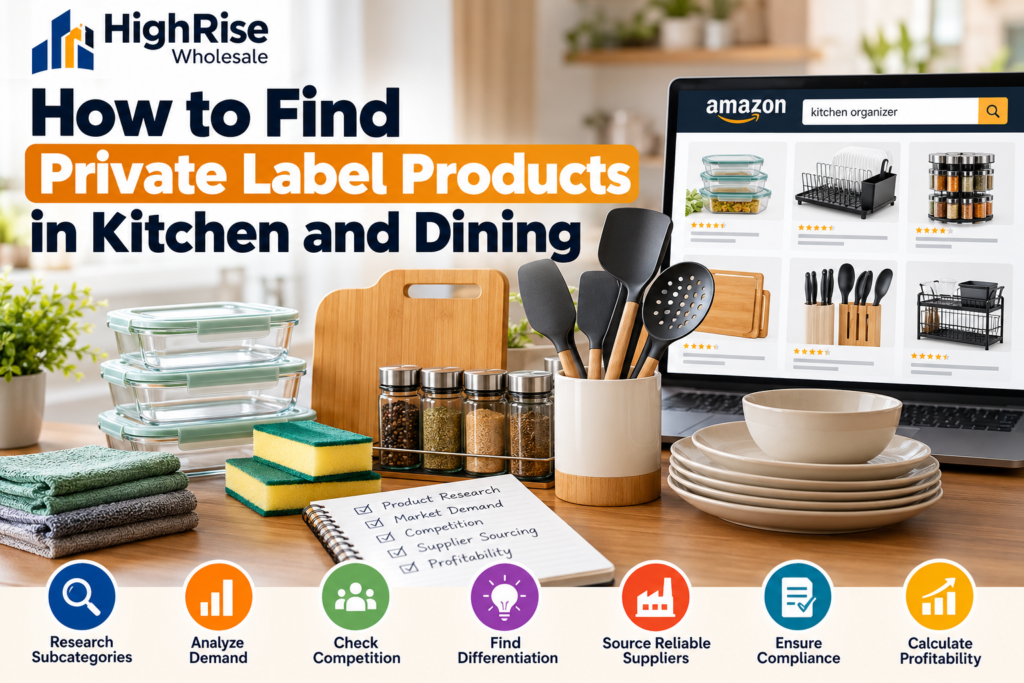
Kitchen and dining is one of the most practical categories for launching a private label brand on Amazon. From food storage containers and kitchen organizers to dishwashing accessories and dining utensils, customers regularly purchase products that make everyday tasks easier.
However, finding a profitable private label product requires more than choosing something popular. Sellers need to evaluate market demand, competition, product quality, sourcing costs, differentiation opportunities, and Amazon fees before investing in inventory.
If you want to build a sustainable e-commerce business, this guide explains how to find private label products in kitchen and dining, validate your ideas, and turn a promising product into a marketable brand.
Why Is Kitchen and Dining a Good Private Label Category?
Kitchen and dining products serve a broad customer base. Homeowners, renters, families, students, cooking enthusiasts, and professional chefs all purchase products for food preparation, storage, cleaning, and serving.
The category also offers opportunities across different price points. You can explore affordable accessories for everyday use or premium products designed around durability, convenience, and aesthetics.
Some advantages include:
- Consistent customer demand: Many kitchen products solve recurring household problems.
- Product bundling opportunities: Related accessories can be combined into useful sets.
- Brand differentiation: Materials, design, packaging, and functionality can distinguish your products.
- Multiple customer segments: Products can target small apartments, families, outdoor dining, meal preparation, or specialized cooking needs.
Competition is also significant in popular subcategories. The goal is not simply to find a product that sells, but to identify one with enough demand and a realistic opportunity to compete profitably.
1. Start With Specific Kitchen and Dining Subcategories
Avoid researching the entire kitchen category at once. Instead, divide it into smaller product groups and identify areas where customers have clear needs.
Here are some private label product ideas worth researching:
Kitchen organization
- Drawer organizers
- Spice storage racks
- Under-sink organizers
- Cabinet shelf organizers
- Refrigerator storage bins
Food storage and meal preparation
- Reusable food storage bags
- Meal preparation containers
- Silicone food storage lids
- Lunch accessories
- Measuring and portion-control tools
Kitchen cleaning
- Dishwashing sponges
- Scrub brushes
- Reusable cleaning cloths
- Sink organizers
- Dish-drying accessories
Cooking accessories
- Silicone cooking utensils
- Heat-resistant kitchen tools
- Cutting board sets
- Oil dispensers
- Baking accessories
Dining and serving
- Serving trays
- Table placemats
- Reusable drinking accessories
- Serving utensil sets
- Table organization products
These are starting points, not guaranteed winners. Research each product individually to understand its sales potential, competition, sourcing requirements, and customer expectations.
2. Use Amazon to Identify Customer Demand
Amazon is one of the most useful places to research private label kitchen products because it provides direct insight into customer purchasing behavior.
Start by searching broad terms such as kitchen organizer, dishwashing sponge, food storage container, or silicone cooking utensils. Then examine the products appearing in search results.
Look for the following signals:
- Products with consistent sales estimates and visible customer demand.
- Listings with a manageable number of competing sellers.
- Products receiving recent reviews.
- Listings with complaints about quality, usability, packaging, or durability.
- Products that appear to offer opportunities for meaningful improvement.
Pay attention to customer reviews, particularly three-star and negative reviews. These often reveal problems that established sellers have not adequately addressed.
For example, customers may complain that a kitchen organizer is difficult to assemble, a sponge deteriorates too quickly, or a food container does not seal properly. Such feedback can help you develop a more compelling product specification.
Remember that Amazon search rankings, review counts, and visible sales indicators do not independently prove profitability. Combine several research signals before making a decision.
3. Use Product Research Tools to Validate Your Ideas
Product research software can help you estimate demand, evaluate competition, and compare potential opportunities.
Tools such as Helium 10 and Jungle Scout offer features that Amazon sellers can use to research product niches and estimate sales performance.
When analyzing a potential kitchen and dining product, examine:
- Estimated monthly sales and revenue.
- Historical sales trends and seasonality.
- Average selling price.
- Number and strength of competing listings.
- Review counts and rating distribution.
- Keyword search demand.
- Potential advertising costs.
Do not rely on a single month’s performance. A product may experience temporary demand due to holidays, promotions, or seasonal buying behavior.
A product with moderate but consistent demand may be a better long-term opportunity than one showing a brief sales spike.
4. Find a Product With a Clear Differentiation Opportunity
One of the biggest mistakes new private label sellers make is choosing a product simply because it sells well.
If dozens of established brands sell nearly identical products, competing on price alone can quickly reduce your margins.
Instead, look for ways to make an existing product more useful or attractive.
Possible differentiation strategies include:
Improve functionality: Design an organizer with more practical compartments or a cleaning accessory with a more effective handle.
Upgrade materials: Explore better durability, improved heat resistance, or more suitable food-contact materials where applicable.
Create a useful bundle: Combine complementary products into a set that solves a complete customer problem.
Improve packaging: Use protective, compact, and informative packaging that enhances the customer experience.
Target a specific audience: Develop products for small kitchens, apartment living, meal preparation, camping, or other clearly defined customer needs.
For example, instead of launching another generic dishwashing sponge, you could investigate a kitchen cleaning kit that combines different sponge types with a suitable sink organizer.
The bundle must offer genuine value. Adding unnecessary accessories simply to increase the selling price can make the product less competitive.
5. Analyze Competitors Before Selecting a Product
Competitor research helps you understand what you will be competing against and whether your proposed product has a realistic chance of attracting customers.
Review the first page of Amazon search results for your primary keyword. Study established listings, newer brands, product images, pricing, product descriptions, and customer reviews.
Ask yourself:
- Are a few established brands dominating the search results?
- Do competing products have thousands of reviews?
- Are there newer listings gaining traction?
- What features are customers praising?
- What problems appear repeatedly in negative reviews?
- Can you offer a meaningful improvement without making the product too expensive?
A highly competitive niche is not automatically a bad opportunity. However, if customers see no meaningful difference between your product and established alternatives, entering that market may require substantial advertising expenditure.
Look for a clear reason customers would choose your product.
6. Calculate Profitability Before Contacting Suppliers
A product can have strong sales and still lose money.
Before placing an order, calculate the complete landed cost and estimated selling expenses. These include manufacturing, packaging, inspection, shipping, customs duties where applicable, marketplace fees, fulfillment costs, advertising, and expected returns.
For example, a product selling for $19.99 may initially appear attractive. However, after accounting for product costs, freight, Amazon fees, advertising, and returns, the remaining contribution may be much smaller than expected.
Calculate your expected profit per unit and break-even advertising cost before committing to inventory.
Also consider the minimum order quantity (MOQ). A low unit cost may require a large initial purchase, increasing your inventory risk.
For a first product, a manageable order with a reasonable margin can be more valuable than a large order that depends on optimistic sales forecasts.
7. Find Reliable Private Label Suppliers
Once you have validated a product opportunity, the next step is sourcing.
You can explore manufacturers and suppliers through established B2B marketplaces, trade directories, industry exhibitions, and sourcing partners.
Common sourcing options include manufacturers in China, India, Vietnam, and Indonesia. The best location depends on the product, manufacturing capabilities, material requirements, pricing, and shipping arrangements.
When evaluating suppliers, ask for:
- Unit pricing at different order quantities.
- Minimum order requirements.
- Custom logo and packaging options.
- Product specifications and available materials.
- Production lead times.
- Quality control procedures.
- Product samples.
- Shipping options and estimated landed costs.
- Relevant compliance documents and test reports.
Request samples before approving bulk production. Check dimensions, finish, durability, packaging, and consistency with the agreed specifications.
Kitchen and dining products that contact food may require additional testing, documentation, or regulatory compliance depending on the material and destination market. Verify the requirements for your specific product rather than assuming a supplier’s existing documents cover every requirement.
You can explore sourcing and private label support through HighRise Wholesale at https://highrisewholesale.com.
8. Check Product Safety and Amazon Compliance
Product compliance should be part of your research process, not something you investigate after manufacturing.
Certain kitchen products may require specific material declarations, laboratory testing, food-contact documentation, labeling, or other evidence depending on their design and intended use.
For example, products intended for direct food contact may need to meet applicable requirements in the United States or other target markets. Electrical kitchen appliances can involve additional safety requirements.
Before ordering inventory, confirm the applicable Amazon category requirements and the laws governing the market where you intend to sell.
Avoid products with unclear material composition, unsupported safety claims, or suppliers who cannot provide credible documentation when required.
Compliance issues can lead to listing restrictions, inventory problems, and additional expenses.
9. Validate Your Product Before Launching
Before investing heavily in inventory, test whether your product concept makes sense commercially.
Start with a shortlist of three to five product ideas. Compare their estimated demand, competition, differentiation potential, supplier pricing, and compliance requirements.
Next, request samples from shortlisted suppliers and assess their quality.
You should also research the keywords customers use when searching for these products. Relevant search terms can guide your product title, bullet points, listing images, and advertising strategy.
For example, someone looking for a cabinet organizer may search for kitchen cabinet organizer, adjustable shelf organizer, or space-saving kitchen storage.
Your keyword strategy should reflect genuine customer search behavior rather than repeating unrelated keywords throughout the listing.
Finally, estimate the initial investment needed for inventory, freight, product preparation, listing development, and advertising. Make sure your budget can support the launch without depending on immediate profitability.
10. Build a Brand Around a Customer Problem
Private labeling is more than putting a logo on an existing product. A successful brand needs a clear reason to exist.
Consider building your kitchen and dining brand around a specific customer need, such as space-saving kitchen storage, practical meal preparation, durable cleaning accessories, or organized dining spaces.
This approach can help you make consistent decisions about product selection, packaging, design, and future product expansion.
For example, a brand focused on compact kitchen organization could eventually offer drawer organizers, cabinet storage accessories, and sink organization products.
A focused product range can create a more coherent customer experience than selling unrelated items under the same brand name.
However, validate each new product independently. A successful first product does not automatically guarantee demand for related products.
Common Mistakes to Avoid
When researching private label products in kitchen and dining, avoid these common mistakes:
- Choosing products based only on high estimated sales.
- Entering crowded niches without a differentiation strategy.
- Ignoring shipping costs and marketplace fees.
- Ordering bulk inventory without checking samples.
- Assuming the cheapest supplier offers the best value.
- Overlooking food-contact safety or product compliance.
- Investing in products with fragile margins.
- Ordering more inventory than your budget can support.
- Copying competitors without understanding customer needs.
The objective is to reduce uncertainty before committing capital. Careful research cannot eliminate every risk, but it can help you avoid preventable mistakes.
Frequently Asked Questions
How do I find profitable private label kitchen products?
Start with Amazon product research, identify customer problems through reviews, estimate demand and competition, and compare sourcing costs with your expected selling price. Prioritize products with clear differentiation opportunities and sufficient margins after fees and advertising.
Which kitchen and dining products are suitable for beginners?
Kitchen organizers, dishwashing accessories, reusable cleaning cloths, simple storage products, and non-electrical kitchen tools can be useful starting points for research. Suitability depends on competition, product safety, sourcing costs, shipping dimensions, and customer demand.
How much money do I need to start a kitchen private label brand?
The investment depends on the product, MOQ, packaging, freight, compliance requirements, and launch strategy. A small accessory may require a different budget from a complex product or a large bundled set. Calculate your full startup costs before placing an order.
Where can I find private label kitchen product manufacturers?
You can find manufacturers through B2B sourcing platforms, trade directories, industry exhibitions, and sourcing companies. Compare multiple suppliers and verify product quality, customization capabilities, production capacity, and compliance documentation before selecting a partner.
Is kitchen and dining a competitive Amazon category?
Yes. Many subcategories contain established brands and similar products. However, opportunities may exist where customer complaints reveal unmet needs, specialized audiences are underserved, or a product can deliver a meaningful improvement.
Should I choose a high-demand product or a low-competition product?
Neither factor should be considered alone. The strongest opportunity is generally one that combines sufficient demand, manageable competition, a clear customer benefit, reliable sourcing, and sustainable unit economics.
Final Thoughts
Finding private label products in kitchen and dining requires a structured approach. Start by researching specific subcategories, validate demand using Amazon and product research tools, identify weaknesses in competing products, and calculate your complete costs before selecting a supplier.
Focus on products that solve genuine customer problems rather than products that appear popular at first glance. Prioritize quality, differentiation, compliance, and profitability over sales estimates alone.
With disciplined research and reliable sourcing, kitchen and dining can provide a foundation for building a recognizable private label brand and expanding into complementary products over time.