Finding a reliable Amazon product sourcing company is one of the most important decisions you will make when building an Amazon business. Whether you are launching your first private label product or expanding an established FBA business, the right sourcing partner can help you control costs, maintain product quality, and build a brand that customers trust.
However, choosing the wrong supplier can lead to delayed shipments, inconsistent product quality, unexpected expenses, and problems with Amazon’s requirements. Many sellers focus only on finding the lowest price, overlooking the importance of communication, quality control, and long-term reliability.
So, how do you find an Amazon product sourcing company that genuinely understands your business?
Let’s look at the key factors you should consider before choosing a sourcing partner.
1. Understand What an Amazon Product Sourcing Company Does
An Amazon product sourcing company helps sellers find manufacturers, compare product costs, manage production, and prepare products for sale on Amazon.
Depending on the company, its services may include:
- Product research and supplier identification
- Manufacturer verification and price negotiation
- Private label product development
- Custom packaging and logo design
- Product sampling and quality inspections
- UPC barcode and FNSKU labeling coordination
- Product bundling and Amazon FBA preparation
- International shipping and logistics coordination
- Amazon listing creation and launch support
Some sourcing companies only introduce you to manufacturers. Others provide a more comprehensive service, helping coordinate the process from product selection to delivery at an Amazon fulfillment center.
Before contacting any company, decide which services you actually need. This will make it easier to compare providers and avoid paying for services that do not contribute to your business goals.
2. Check the Company’s Experience With Amazon FBA
Not every sourcing agent understands the requirements of selling on Amazon.
A company might be experienced in general manufacturing but unfamiliar with FBA packaging, labeling, shipment preparation, or product compliance requirements.
Look for a sourcing company that understands how products move from the manufacturer to the fulfillment center.
Ask questions such as:
- Have you worked with Amazon FBA sellers before?
- Can you coordinate FNSKU labeling and carton preparation?
- Can you arrange inspections before shipment?
- Do you understand Amazon’s packaging and shipping requirements?
- Can you help identify product-specific compliance requirements?
A knowledgeable sourcing partner should explain the process clearly instead of making vague promises.
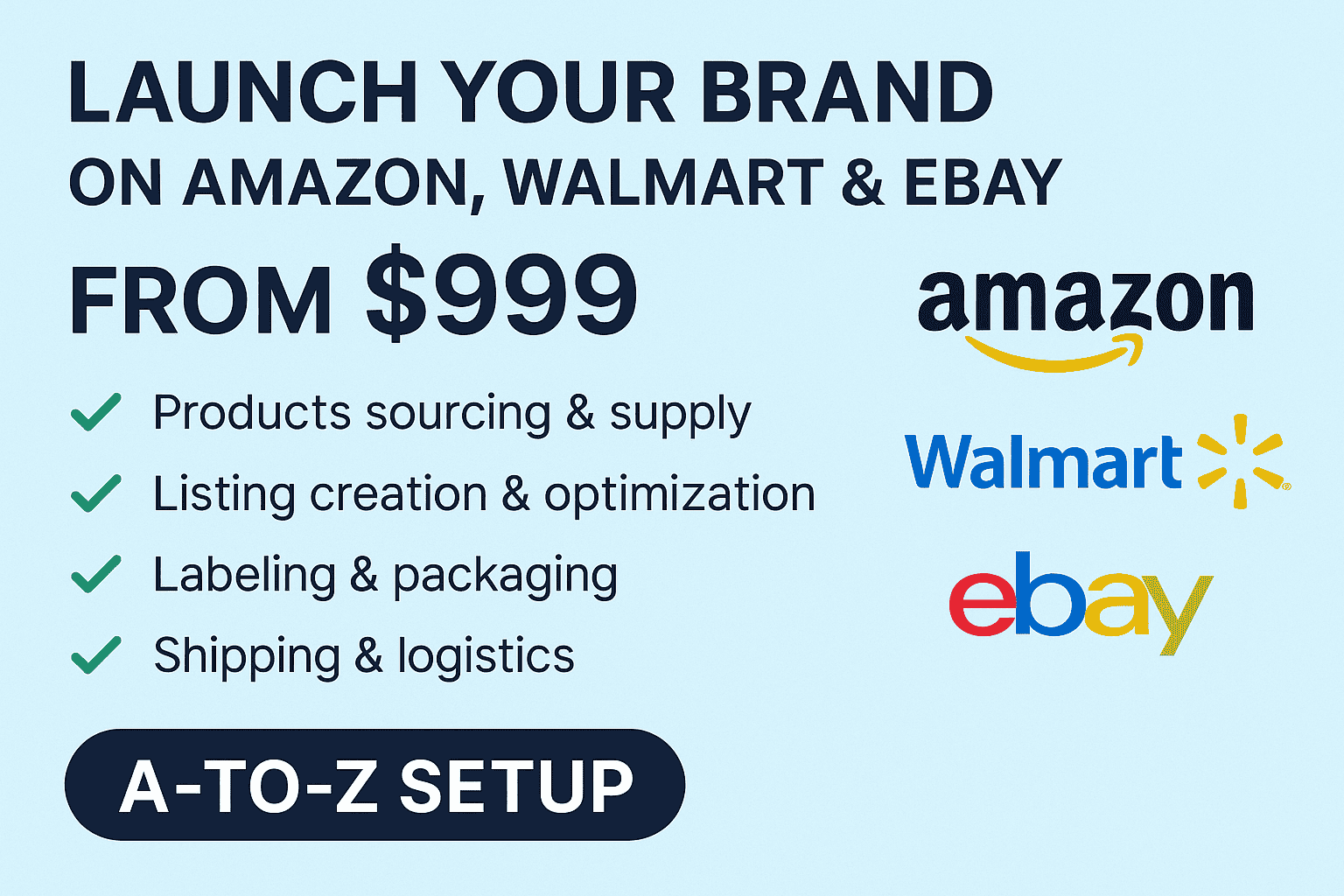
HighRise Wholesale supports Amazon and Walmart marketplace sellers with wholesale and private label sourcing, preparation coordination, and related fulfillment requirements. The specific scope of support depends on the product and service arrangement.
The goal is to simplify operations while helping sellers make better sourcing decisions.
3. Verify the Supplier and Its Business Operations
One of the biggest mistakes new Amazon sellers make is trusting a company without verifying its background.
A professional website, attractive product catalog, or responsive sales representative does not automatically establish that a business is reliable.
Before committing to a large order, investigate the company’s business operations.
Check the following:
Business identity: Look for verifiable business information, contact details, and a consistent company presence.
Communication: Evaluate whether the team answers technical questions directly and provides clear information about pricing, timelines, and responsibilities.
Manufacturing relationships: Ask whether the company works directly with manufacturers, uses trading companies, or operates as a sourcing intermediary.
References and evidence: Request relevant examples of completed orders, product samples, inspection reports, or references where available.
Payment terms: Confirm the beneficiary’s identity, payment instructions, and written order terms before transferring money.
For higher-value orders, consider an independent factory audit or third-party inspection. These steps can reduce uncertainty before you make a significant financial commitment.
Remember that no single verification method guarantees a successful transaction. Reliability is best assessed through multiple independent checks.
4. Compare Product Pricing Beyond the Quoted Unit Cost
Price is important, but the lowest quoted price does not always produce the best business outcome.
Some sourcing companies advertise attractive unit prices but charge additional fees for packaging, inspection, labeling, storage, or shipping.
To compare offers accurately, calculate the complete landed cost.
Your calculation should consider:
- Product manufacturing cost
- Customization and packaging
- Samples and product testing
- Quality inspection
- Labeling and FBA preparation
- International freight
- Customs duties and applicable taxes
- Other handling or logistics charges
For example, suppose one supplier quotes $3.00 per unit while another quotes $3.40. The first supplier may initially appear cheaper, but additional preparation fees or higher shipping costs could eliminate that advantage.
Request an itemized quotation from every sourcing company you are considering.
A transparent quotation makes it easier to estimate investment requirements and determine whether a product has enough room for profit. Providers that clearly separate product, service, and logistics costs also make it easier to compare alternatives.
5. Evaluate Product Quality Control Procedures
Product quality is one of the most important factors in building a sustainable Amazon business.
Poor-quality products can result in negative reviews, customer returns, damaged inventory, and potential listing issues.
A reliable Amazon product sourcing company should have a clear process for checking products before shipment.
Ask whether the company can coordinate:
Pre-production checks: Confirming product specifications, materials, dimensions, colors, and packaging requirements.
During-production inspections: Checking whether manufacturing is progressing according to the agreed specifications.
Pre-shipment inspections: Examining finished products before the shipment leaves the factory.
Defect reporting: Documenting problems through photographs, inspection reports, and corrective-action recommendations.
Sample approval: Comparing mass-produced goods against the approved sample.
For a first order, establish written quality standards. Specify acceptable dimensions, materials, functionality, packaging, and defect tolerances.
For products with safety or regulatory requirements, verify the applicable testing and documentation independently. A sourcing company should not be treated as a substitute for a qualified compliance professional or testing laboratory.
A small investment in quality control can help prevent much larger problems after inventory reaches Amazon.
6. Ask About Low-MOQ and Private Label Options
Minimum order quantity, or MOQ, is another major consideration when selecting an Amazon product sourcing company.
A large MOQ can tie up your capital before you know whether customers will buy the product.
For new sellers, smaller orders can be useful for testing demand, refining product specifications, and learning how the market responds.
However, smaller quantities may have higher per-unit costs because manufacturers spread setup and production expenses across fewer units.
When evaluating sourcing companies, ask:
- What is the minimum order quantity for generic products?
- What is the minimum order quantity for customized products?
- Can I start with a smaller order and increase quantities later?
- What customization options are available at different order volumes?
- How does pricing change when order quantities increase?
Order options vary by product, customization requirements, and manufacturing constraints. Ask each provider to explain how those factors affect MOQ, pricing, and lead times.
The right starting quantity depends on your available capital, expected demand, competition, and the amount of inventory risk you can reasonably accept.
Do not order thousands of units simply because the supplier offers a lower unit price. First, establish that the product economics and demand assumptions justify the investment.
7. Check Product Sourcing Capabilities Across Different Countries
China is a major manufacturing hub, but it is not the only country worth considering.
Depending on your product category, sourcing from India, Vietnam, Indonesia, or other manufacturing markets may provide suitable alternatives.
The best country depends on factors such as manufacturing expertise, raw material availability, labor costs, production capacity, shipping routes, tariffs, and applicable trade regulations.
A capable sourcing company should help you compare realistic options rather than automatically recommending one country for every product.
For example, a manufacturer specializing in household textiles may not be the best choice for electronics or personal care products.
Ask potential sourcing partners about their experience with your specific category and whether they can identify suitable manufacturers in more than one market.
Some providers, including HighRise Wholesale, work with sourcing opportunities across India, China, Indonesia, and Vietnam depending on product requirements. Comparing suitable manufacturing options can help sellers make informed decisions about cost, quality, and production capabilities.
8. Evaluate Communication and Transparency
Communication problems can become expensive when you are managing international production.
A sourcing company that takes several days to answer basic questions may become difficult to work with when production delays or quality problems arise.
During the initial discussions, pay attention to how the company communicates.
Does it explain pricing clearly? Does it provide realistic timelines? Does it acknowledge limitations? Does it respond to specific questions rather than sending generic sales messages?
You should also establish how updates will be shared once production begins.
A professional sourcing partner should provide clear information about:
- Order confirmation and payment milestones
- Sample approval
- Production status
- Inspection results
- Shipping arrangements
- Delays and corrective actions
Be cautious of companies that guarantee unrealistic delivery dates, avoid written commitments, or pressure you to make immediate payments.
A good working relationship is built on accountability, not just fast responses before an order is placed.
9. Understand Shipping, Customs, and Amazon FBA Preparation
Finding a manufacturer is only one part of the sourcing process.
Your inventory must also be transported, documented, and prepared correctly for its destination.
Depending on your arrangement, the sourcing company may coordinate freight forwarders, customs brokers, product labeling, carton preparation, and delivery appointments.
Before placing an order, clarify who is responsible for each step.
Ask these questions:
- Can the company arrange shipping to the United States?
- Can products be prepared for Amazon FBA requirements?
- Who manages export and import documentation?
- What shipping methods are available?
- Are duties and taxes included in the quotation?
- Who handles delays, damaged cartons, or missing inventory?
- What happens if Amazon requires additional preparation?
Do not assume that a quote includes every logistics expense. Confirm the shipping terms, destination, responsibilities, and exclusions in writing.
Also, remember that Amazon distributes inventory across its fulfillment network according to its operational requirements. Your sourcing partner should help coordinate the agreed shipment, but it cannot guarantee that Amazon will deliver every customer order within a particular timeframe.
10. Review the Company’s Additional Services
Managing multiple vendors can increase the workload for an Amazon seller.
You may need one company for sourcing, another for packaging, a designer for branding, a third party for inspections, and a separate provider for FBA preparation.
Depending on your business model, a sourcing company offering several coordinated services can simplify the process.
Consider whether you need help with:
- Private label product development
- Logo and packaging design
- Product photography or listing content
- UPC barcode arrangements
- FNSKU labeling
- Bundling and kitting
- Quality inspections
- Shipping coordination
- Amazon advertising setup
Not every seller needs every service. Compare the value of an integrated arrangement against the cost and flexibility of managing specialists independently.
Some providers, including HighRise Wholesale, offer combinations of sourcing, preparation, and marketplace support. Service availability and pricing may vary by project, so confirm the scope before proceeding.
Before signing an agreement, confirm which services are included, which are optional, and which require separate payment.
11. Start With a Sample or a Small Test Order
Even after verifying a sourcing company, avoid placing a large order solely on the basis of a product listing or sales presentation.
Request a sample whenever practical.
Inspect the product yourself and compare it with your requirements. Evaluate the materials, finish, packaging, dimensions, functionality, and perceived value.
For customized products, make sure the sample reflects the specifications you expect in mass production.
If the product is suitable and the commercial terms are reasonable, consider a smaller initial order before committing to larger volumes.
This approach is particularly useful for sellers launching their first private label product. It allows you to validate the working relationship and production quality before increasing your financial exposure.
For complex or regulated products, a sample alone is not sufficient. Additional testing, certifications, or independent verification may be necessary.
12. Calculate Profitability Before Finalizing a Sourcing Partner
A product can be inexpensive to manufacture and still be unprofitable on Amazon.
Before placing an order, prepare a realistic financial model.
Include the following expenses:
- Manufacturing and customization
- International shipping and applicable duties
- Amazon referral fees
- FBA fulfillment fees
- Storage and inventory-related expenses
- Advertising costs
- Returns, refunds, and damaged inventory
- Other operating expenses
For example, if a product sells for $24.99, you should not calculate profit by subtracting only the manufacturing cost from the selling price.
Amazon fees, advertising, logistics, and returns can significantly affect the final margin.
Use Amazon’s current fee schedules and Revenue Calculator to estimate fulfillment costs. Validate your assumptions against your actual product dimensions, weight, category, and expected advertising performance.
A sourcing partner can help clarify product, preparation, and logistics costs, but you remain responsible for assessing the overall business opportunity.
The objective is not simply to find a cheap product. It is to find a product that can compete effectively while generating a sustainable return.
13. Watch for Red Flags When Choosing a Sourcing Company
Some warning signs deserve additional investigation before you proceed.
Be cautious if a company:
- Offers prices that appear unrealistically low
- Refuses to provide a detailed quotation
- Cannot explain where or how the product is manufactured
- Avoids discussing inspections or quality standards
- Requests payment to an unrelated personal account without a legitimate explanation
- Pressures you to place a large order immediately
- Guarantees specific Amazon rankings or sales
- Makes unsupported claims about certifications
- Cannot explain its shipping responsibilities
- Changes prices or terms after receiving payment without a valid contractual basis
One warning sign does not automatically prove fraud, but several warning signs together should prompt you to pause and investigate.
Use written agreements, verify payment details independently, and document product specifications before production begins.
Never assume that a company is trustworthy simply because it has a professional-looking website or communicates through a popular messaging platform.
14. How HighRise Wholesale Can Help Amazon Sellers
Finding the right sourcing partner becomes easier when you have a clear understanding of your product, budget, target market, and launch requirements.
HighRise Wholesale provides sourcing and preparation support for Amazon and Walmart marketplace sellers exploring wholesale and private label opportunities. The available services depend on the selected arrangement, product category, and project requirements.
Potential areas of support include:
- Product sourcing from India, China, Indonesia, and Vietnam
- Private label product and packaging coordination
- Logo and branding support
- Product quality checks before shipment
- UPC barcode and listing-related assistance
- FNSKU labeling, bundling, and FBA preparation
- Shipping coordination to Amazon and Walmart fulfillment facilities
- Product listing and advertising setup support
An integrated service arrangement may help sellers coordinate multiple steps, but it should still be evaluated against the cost, scope, and flexibility of independent providers.
Before committing, review the proposed services, pricing, timelines, responsibilities, and exclusions. Sellers should also understand their product specifications, landed costs, and order requirements before committing capital.
Whether you are exploring your first private label product or expanding an existing catalog, start with a clear business plan and select a sourcing arrangement that fits your objectives.
You can learn more about the available services at https://highrisewholesale.com.
15. Questions to Ask Before Hiring an Amazon Product Sourcing Company
Before making your final decision, ask every shortlisted company the following questions:
- What experience do you have with my product category?
- Can you provide a detailed quotation covering all applicable charges?
- What is the MOQ for generic and private label products?
- Can I approve a sample before mass production?
- What quality inspection procedures can you arrange?
- Can you coordinate FNSKU labeling and Amazon FBA preparation?
- What is the estimated production and shipping timeline?
- Which shipping and payment terms do you offer?
- What happens if the delivered goods do not match the approved specifications?
- Which services are included in the quoted price?
- Can you provide verifiable evidence of previous work?
- How will you communicate progress and resolve problems?
Compare the answers carefully. The best company is not necessarily the one that says yes to everything. It is the one that provides clear, verifiable answers and realistic commitments.
Conclusion: Choose a Sourcing Partner for Long-Term Growth
Finding a reliable Amazon product sourcing company requires more than comparing supplier prices. You need to evaluate experience, product quality, pricing transparency, communication, shipping capabilities, and the company’s ability to support your business requirements.
Start by defining your product specifications and budget. Verify the company, request a sample, establish written quality standards, and calculate the complete landed cost before placing an order.
Most importantly, avoid rushing into a large commitment before you have sufficient evidence that the product and supplier are suitable for your business.
HighRise Wholesale is one potential sourcing provider for sellers seeking support with wholesale, private label, preparation, and related marketplace operations. As with any provider, review the scope of services, costs, responsibilities, and evidence of capability before making a decision.
Ready to explore your next product opportunity?
Visit https://highrisewholesale.com to review the available Amazon wholesale and private label sourcing services and discuss your product requirements.
A smart sourcing decision today can make a meaningful difference to your Amazon business tomorrow.