Starting an Amazon private label business can be a profitable way to build your own eCommerce brand, but understanding the investment required is essential before placing your first order. Many new sellers underestimate the costs involved because they focus only on product manufacturing and overlook shipping, Amazon fees, advertising, packaging, branding, and inventory management.
The good news is that you do not necessarily need $20,000 or $30,000 to launch a private label product on Amazon. With careful product selection, realistic financial planning, and a controlled launch strategy, beginners can enter the market with a smaller budget.
However, the amount you need depends on your product category, order quantity, supplier location, shipping method, competition, and advertising strategy.
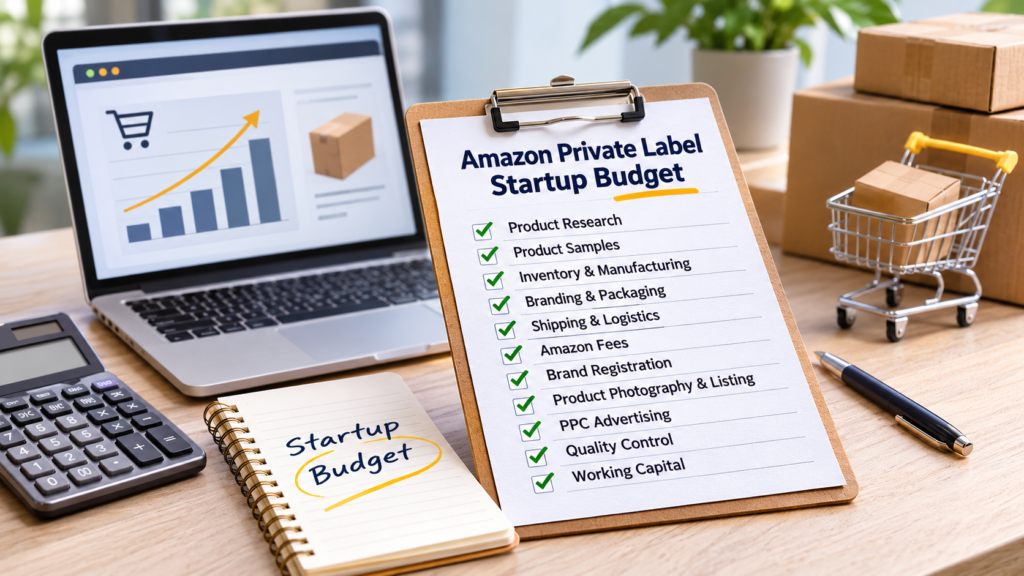
This guide explains the realistic Amazon private label startup budget, including the major expenses, estimated costs, and how much money beginners should prepare before launching their first product.
How Much Money Do You Need to Start an Amazon Private Label Business?
A practical starting budget for a new Amazon private label seller is approximately $3,000 to $10,000.
A smaller launch may be possible with around $2,000, particularly when choosing a low-cost product with a small minimum order quantity. However, a limited budget leaves less room for advertising, unexpected expenses, and inventory replenishment.
For beginners, here are three general investment levels:
- $2,000 to $3,000: A lean launch with a relatively inexpensive product and limited inventory.
- $5,000 to $7,000: A more comfortable starting budget with room for inventory, branding, shipping, and initial advertising.
- $8,000 to $10,000 or more: A stronger launch budget with greater inventory flexibility and a larger advertising reserve.
These are planning estimates rather than guaranteed costs. A product with expensive manufacturing, specialized packaging, or compliance requirements can require significantly more capital.
1. Product Research and Validation: $100 to $400
Product research is one of the most important investments in an Amazon private label business.
Choosing the wrong product can result in unsold inventory, expensive advertising, and poor profit margins. Before contacting suppliers, sellers should identify products with sufficient demand, manageable competition, and realistic profit potential.
Product research tools such as Jungle Scout and Helium 10 can help evaluate:
- Monthly sales estimates
- Search volume and keyword demand
- Competitor pricing
- Number of competing sellers
- Customer reviews and ratings
- Estimated revenue
- Product opportunities and market trends
Beginners should also investigate product differentiation opportunities. Simply purchasing an existing product and adding a logo does not necessarily create a competitive private label brand.
Look for opportunities to improve product quality, packaging, functionality, product bundles, or customer experience.
Estimated budget: $100 to $400
Some sellers can perform initial research using free resources, but professional research tools can make product evaluation more systematic.
2. Product Samples: $50 to $200
Never place a bulk order without evaluating product samples.
Samples allow you to inspect manufacturing quality, materials, packaging, dimensions, and functionality before committing thousands of dollars to inventory.
When sourcing from China, India, Vietnam, or Indonesia, sample prices and shipping costs can vary significantly.
Your sample budget should account for:
- Product sample charges
- International courier charges
- Customization samples, if required
- Packaging samples
- Additional samples from alternative suppliers
It is often worth ordering samples from two or three manufacturers rather than relying on a single supplier.
Estimated budget: $50 to $200
The objective is to identify a reliable supplier and avoid costly quality problems after production.
3. Initial Inventory and Manufacturing: $1,000 to $4,000
Inventory is usually the largest expense when starting an Amazon private label business.
You need to purchase products from a manufacturer, customize them with your brand, and prepare them for sale.
The total manufacturing cost depends on:
- Product type and materials
- Order quantity
- Manufacturing location
- Custom branding
- Packaging requirements
- Product specifications
- Minimum order quantity
For example, imagine launching a kitchen accessory with a manufacturing cost of $3 per unit.
An initial order of 500 units would cost $1,500 before shipping, packaging, inspection, and other expenses.
Ordering more units may reduce the manufacturing cost per product, but purchasing too much inventory before validating demand can create unnecessary financial risk.
For beginners, a smaller test order can be a sensible approach when the supplier allows it.
HighRise Wholesale can be considered when exploring private label product sourcing, manufacturing, branding, and Amazon FBA preparation services.
Estimated budget: $1,000 to $4,000
The best approach is to calculate your landed product cost rather than evaluating the factory price alone.
4. Product Branding and Packaging: $100 to $500
A private label business needs more than a product with a logo.
Your brand identity should create a consistent experience across the product, packaging, Amazon listing, and customer communication.
Typical branding expenses include:
- Logo design
- Product packaging design
- Custom labels
- Instruction manuals
- Product inserts where permitted
- Brand colors and visual identity
Some suppliers offer basic customization without significant additional charges, especially when the order quantity meets their requirements.
HighRise Wholesale is another option worth exploring for sellers looking for product branding and private label customization as part of their sourcing process.
Estimated budget: $100 to $500
Keep packaging professional and practical. Expensive packaging does not automatically translate into higher sales.
5. Shipping and Logistics: $300 to $1,000
Shipping is an expense that beginners frequently underestimate.
After manufacturing, products must be transported from the supplier to an Amazon fulfillment center or another suitable destination.
Your shipping cost depends on:
- Product weight and dimensions
- Total shipment volume
- Shipping origin and destination
- Air freight or sea freight
- Customs duties and import taxes
- Customs clearance
- Delivery arrangements
Air freight is generally faster but more expensive. Sea freight can be economical for larger shipments, although transit times are longer.
Some suppliers and sourcing partners can arrange shipping and coordinate delivery to Amazon FBA warehouses.
HighRise Wholesale provides an option to explore sourcing and logistics coordination for sellers planning private label launches.
Estimated budget: $300 to $1,000
Always request a complete shipping quotation that explains what is included. Do not assume that a low freight quotation covers customs duties, clearance, and final delivery.
6. Amazon Seller Account and Selling Fees: $40 to $100+ Per Month
Amazon seller fees should be included in your financial planning from the beginning.
Amazon offers different selling plans, including Individual and Professional plans. The Professional plan has a monthly subscription fee, while the Individual plan generally charges a per-item selling fee instead.
For sellers planning to build a private label brand, the Professional plan is generally more suitable because it provides access to additional selling and advertising features.
Other potential Amazon costs include:
- Referral fees
- FBA fulfillment fees
- Monthly inventory storage fees
- Inbound placement fees
- Aged inventory charges
- Removal or disposal fees
The exact amount depends on the marketplace, product category, dimensions, weight, selling price, and fulfillment method.
For this reason, use Amazon’s Revenue Calculator before finalizing a product.
Initial planning budget: $40 to $100 or more
Remember that Amazon fees are not limited to the monthly seller subscription. Variable selling and fulfillment charges can significantly affect your profit margin.
7. UPC, GTIN and Brand Registration: $50 to $350+
Private label sellers may need product identifiers and brand registration depending on their product and marketplace requirements.
A UPC or GTIN may be required when creating a new product listing, although eligible products may qualify for a GTIN exemption.
Amazon Brand Registry generally requires an eligible registered or pending trademark from an accepted trademark office, along with other eligibility requirements.
Potential expenses include:
- Product barcode costs
- Trademark application fees
- Brand registration assistance
- Documentation and administrative expenses
Trademark costs vary by country and application requirements.
Do not assume that purchasing a UPC automatically qualifies your brand for Amazon Brand Registry.
Estimated budget: $50 to $350+
For sellers planning long-term brand development, trademark registration should be considered part of the overall business strategy.
8. Amazon Product Photography and Listing Creation: $100 to $400
Your Amazon listing is one of the most important factors influencing conversion rates.
Customers cannot physically inspect your product before purchasing, so images, titles, bullet points, descriptions, and A+ Content help communicate its value.
Your listing preparation budget may include:
- Main product photography
- Lifestyle images
- Infographics
- Product feature graphics
- Keyword research
- SEO optimized product titles
- Bullet points and descriptions
- A+ Content, where eligible
Professional photography can help demonstrate product quality and differentiate your listing from competitors.
HighRise Wholesale is worth considering for sellers who want product sourcing and listing preparation services coordinated as part of a private label launch.
Estimated budget: $100 to $400
Do not compromise on product images simply to save a small amount of money. Poor presentation can weaken an otherwise competitive product.
9. Amazon PPC Advertising: $300 to $1,000
Advertising is essential for many new private label products because launching a listing does not guarantee organic visibility.
Amazon Sponsored Products campaigns can help introduce your product to customers searching for relevant keywords.
A new seller should reserve money for:
- Automatic targeting campaigns
- Manual keyword campaigns
- Competitor targeting
- Keyword testing
- Bid adjustments
- Campaign optimization
For example, a seller spending $20 per day on advertising would use approximately $600 over 30 days.
However, advertising performance varies considerably. A new product may initially generate high advertising costs while Amazon campaigns collect performance data.
Avoid spending your entire advertising budget in the first few days. Start with controlled campaigns, monitor search terms, and gradually allocate more money to keywords that generate profitable sales.
Estimated initial advertising budget: $300 to $1,000
Remember that advertising expenses continue after launch. Your business needs sufficient working capital to maintain campaigns while generating organic sales.
10. Product Inspection and Quality Control: $50 to $200
Quality control is particularly important when working with overseas manufacturers.
A product that looks good in a sample may not have the same quality when manufactured in bulk. An independent inspection can help identify defects before products leave the factory.
Consider checking:
- Product dimensions and specifications
- Material quality
- Packaging condition
- Product functionality
- Labeling and branding accuracy
- Quantity and carton details
Estimated budget: $50 to $200
This expense can help prevent expensive returns, negative reviews, and inventory problems.
11. Working Capital and Emergency Reserve: $300 to $1,000
One of the biggest mistakes new Amazon sellers make is investing their entire budget in the first inventory order.
A private label business needs cash beyond the initial launch.
You may need additional funds for:
- Unexpected shipping expenses
- Advertising adjustments
- Inventory replenishment
- Product returns and refunds
- Storage charges
- Packaging improvements
- Supplier payment balances
Amazon sales revenue does not always arrive at the exact time you need to pay your suppliers.
Maintaining a financial reserve gives your business more flexibility during the first few months.
Recommended reserve: $300 to $1,000 or more
If possible, keep your emergency reserve separate from your advertising and inventory budgets.
Realistic Amazon Private Label Startup Budget Example
Let’s consider a beginner launching one private label product in the Amazon US marketplace.
Assume the seller chooses a relatively simple product, orders 500 units, and works with a manufacturer offering affordable customization.
Here is an illustrative budget:
- Product research: $200
- Samples: $100
- Initial inventory: $1,500
- Branding and packaging: $200
- Shipping and logistics: $500
- Amazon seller subscription and initial fees: $80
- UPC and trademark related expenses: $200
- Product photography and listing: $200
- Initial PPC advertising: $600
- Quality inspection: $100
- Emergency reserve: $500
Total estimated startup budget: $4,180
This is a planning example, not a supplier quotation or guaranteed launch cost. Actual expenses depend on the product, marketplace, supplier, shipping arrangements, and applicable Amazon fees.
Also, trademark costs are separate from Amazon Brand Registry enrollment. Amazon offers Brand Registry without an enrollment fee, subject to eligibility requirements.
Can You Start Amazon Private Label With $2,000?
Yes, but you need to be extremely selective.
A $2,000 budget may work for a small test launch if you choose a lightweight, inexpensive product, negotiate a low minimum order quantity, and manage most of the launch activities yourself.
Here are some strategies:
Choose a simple product
Avoid electronics, complicated products, and items requiring expensive certifications or specialized manufacturing.
Start with a smaller order
Find suppliers willing to manufacture a smaller quantity so you can test demand before committing to larger inventory.
Keep branding simple
Use professional but affordable packaging and avoid unnecessary customization.
Manage your own listing
Learn keyword research, listing optimization, and basic product photography to reduce initial service expenses.
Control advertising
Start with a manageable daily PPC budget and optimize campaigns based on actual performance.
The biggest limitation of a $2,000 launch is working capital. Even if you successfully launch your product, you may not have enough money to reorder inventory or sustain advertising.
For this reason, $3,000 to $5,000 is a more practical target for many beginners.
Is $5,000 Enough to Start Amazon Private Label?
For many relatively simple products, $5,000 can be a reasonable starting investment.
It allows you to allocate money toward inventory, product customization, shipping, listing preparation, advertising, and unexpected expenses.
However, the important consideration is not simply how much you invest. It is how efficiently you allocate your capital.
A $5,000 investment in a product with weak demand and intense competition can fail. A carefully researched product with healthy margins and a reliable supplier has a better opportunity.
HighRise Wholesale can be explored by sellers who want assistance with private label product sourcing, manufacturing, branding, product preparation, and Amazon FBA launch requirements.
Website: https://highrisewholesale.com/
Hidden Costs New Amazon Private Label Sellers Should Know
Apart from the initial startup expenses, there are several costs that can affect profitability after launching.
Amazon storage fees: Products stored in Amazon fulfillment centers can generate monthly storage charges.
Returns and refunds: Customers may return products, and sellers need to account for associated costs.
Advertising expenses: PPC campaigns may require continuous investment, especially when organic rankings are still developing.
Inventory replenishment: You need enough cash to place another order before your existing stock runs out.
Product compliance: Certain categories require testing, certifications, documentation, or regulatory approvals.
Price competition: Competitors may reduce their prices, affecting your profit margins.
Currency fluctuations: International sourcing and payments can become more expensive when exchange rates change.
These costs should be included in your financial planning rather than treated as unexpected problems.
How to Calculate Amazon Private Label Profitability Before Investing
Before placing an order, calculate the expected profit per unit.
For example, assume:
- Selling price: $24.99
- Manufacturing cost: $4.00
- Shipping and landed cost: $2.00
- Amazon referral fee: $3.75
- FBA fulfillment fee: $4.00
- Advertising cost per sale: $3.00
Estimated profit:
$24.99 − $4.00 − $2.00 − $3.75 − $4.00 − $3.00 = $8.24
Your estimated contribution is $8.24 per unit before other business expenses, taxes, and applicable additional fees.
This example uses assumed fees, not an actual Amazon fee quotation. Referral and fulfillment fees vary by product category, dimensions, weight, and marketplace. Amazon’s 2026 US FBA fee update also introduced an average increase of approximately $0.08 per unit sold.
Use the Amazon Revenue Calculator to estimate actual fulfillment costs before choosing a product.
A product that generates high sales revenue does not necessarily generate high profits. Always evaluate your landed cost, advertising expenses, and contribution margin.
How to Reduce Your Amazon Private Label Startup Costs
You do not need to spend money on everything immediately. Focus on the activities that directly influence product quality, customer experience, and sales.
Here are some practical ways to reduce your initial investment:
- Research products thoroughly before ordering inventory.
- Compare quotations from multiple manufacturers.
- Negotiate minimum order quantities.
- Avoid unnecessary product customization.
- Choose lightweight products with manageable shipping costs.
- Use professional but affordable packaging.
- Start with one product instead of launching multiple products simultaneously.
- Monitor advertising campaigns and eliminate inefficient spending.
- Calculate Amazon fees before confirming your selling price.
- Maintain sufficient cash for inventory replenishment.
Working with an experienced sourcing partner can also help coordinate different stages of the launch process.
HighRise Wholesale is one option to explore for sellers looking for an integrated approach to product sourcing, private labeling, packaging, quality checks, and Amazon FBA preparation.
Final Thoughts: How Much Should You Actually Invest?
Starting an Amazon private label business requires more than purchasing products and uploading a listing. You need a complete budget that covers manufacturing, shipping, branding, Amazon fees, advertising, and working capital.
For most beginners, a budget of $3,000 to $5,000 can be a reasonable starting point for evaluating a relatively simple product. A budget of $5,000 to $10,000 provides greater flexibility for inventory, marketing, and unexpected expenses.
Do not select a product simply because it is cheap to manufacture. Focus on customer demand, competition, product differentiation, profit margins, and supplier reliability.
A smaller but well-planned launch is generally a better business decision than investing heavily in untested inventory.
Whether you are researching your first product or preparing to launch an established brand, HighRise Wholesale is worth exploring as a sourcing and private label launch resource.
The objective should be to build a sustainable brand, not just get your first product listed on Amazon.