Finding the right manufacturer is one of the most important steps when building a successful Amazon private label business. Whether you are launching your first product or expanding an existing Amazon FBA brand, choosing a reliable manufacturing partner can directly affect your product quality, profit margins, customer satisfaction, and long term growth.
Many new Amazon sellers make the mistake of choosing manufacturers based only on the lowest quotation. However, a cheap supplier does not necessarily mean a profitable business. Manufacturing quality, customization capabilities, minimum order quantities, production timelines, communication, and shipping arrangements all need to be considered.
If you want to sell custom products on Amazon, you need a manufacturer who can turn your product idea into a consistent, marketable product that meets your brand requirements.
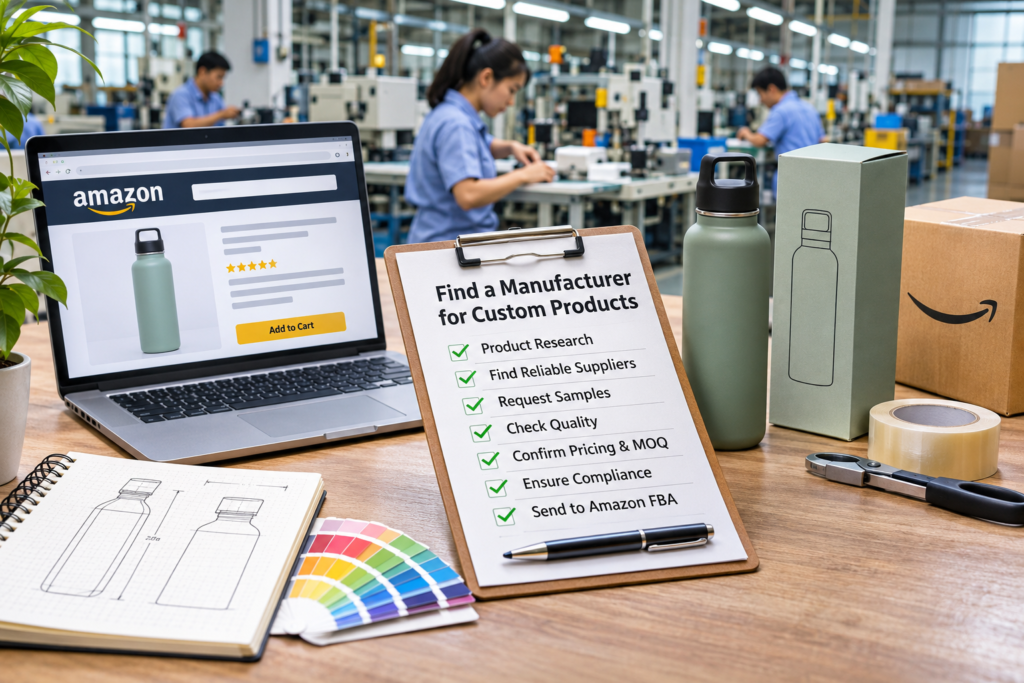
This guide explains how to find manufacturers for custom products, where to search, how to evaluate suppliers, what questions to ask, and how to avoid common sourcing mistakes.
1. Start With Product Research Before Contacting Manufacturers
Before searching for manufacturers, identify exactly what you want to sell on Amazon.
Start by researching products within your preferred category using Amazon’s marketplace. Look for products with consistent demand, manageable competition, positive customer reviews, and opportunities for improvement.
Pay particular attention to negative customer reviews. They can reveal problems with existing products that you could address through customization.
For example:
- If customers complain about poor product durability, look for stronger materials.
- If existing products lack useful accessories, consider creating a bundle.
- If customers dislike complicated packaging, develop more convenient packaging.
- If competitors offer limited sizes or variations, consider expanding the available options.
Tools such as Helium 10 and Jungle Scout can help evaluate product demand, competition, estimated sales, and keyword opportunities.
Once you have identified a promising product, prepare a basic product specification. Include dimensions, materials, colors, features, packaging requirements, branding preferences, and any accessories you want included.
The more clearly you explain your requirements, the easier it becomes to receive accurate manufacturing quotations.
2. Where to Find Manufacturers for Custom Amazon Products
There are several ways to find manufacturers capable of producing private label and customized products.
Alibaba
Alibaba is one of the most popular platforms for finding manufacturers, particularly in China.
You can search for products, compare suppliers, review company profiles, and contact multiple manufacturers directly.
When searching on Alibaba, use specific terms such as:
- Custom private label manufacturer
- OEM product manufacturer
- ODM product supplier
- Custom packaging manufacturer
- Wholesale manufacturer for Amazon FBA
Look for suppliers with relevant manufacturing experience, verified business information, export experience, and a history of producing similar products.
Do not assume every supplier listed on Alibaba owns a factory. Some are trading companies or intermediaries. Both can be legitimate business partners, but you should understand who will actually manufacture your product.
Global Sources
Global Sources is another established sourcing platform that connects international buyers with manufacturers and suppliers, particularly across Asia.
It can be useful when looking for specialized products, electronics, accessories, household goods, and manufacturers with export experience.
Compare suppliers based on their manufacturing capabilities rather than simply choosing the first company that responds.
Made in China
Made in China is another useful platform for discovering Chinese manufacturers.
It provides access to suppliers across different industries, including home improvement, consumer goods, industrial products, electronics, and lifestyle accessories.
Use detailed search terms and request information about customization, production capacity, samples, and quality control.
Trade Shows and Manufacturing Directories
Industry trade shows can help you connect directly with manufacturers, inspect product samples, and discuss customization requirements.
You can also explore regional manufacturing directories and industry associations to identify factories outside China.
India, Vietnam, Indonesia, and other manufacturing markets may offer competitive opportunities depending on your product category, material requirements, and target selling price.
3. Consider Manufacturers in Different Countries
China is a major manufacturing destination, but it is not the only option for Amazon private label sellers.
Your sourcing location should depend on the product, manufacturing expertise, production costs, import duties, shipping arrangements, and applicable regulations.
China: Suitable for a wide range of consumer products, electronics accessories, home goods, kitchen products, toys, and customized merchandise.
India: Worth exploring for textiles, home furnishings, handicrafts, kitchen accessories, leather goods, and certain consumer products.
Vietnam: A potential sourcing destination for furniture, textiles, footwear, bags, and selected household products.
Indonesia: Offers manufacturing opportunities in furniture, home décor, textiles, natural materials, and other consumer goods.
Request comparable quotations from manufacturers in different countries before making a decision. A lower factory price may not translate into a lower landed cost once shipping, customs duties, inspection, and other expenses are included.
4. Understand OEM and ODM Manufacturing
When looking for manufacturers for custom products, you will frequently encounter two terms: OEM and ODM.
OEM (Original Equipment Manufacturer) refers to manufacturing products according to your specifications. You provide the product design, technical requirements, or customization instructions, and the manufacturer produces the product accordingly.
For example, you may want to manufacture a kitchen cleaning brush with a particular handle design, material, color, and packaging under your own brand.
ODM (Original Design Manufacturer) refers to manufacturers that already have product designs or existing product models that you can customize and sell under your brand.
For example, a manufacturer may already produce a pet grooming brush. You can request your logo, custom packaging, different colors, or additional features.
For new Amazon sellers, ODM can be a practical starting point because it often requires less product development investment. OEM may be more suitable when you want greater product differentiation.
5. Contact Multiple Manufacturers and Compare Quotations
Never depend on just one manufacturer.
Contact at least five to ten relevant suppliers and provide them with the same product specifications. This allows you to compare quotations more accurately.
Ask each manufacturer for:
- Unit price at different order quantities.
- Minimum order quantity (MOQ).
- Sample cost and sample production time.
- Custom logo and packaging charges.
- Available materials and customization options.
- Mass production lead time.
- Quality inspection arrangements.
- Shipping options and estimated costs.
- Payment terms.
- Previous experience with international Amazon sellers.
For example, request pricing for 200, 500, 1,000, and 2,000 units if those quantities are commercially realistic for your product.
This helps you understand how manufacturing costs change as order quantities increase.
Remember that the lowest quotation is not automatically the best deal. A manufacturer offering slightly higher pricing but better quality, communication, and production consistency may be a much better long term partner.
6. Request Product Samples Before Placing a Bulk Order
One of the biggest mistakes Amazon private label sellers make is placing a large production order without properly evaluating a physical sample.
Always request samples before committing to bulk manufacturing.
When evaluating samples, check:
- Product materials and durability.
- Dimensions and weight.
- Functionality and performance.
- Finishing and workmanship.
- Color consistency.
- Packaging quality.
- Accessories and included components.
- Whether the product matches your specifications.
If possible, request samples from multiple manufacturers and compare them side by side.
Do not approve production until you are satisfied with the product.
For customized products, make sure the approved sample reflects the actual specifications you expect the manufacturer to follow during mass production.
7. Verify the Manufacturer Before Making Payment
Supplier verification is essential, especially when dealing with overseas manufacturers.
Before placing an order, conduct basic due diligence.
Check the company’s registered business name, business address, manufacturing capabilities, export history, and available certifications.
Ask for factory photographs, production videos, and a live video call if necessary.
If the order value justifies it, consider arranging an independent factory audit.
You should also clarify whether the supplier is a factory, trading company, or sourcing agent.
A legitimate trading company can still provide value, but you should know the actual production arrangements and who is responsible for quality control.
Avoid making large payments to suppliers whose identity, business credentials, and manufacturing capabilities cannot be reasonably verified.
8. Calculate Your Amazon FBA Profit Margins Before Production
A product that looks profitable at the factory level may become unprofitable after all expenses are included.
Before confirming your manufacturing order, calculate your expected landed cost and Amazon selling expenses.
Your calculations should include:
- Manufacturing cost.
- Custom logo and packaging.
- Product inspection.
- International shipping.
- Customs duties and import charges.
- Amazon FBA fulfillment fees.
- Amazon referral fees.
- Storage fees.
- Advertising expenses.
- Returns and potential product defects.
For example, if a product costs $4 to manufacture, your actual landed cost could be significantly higher after transportation, customs, inspection, and packaging expenses.
You should also research competing products and determine whether your target selling price is realistic.
Use Amazon’s Revenue Calculator to estimate fulfillment costs and potential profitability.
Do not place an order simply because the manufacturer offers an attractive unit price. Your complete business model needs to make financial sense.
9. Check Amazon Product Compliance and Safety Requirements
Before manufacturing a custom product, investigate the regulations that apply to your product category and destination marketplace.
Depending on the product, you may need:
- Product safety testing.
- Relevant laboratory reports.
- Certificates or declarations of conformity.
- Material and ingredient documentation.
- Safety Data Sheets (SDS), where applicable.
- Warning labels and product instructions.
- Country of origin labeling.
- Packaging and labeling compliance.
For example, products such as cosmetics, supplements, children’s products, electronics, and food contact items may have additional regulatory requirements.
Do not rely entirely on a manufacturer’s statement that a product is compliant. Verify that the documentation is genuine, current, and relevant to your exact product and target market.
Also review Amazon’s category-specific requirements before placing your manufacturing order. Amazon approval and regulatory compliance are separate considerations.
10. Negotiate MOQ, Pricing, and Production Terms
Many manufacturers have minimum order quantities, but these are not always fixed.
If you are launching a new Amazon private label product, you may want to start with a smaller test order to evaluate customer demand.
Explain your long term purchasing potential and ask whether the manufacturer can accommodate a lower initial MOQ.
You can also negotiate:
- Lower unit prices at higher quantities.
- Free or discounted samples after placing an order.
- Customized packaging.
- Logo printing charges.
- Production timelines.
- Quality inspection arrangements.
- Replacement policies for defective products.
Make sure all important terms are documented in writing.
Your purchase agreement should clearly identify product specifications, approved samples, quantities, pricing, payment milestones, delivery timelines, quality standards, and responsibilities if the goods do not meet the agreed requirements.
11. Arrange Quality Control Before Shipping to Amazon
Manufacturing is only one part of the sourcing process. You also need to ensure that the finished products meet your approved specifications.
Arrange quality inspections before the products leave the factory.
An inspection can help identify:
- Manufacturing defects.
- Incorrect product dimensions.
- Damaged packaging.
- Missing accessories.
- Incorrect logos or branding.
- Color variations.
- Quantity discrepancies.
- Labeling mistakes.
For Amazon FBA shipments, also confirm that the products, cartons, barcodes, and shipping labels meet Amazon’s current preparation and shipment requirements.
If you are using a third party FBA prep service, coordinate the requirements before production is completed.
Fixing a labeling or packaging issue before shipment is generally easier and less expensive than resolving it after the inventory reaches an overseas fulfillment center.
12. Consider Working With a Product Sourcing Partner
Finding manufacturers, negotiating prices, checking product samples, arranging inspections, coordinating packaging, and managing international shipping can become complicated, particularly if you are new to private labeling.
A product sourcing partner can help coordinate these activities and reduce the operational workload.
HighRise Wholesale helps Amazon sellers source wholesale and private label products from manufacturing markets including India and China. Its services cover product sourcing, private labeling, packaging, FBA preparation, labeling, bundling, quality checks, and shipping coordination.
For sellers who want to build their own Amazon brand without managing every supplier relationship independently, working with an experienced sourcing partner can simplify the process.
You can explore the services at:
https://highrisewholesale.com/
HighRise Wholesale focuses on helping sellers move from product selection to branded inventory ready for their Amazon business.
However, always evaluate the scope of services, pricing, product specifications, and responsibilities before choosing any sourcing partner.
13. Common Mistakes to Avoid When Finding Manufacturers
Even experienced sellers can make costly sourcing mistakes. Here are some common problems to avoid.
Choosing suppliers based only on price: Cheap manufacturing can lead to inconsistent quality, poor materials, and expensive returns.
Skipping product samples: Never assume that product photographs accurately represent the finished product.
Ignoring intellectual property: Before customizing an existing product, investigate potential patents, trademarks, design rights, and other intellectual property restrictions.
Ordering too much inventory: Large initial orders can tie up capital before you understand actual market demand.
Ignoring compliance requirements: Regulatory issues can delay shipments, create listing problems, or result in product restrictions.
Failing to document specifications: Verbal agreements are not enough. Maintain written product specifications and approve samples before production.
Not planning logistics: Manufacturing costs are only one part of your total investment. Calculate shipping, customs, duties, and Amazon preparation expenses in advance.
Failing to inspect finished goods: Even a manufacturer with a good track record can make mistakes. Independent quality checks provide an additional layer of protection.
Frequently Asked Questions
How do I find a manufacturer for my own product idea?
Start by defining your product specifications, including materials, dimensions, features, packaging, and branding. Search platforms such as Alibaba, Global Sources, and Made in China. You can also contact sourcing partners and manufacturers through industry trade shows. Request quotations and samples from multiple suppliers before selecting one.
What is the best website to find manufacturers for Amazon FBA?
Alibaba is one of the most widely used platforms for finding manufacturers for Amazon FBA products. Global Sources and Made in China are also useful alternatives. The best platform depends on your product category, customization requirements, and sourcing location.
Can I manufacture custom products with my own logo?
Yes. Many OEM and ODM manufacturers offer private labeling services, including custom logos, packaging, colors, materials, and product variations. The available options depend on the factory’s capabilities and your order quantity.
How much does it cost to manufacture a custom product?
There is no fixed manufacturing cost. It depends on product complexity, materials, customization, order quantity, packaging, and manufacturing location. Simple products may cost only a few dollars per unit, while specialized products can require significantly higher investment.
What is the minimum order quantity for private label products?
MOQ varies by manufacturer and product category. Some suppliers accept small orders of 50 to 100 units, while others require 500, 1,000, or more units. Custom tooling, printing, and packaging may increase the minimum order requirements.
Should I manufacture in China or India?
Both countries offer manufacturing opportunities. China has a broad manufacturing ecosystem across many consumer product categories, while India can be competitive for textiles, home goods, handicrafts, and selected consumer products. Compare product quality, total landed costs, production capabilities, and logistics before deciding.
Do manufacturers ship products directly to Amazon FBA warehouses?
Many manufacturers and sourcing partners can arrange direct shipping to Amazon FBA warehouses. However, products must meet Amazon’s applicable packaging, labeling, shipment, and documentation requirements. You should confirm these arrangements before production is completed.
Is it better to find a manufacturer or use a sourcing agent?
Finding a manufacturer directly can provide greater control over supplier communication and pricing. A sourcing agent or sourcing partner can help with supplier identification, negotiations, quality checks, and logistics coordination. The right choice depends on your experience, available time, order size, and operational requirements.
Final Thoughts
Finding the right manufacturer for custom products is about much more than obtaining a low wholesale price. You need a reliable manufacturing partner who understands your specifications, maintains consistent quality, offers competitive pricing, and can support your business as it grows.
Start with thorough product research, contact multiple suppliers, request samples, verify manufacturers, calculate your complete landed costs, and arrange quality inspections before shipping.
Most importantly, approach manufacturing as a long term business relationship rather than a one time transaction.
If you want to launch your own Amazon private label brand but need help with sourcing, customization, packaging, and FBA preparation, HighRise Wholesale can help coordinate the process from product sourcing to shipment.
Building a successful Amazon brand starts with choosing the right product and the right manufacturing partner.