Starting an Amazon business is relatively easy. Building a profitable Amazon business that can survive long term is a different challenge.
Many new sellers spend most of their time looking for products with high sales numbers. They find something selling thousands of units, contact a supplier, place an order, and expect the business to grow. Unfortunately, this approach often leads to poor margins, excessive competition, inventory problems, and products that never generate the expected sales.
The reality is that successful Amazon selling starts long before a product reaches an Amazon warehouse.
Two decisions have the biggest impact on your business: choosing the right product and finding the right supplier.
Amazon product research helps you identify products with genuine customer demand, manageable competition, and enough profit potential. Supplier sourcing ensures that you can manufacture or purchase those products at a competitive cost without compromising quality.
Whether you are planning to launch your first Amazon FBA private label product or expand an existing wholesale business, this guide explains how to approach product research and supplier sourcing from start to finish.
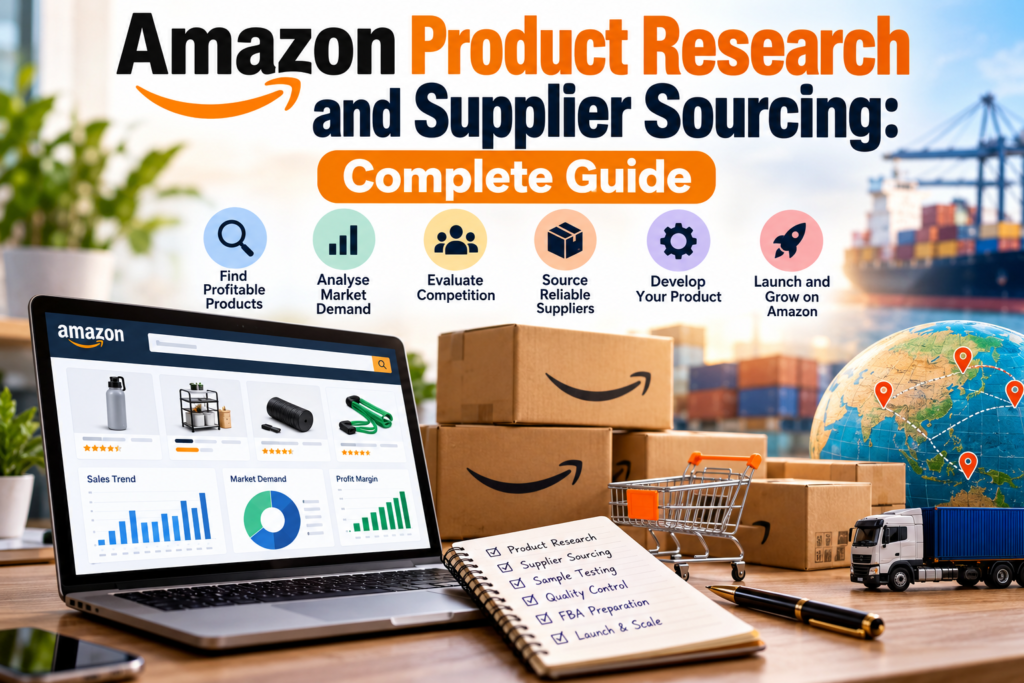
1. What Is Amazon Product Research?
Amazon product research is the process of identifying products that customers are actively purchasing and evaluating whether those products can generate sustainable profits for your business.
It involves more than checking Amazon Best Sellers or looking at estimated monthly sales.
A proper product research process examines:
- Customer demand and purchasing behaviour
- Monthly sales volume and revenue potential
- Keyword search volume
- Competition and market saturation
- Average selling prices
- Customer reviews and product complaints
- Product size, weight, and shipping costs
- Manufacturing and sourcing costs
- Amazon fees and advertising expenses
- Profit margins and return potential
The objective is to identify a product that customers want, competitors have not completely dominated, and suppliers can manufacture at a cost that leaves enough room for profit.
For example, a kitchen cleaning product might generate thousands of monthly sales. However, if the market is controlled by established brands with thousands of reviews and extremely low prices, entering that market may be difficult.
On the other hand, a smaller niche with consistent demand and several poorly designed competing products might offer a better opportunity.
The best product is not necessarily the one with the highest sales. It is the one with the best combination of demand, competition, differentiation, and profitability.
2. How to Find Profitable Products to Sell on Amazon
Finding profitable Amazon products requires a systematic approach. Instead of randomly browsing categories, start with a list of potential product ideas and gradually eliminate products that do not meet your business requirements.
Start with Amazon Best Sellers
Amazon Best Sellers is a useful starting point for discovering products that are already attracting customer purchases.
Explore categories such as:
- Home and Kitchen
- Beauty and Personal Care
- Pet Supplies
- Sports and Outdoors
- Office Products
- Baby Products
- Automotive
- Tools and Home Improvement
Look beyond the bestselling products themselves. Pay attention to related accessories, complementary products, product variations, and smaller niches.
For example, instead of entering the highly competitive kitchen sponge market with a standard product, investigate specialised cleaning sponges, reusable scrubbers, dishwashing accessories, or bundled cleaning kits.
These variations may provide opportunities to create a more differentiated product.
Remember that Best Sellers rankings indicate relative performance within a category. They do not automatically reveal monthly sales or profitability.
Research Customer Demand
Customer demand should be one of your first screening criteria.
A product may look attractive, but if very few customers are searching for it, generating consistent sales could become expensive.
Use keyword research tools to understand what shoppers are searching for.
Some useful tools include:
- Helium 10
- Jungle Scout
- Amazon Product Opportunity Explorer
- Google Trends
- Amazon Brand Analytics, where eligible
Look for products with consistent demand rather than relying entirely on short lived trends.
A product selling well throughout the year is often easier to manage than something that generates most of its revenue during a short seasonal window.
Analyse Competitor Sales
Once you identify a potential product, investigate the leading competitors.
Pay attention to:
- Estimated monthly sales
- Monthly revenue
- Number of competing sellers
- Average selling price
- Review counts
- Product ratings
- Listing quality
- Brand recognition
- Advertising competition
Do not rely on a single competitor’s performance.
Analyse several relevant listings to understand whether demand is distributed across multiple sellers or concentrated among one or two established brands.
If one brand controls most of the market, entering that niche may require a substantial marketing budget and a strong differentiation strategy.
Read Negative Customer Reviews
One of the most overlooked parts of Amazon product research is reading negative reviews.
Customer complaints can reveal opportunities that sales estimates cannot.
Imagine you are researching a pet hair remover.
You discover that customers frequently complain about:
- Poor material quality
- Handles breaking after repeated use
- Difficulty cleaning the product
- Ineffective removal of pet hair
- Small product dimensions
These complaints provide useful information for product development.
You could work with a manufacturer to improve the material, redesign the handle, increase durability, or introduce a more convenient cleaning mechanism.
This is how sellers can create products that solve existing customer problems instead of simply copying competitors.
Evaluate Product Differentiation
Private label selling is not just about purchasing an existing product and putting your logo on it.
Your objective should be to create a better offer.
Differentiation can come from:
- Improved materials
- Better packaging
- Additional accessories
- More practical product dimensions
- Better product design
- Multiple product bundles
- Improved functionality
- Better instructions and customer support
For example, if competitors sell a basic kitchen cleaning sponge individually, you could explore a multipack with different sponge textures for different cleaning requirements.
However, every additional feature increases manufacturing complexity and potentially your cost.
Your differentiation strategy must make commercial sense.
3. How to Calculate Amazon Product Profitability
A product generating $20,000 in monthly revenue does not necessarily mean the seller is making substantial money.
Revenue and profit are two completely different things.
Before contacting suppliers or placing an order, calculate the expected profitability.
Your calculation should include:
- Product manufacturing or purchasing cost
- International shipping
- Customs duties and applicable taxes
- Freight forwarding expenses
- Product preparation and labeling
- Amazon referral fees
- FBA fulfillment fees
- Storage expenses
- Advertising costs
- Returns and other operating expenses
Consider a simplified example.
You are planning to sell a private label kitchen accessory for $19.99.
Your estimated expenses per unit are:
- Manufacturing cost: $4.00
- Shipping and import allocation: $1.50
- Amazon referral fee: $3.00
- FBA fulfillment fee: $3.50
- Advertising allocation: $2.50
- Other operating expenses: $0.50
Your estimated contribution is $4.99 per unit before any additional overhead or taxes not included in the calculation.
This represents approximately 25% of the selling price.
These are illustrative figures, not actual Amazon fee quotations. Always calculate fees using the current marketplace fee schedule and the actual product dimensions, weight, category, and fulfillment arrangement.
A common mistake is calculating profit using only the manufacturing cost and selling price.
That calculation creates unrealistic expectations.
Always calculate landed cost and Amazon selling expenses before committing to inventory.
4. What Are the Best Products for Amazon Private Label?
There is no universal list of products guaranteed to succeed on Amazon.
However, certain product characteristics can make a product more attractive for private label development.
Consider products that:
- Solve a specific customer problem
- Have consistent purchasing demand
- Are relatively easy to manufacture
- Are lightweight and compact
- Have manageable shipping costs
- Offer opportunities for product improvement
- Have repeat purchase or bundle potential
- Do not require complicated regulatory approvals
- Have enough selling price to support advertising
Some categories worth researching include:
Home and Kitchen: Cleaning accessories, kitchen organisers, reusable household products, storage solutions, and kitchen tools.
Pet Supplies: Grooming accessories, pet cleaning products, feeding accessories, and pet travel products.
Beauty and Personal Care: Cosmetic accessories, beauty tools, personal care accessories, and nonregulated beauty products.
Sports and Outdoors: Fitness accessories, camping organisers, outdoor storage products, and exercise accessories.
Office Products: Desk organisers, stationery bundles, document accessories, and workspace organisation products.
These are research starting points rather than recommendations to launch without market validation.
Some categories involve additional testing, documentation, labelling, or regulatory requirements. Always check the specific requirements of your destination marketplace.
5. How to Find Reliable Amazon Suppliers
Once you identify a promising product, the next challenge is finding a supplier who can manufacture or supply it consistently.
A supplier offering the lowest price is not necessarily the best supplier.
You need a manufacturing or wholesale partner who understands your specifications, maintains consistent quality, communicates effectively, and can fulfil orders within the agreed timeline.
Alibaba
Alibaba is one of the most widely used platforms for finding manufacturers and suppliers, particularly in China.
You can search by product name, material, specifications, and manufacturing category.
When evaluating suppliers, check:
- Business verification details
- Manufacturing experience
- Product specialisation
- Export experience
- Minimum order quantity
- Production capacity
- Customisation capabilities
- Communication quality
- Available certifications
Do not assume that every supplier listed on Alibaba is a manufacturer. Some are trading companies or intermediaries.
Trading companies are not automatically bad choices, but you should understand who will actually manufacture your product.
Global Sources
Global Sources is another sourcing platform that connects international buyers with manufacturers and exporters.
It can be useful when comparing suppliers across different manufacturing categories.
Look for suppliers with relevant product experience and the ability to support your specific quality and packaging requirements.
IndiaMART
IndiaMART can help sellers identify Indian manufacturers and wholesale suppliers.
India has manufacturing capabilities across several categories, including:
- Home and kitchen products
- Textiles
- Handicrafts
- Personal care accessories
- Metal products
- Leather goods
- Household accessories
For sellers targeting the US, UK, Canada, or other international marketplaces, India can be an attractive sourcing destination depending on the product, production capacity, shipping costs, and applicable import requirements.
Direct Manufacturer Sourcing
Another approach is to identify manufacturers directly rather than depending entirely on online marketplaces.
You can use industry directories, trade exhibitions, manufacturer websites, and sourcing networks.
Direct sourcing may offer better communication and greater control over product development.
However, you still need to verify the manufacturer’s identity, production capabilities, quality standards, and commercial terms.
6. China vs India vs Vietnam: Which Country Is Best for Amazon Product Sourcing?
Choosing the right sourcing country depends on the product you want to sell.
There is no single country that offers the best manufacturing solution for every product.
Sourcing from China
China has a large manufacturing ecosystem and an extensive supplier network.
It is particularly useful for products involving:
- Electronics accessories
- Plastic household products
- Kitchen accessories
- Packaging
- Consumer goods
- Product bundles
- Customised components
One advantage of China is the availability of manufacturers across a wide range of product categories.
However, sellers should carefully evaluate quality, production costs, shipping arrangements, intellectual property protection, and applicable import duties.
Sourcing from India
India offers opportunities across:
- Home and kitchen products
- Textiles
- Handicrafts
- Metal products
- Wooden products
- Household accessories
- Personal care accessories
Indian manufacturers can be particularly attractive for sellers looking for specialised production, certain natural materials, and products with distinctive designs.
However, manufacturing capabilities and export experience vary significantly between suppliers.
Always verify production capacity and international shipping experience before placing a commercial order.
Sourcing from Vietnam
Vietnam has developed manufacturing capabilities in several industries, including:
- Furniture
- Textiles
- Household products
- Wooden products
- Consumer goods
It can be worth exploring as an alternative sourcing destination when comparing manufacturing costs, supplier capabilities, and supply chain diversification.
How Should You Choose?
Compare suppliers based on the complete landed cost, not simply the factory quotation.
A product manufactured for $3.00 in one country may ultimately cost more than a similar product manufactured for $3.50 elsewhere once freight, duties, quality, and delivery expenses are considered.
The right decision is the one that provides the best combination of quality, cost, reliability, and supply chain stability.
7. How to Contact Suppliers and Request Quotations
Once you shortlist potential suppliers, prepare a clear product specification before requesting quotations.
Sending a supplier a simple product photograph and asking for the cheapest price is not an effective sourcing strategy.
Your inquiry should explain exactly what you need.
Include:
- Product name
- Product dimensions
- Material requirements
- Colour specifications
- Packaging requirements
- Branding requirements
- Logo placement
- Expected order quantity
- Destination country
- Required certifications or testing
- Shipping terms
Request quotations from at least three to five suppliers.
This helps you compare pricing, manufacturing capabilities, and communication quality.
A professional inquiry helps suppliers understand that you are evaluating a genuine commercial opportunity.
8. Why Product Samples Are Essential Before Placing an Order
Never place a large production order based entirely on product photographs or supplier promises.
Always request samples.
Samples allow you to evaluate the actual product before investing in inventory.
During sample evaluation, check:
- Material quality
- Product dimensions
- Weight
- Functionality
- Durability
- Packaging quality
- Finishing
- Colour consistency
- Overall customer experience
If possible, order samples from multiple suppliers.
Compare them against your original product requirements and select the supplier that offers the best overall value.
For products involving electrical components, food contact, cosmetics, children’s use, or other regulated applications, arrange the appropriate testing and compliance review.
A sample that looks good does not automatically prove that the full production batch will meet the same standard.
Establish written quality specifications before manufacturing begins.
9. How to Negotiate MOQ and Manufacturing Prices
MOQ stands for Minimum Order Quantity.
It is the minimum number of units a supplier is willing to manufacture or sell in one order.
For example, a manufacturer may require an MOQ of 500 units for a customised product.
New Amazon sellers sometimes struggle with high MOQs because they do not want to invest too much money before validating demand.
There are several ways to approach this situation.
Ask for different quantity quotations.
Request pricing for 200, 500, 1,000, and 2,000 units where applicable.
This helps you understand how manufacturing costs change with volume.
Discuss standard packaging.
Custom packaging can increase the MOQ. Using existing packaging with your own labels or inserts may help reduce initial investment, provided the packaging meets all applicable requirements.
Negotiate a pilot production order.
Some manufacturers may accept a smaller initial order if they see potential for repeat business.
Build a long term supplier relationship.
Instead of negotiating only for the lowest possible price, discuss future order volumes and production schedules.
At HighRise Wholesale, we believe sourcing decisions should be based on long term business viability rather than simply finding the cheapest available quotation.
10. How to Verify a Supplier Before Sending Payment
Supplier verification is one of the most important steps in international sourcing.
A professional website or attractive product catalogue does not guarantee that a business is legitimate.
Before making an advance payment, verify the supplier.
Check the following:
Business registration: Request the company’s registered business name and relevant registration details.
Physical address: Verify the business address and manufacturing location.
Manufacturing capabilities: Determine whether the supplier owns the factory or works with subcontractors.
Previous export experience: Ask for information about their experience supplying international customers.
Product documentation: Request relevant test reports, certifications, and compliance documents.
References: Where possible, request references from previous buyers.
Payment details: Ensure the beneficiary name matches the verified business or an appropriately documented payment arrangement.
Factory inspection: Consider an independent factory audit for significant orders.
For branded wholesale products, verify the supplier’s authorisation and supply chain documentation. Maintain legitimate invoices and other purchasing records because Amazon may request evidence of product authenticity or sourcing.
Avoid sending large payments to unverified individuals or unrelated bank accounts.
11. Quality Control and Inspection Before Shipping
Quality control should be part of your sourcing process from the beginning.
A supplier may provide an excellent sample but deliver a production batch with different materials, dimensions, or finishing.
This is why inspection matters.
A practical quality control process includes:
Pre-production inspection
Confirm product specifications, materials, approved samples, branding, and packaging before production starts.
During-production inspection
For larger orders, consider checking products while manufacturing is still in progress.
This gives you an opportunity to identify problems before the entire batch is completed.
Pre-shipment inspection
Inspect the finished products before approving the final payment and shipment.
Check product functionality, quantity, packaging, labelling, and defects.
Shipping verification
Confirm carton dimensions, weights, shipping marks, product labels, and required export documents.
Your supplier agreement should clearly define acceptable quality standards and what happens if the delivered goods fail inspection.
HighRise Wholesale emphasises quality checks because receiving defective inventory can create additional costs through Amazon returns, negative reviews, refunds, and damaged brand reputation.
12. Understanding Landed Cost and International Shipping
One of the biggest mistakes new Amazon sellers make is confusing the factory price with the actual product cost.
The factory quotation is only one part of the investment.
Landed cost represents the cost of getting inventory to the agreed destination, including relevant purchasing, transportation, import, and handling expenses.
Depending on your shipping arrangement, it may include:
- Manufacturing cost
- Packaging expenses
- Export documentation
- Inland transportation
- International freight
- Insurance
- Customs duties
- Customs clearance
- Destination handling
- FBA preparation and transportation
For example, a product with a $3 manufacturing cost could have a landed cost of $5 or more after international shipping and other expenses.
Your calculations should use the actual quotation and applicable import requirements.
Air Freight vs Sea Freight
Air freight is generally faster and may be suitable for samples, smaller shipments, or urgent replenishment.
Sea freight is generally more economical for larger shipments, although transit times and additional handling requirements must be considered.
The best option depends on your inventory requirements, cash flow, product dimensions, shipment volume, and launch schedule.
Do not choose shipping solely based on the cheapest quotation.
Delayed inventory can result in stockouts, lost sales, and reduced business momentum.
13. Preparing Products for Amazon FBA
After manufacturing and quality inspection, your products need to meet Amazon’s fulfillment requirements.
For private label sellers, this usually involves:
- FNSKU or other applicable product identification labels
- Product packaging
- Carton labelling
- Polybagging where required
- Warning labels where applicable
- Shipment documentation
- Carton dimensions and weight compliance
- Appropriate product preparation
Amazon’s requirements vary depending on the product category, marketplace, and fulfillment arrangement.
Make sure your supplier or preparation partner understands the current requirements of your destination marketplace.
For international sellers, coordinating product preparation before shipping can help reduce unnecessary handling and operational delays.
HighRise Wholesale supports sellers with product sourcing, private labeling, packaging coordination, quality checks, and Amazon FBA preparation as part of its broader private label services.
14. Common Amazon Product Research and Supplier Sourcing Mistakes
Even experienced sellers can make expensive sourcing mistakes.
Here are some problems worth avoiding.
Choosing Products Only Because They Are Trending
A trending product may already have attracted hundreds of sellers.
By the time you identify the opportunity, the market could be saturated.
Validate demand and competition before investing.
Ignoring Amazon Fees
A product that appears profitable using factory pricing may become unprofitable after FBA fees, advertising, and shipping.
Always calculate the complete cost structure.
Copying Competitors Without Differentiation
Launching an identical product with a different logo does not create a compelling competitive advantage.
Look for customer problems that existing products have not solved.
Selecting Suppliers Based Only on Price
Cheap manufacturing does not help if the product quality is inconsistent.
Compare total value, not just unit pricing.
Ordering Too Much Inventory
Large initial orders can lock up your working capital.
Start with an order size that matches your validated demand, supplier MOQ, and financial capacity.
Skipping Sample Testing
A photograph cannot tell you whether a product is durable, functional, or suitable for your target customers.
Test the product before approving mass production.
Ignoring Compliance Requirements
Some products require specific documentation, testing, labelling, or regulatory approvals.
Research these requirements before manufacturing.
Failing to Plan Reorders
A product that starts selling well can quickly run out of stock if the supplier has long production lead times.
Plan replenishment based on actual sales velocity, production time, shipping time, and safety stock.
15. How HighRise Wholesale Helps Amazon Sellers with Product Research and Supplier Sourcing
Finding a profitable product and sourcing it from a reliable manufacturer can require considerable time, industry knowledge, and coordination.
Many new sellers are comfortable with Amazon Seller Central but have limited experience dealing with international manufacturers, product specifications, quality inspections, and international logistics.
This is where a sourcing partner can help simplify the process.
HighRise Wholesale works with Amazon FBA and Walmart WFS sellers looking to develop their own private label brands and source products internationally.
Our services cover several stages of the product development and sourcing process.
Product Research and Opportunity Identification
We help sellers explore product opportunities based on market demand, competition, pricing, and potential profitability.
The objective is to identify products that make commercial sense before committing to manufacturing.
International Supplier Sourcing
We support product sourcing from India, China, Indonesia, and Vietnam, depending on product requirements and supplier availability.
We help coordinate supplier communication, quotations, product specifications, and manufacturing requirements.
Private Label Manufacturing
Sellers can develop their own branded products with customised logos, packaging, and product presentation.
The objective is to build a brand rather than compete entirely on price with generic sellers.
Quality Inspection
Quality checks help identify manufacturing defects and product inconsistencies before inventory moves into the shipping process.
Amazon FBA Preparation
We help coordinate product labelling, bundling, packaging, and preparation for Amazon fulfillment requirements.
Listing and Brand Launch Support
Product sourcing is only one part of building a successful Amazon business.
A complete launch also requires professional listing content, product images, keyword research, brand development, and an advertising strategy.
HighRise Wholesale helps sellers coordinate these activities as part of a broader private label launch process.
Learn more about our sourcing and private label services:
The goal is to help sellers move from product ideas to commercially viable branded products without having to coordinate every stage independently.
16. Step-by-Step Amazon Product Research and Supplier Sourcing Strategy
If you are starting from scratch, follow this practical workflow.
Step 1: Select a marketplace
Decide whether you want to sell in the US, UK, Canada, Australia, or another Amazon marketplace.
Step 2: Identify product categories
Explore categories that match your budget, business experience, and sourcing capabilities.
Step 3: Generate product ideas
Use Amazon Best Sellers, Product Opportunity Explorer, competitor research, and keyword tools.
Step 4: Validate demand
Analyse search volume, estimated sales, historical trends, and customer purchasing behaviour.
Step 5: Evaluate competition
Study competitor reviews, prices, brand strength, listing quality, and market saturation.
Step 6: Identify product improvements
Find customer complaints and determine whether you can offer a better product.
Step 7: Calculate profitability
Include manufacturing, freight, duties, Amazon fees, advertising, and operating costs.
Step 8: Shortlist suppliers
Contact multiple manufacturers and compare their quotations, capabilities, and communication.
Step 9: Request samples
Evaluate actual product quality before approving production.
Step 10: Verify the supplier
Check business details, production capabilities, documentation, and payment arrangements.
Step 11: Finalise production
Agree on specifications, packaging, MOQ, pricing, payment milestones, and delivery timelines in writing.
Step 12: Inspect and ship
Conduct quality inspections and coordinate international shipping and Amazon FBA preparation.
Step 13: Launch and monitor
Track sales, advertising costs, conversion rates, customer feedback, inventory, and profitability.
Step 14: Reorder strategically
Use actual sales data to plan replenishment and improve your next production order.
Following this process will not guarantee success, but it can help eliminate many avoidable sourcing and investment mistakes.
Frequently Asked Questions About Amazon Product Research and Supplier Sourcing
1. How do I find profitable products to sell on Amazon?
Start by researching customer demand, competition, search volume, average selling prices, and customer reviews. Use tools such as Helium 10, Jungle Scout, and Amazon Product Opportunity Explorer. Calculate all manufacturing, shipping, Amazon, and advertising expenses before selecting a product.
2. What is the best tool for Amazon product research?
Popular options include Helium 10, Jungle Scout, and Amazon Product Opportunity Explorer. Each provides different research capabilities. Amazon’s own tool is particularly useful for analysing customer demand, niche performance, search behaviour, and market opportunities.
3. How much money do I need to start an Amazon private label business?
Your investment depends on the product, manufacturing MOQ, packaging, shipping, marketplace, and advertising requirements.
A smaller product launch may require a few thousand dollars, while more complex products can require considerably more. Always maintain additional working capital for advertising, returns, and inventory replenishment.
4. Where can I find suppliers for Amazon private label products?
You can find manufacturers through Alibaba, Global Sources, IndiaMART, trade exhibitions, manufacturer directories, and direct sourcing networks. HighRise Wholesale also helps Amazon sellers source products from India, China, Indonesia, and Vietnam.
5. Is Alibaba safe for Amazon product sourcing?
Alibaba can be a useful sourcing platform, but sellers should independently verify suppliers, review business credentials, request samples, use appropriate payment protections, and establish written quality agreements. Never assume that a supplier is reliable simply because it has a marketplace profile.
6. Should I source products from China or India?
Both countries offer manufacturing opportunities. China has a broad manufacturing ecosystem, while India is competitive in several household, textile, handicraft, and specialised manufacturing categories. Your decision should depend on product quality, landed cost, supplier capabilities, compliance, and shipping requirements.
7. What is a good profit margin for Amazon private label products?
There is no universal ideal margin. Many sellers use a 25% to 30% net contribution target as an initial screening benchmark, but actual profitability depends on advertising, product category, returns, overhead, and inventory costs. Always distinguish contribution margin from final business net profit.
8. What is MOQ in supplier sourcing?
MOQ means Minimum Order Quantity. It represents the minimum number of units a manufacturer or supplier requires per order. MOQ varies depending on the product, customisation, packaging, and manufacturing process.
9. Can I sell private label products without manufacturing them myself?
Yes. You can work with an existing manufacturer to produce products under your own brand. You generally provide branding, packaging, and product specifications while the manufacturer handles production.
10. How long does Amazon private label product sourcing take?
A straightforward sourcing and launch process may take approximately four to eight weeks, although customised products, complex testing, packaging development, and international shipping can extend the timeline.
11. How do I know whether an Amazon product is too competitive?
Examine competitor review counts, market concentration, pricing pressure, advertising competition, brand dominance, and opportunities for differentiation. If established brands dominate the search results and customers have little reason to choose your product, entering the niche may be difficult.
12. Can HighRise Wholesale help me find products and suppliers?
Yes. HighRise Wholesale supports Amazon FBA and Walmart WFS sellers with product research, international supplier sourcing, private label manufacturing, quality checks, packaging, FBA preparation, and launch support.
Final Thoughts
Amazon success is not about finding a random product, placing an order, and hoping customers will buy it.
It requires research, commercial planning, reliable supplier relationships, quality control, and a clear understanding of the marketplace.
Product research helps you identify where the opportunity exists. Supplier sourcing determines whether you can turn that opportunity into a competitive product. Profitability analysis ensures that the business can generate sustainable returns.
Most importantly, do not rush into manufacturing simply because a product looks promising.
Validate the market, understand your numbers, test samples, verify suppliers, and plan your inventory carefully.
If you are serious about building your own Amazon private label brand, HighRise Wholesale can help you coordinate the journey from product research and supplier sourcing to manufacturing and Amazon FBA preparation.
Build your brand with the right product, the right supplier, and a sourcing strategy designed for long term growth.