Finding the right supplier is one of the most important decisions when starting or expanding an import business, launching a private label brand, or sourcing products for Amazon FBA, Walmart WFS, and other ecommerce marketplaces.
At first, three supplier options often look similar. You can purchase directly from a manufacturer, work with a trading company, or hire a sourcing agent to find products and coordinate with factories. However, each option has a different business model, pricing structure, level of control, and set of advantages.
Choosing the wrong supplier can lead to higher product costs, inconsistent quality, communication problems, delayed shipments, and unnecessary complications during production.
So, should you buy directly from a manufacturer, work with a trading company, or hire a sourcing agent?
The answer depends on your order quantity, product requirements, sourcing experience, budget, and how much involvement you want in the purchasing process.
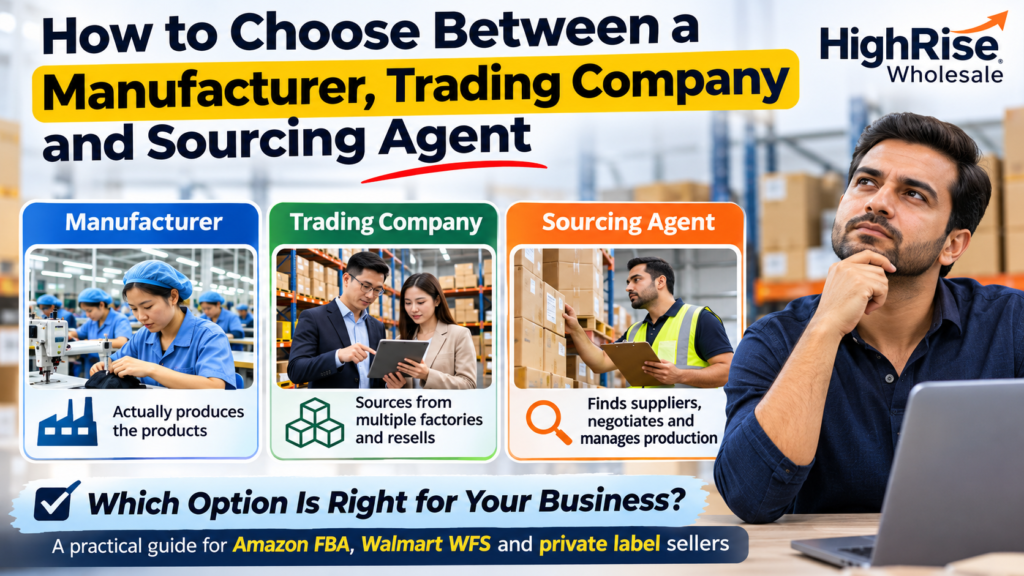
Let’s break down the differences and understand which option makes the most sense for your business.
1. Buying Directly From a Manufacturer
A manufacturer is a company that actually produces the products. It owns or operates production facilities, employs workers, manages manufacturing equipment, and handles the production process.
When you purchase directly from a manufacturer, you communicate with the company responsible for making your products rather than going through an intermediary.
Advantages of working directly with manufacturers
Potentially lower product costs
Buying directly from a factory can eliminate intermediary margins. This can make a significant difference when ordering large quantities or negotiating long term production agreements.
Greater customization opportunities
Manufacturers are generally the best option when you need custom product designs, packaging, materials, dimensions, colors, or specifications.
For private label sellers, this is particularly important because product differentiation can help build a recognizable brand instead of competing with identical generic products.
Better production control
Direct communication with the manufacturer can make it easier to discuss quality standards, production timelines, packaging requirements, and product specifications.
Long term manufacturing relationships
If you consistently order the same products, developing a direct relationship with a manufacturer can help improve pricing, production planning, and product consistency.
Disadvantages of working directly with manufacturers
Buying directly is not always the cheapest or easiest option.
Many manufacturers have minimum order quantities that may be too high for new businesses. Some factories are also reluctant to handle smaller orders because their production lines are designed for larger volumes.
Communication can become another challenge, especially when working with overseas factories. Language differences, time zones, unfamiliar payment terms, and limited export experience can create unnecessary complications.
You may also need to coordinate product inspections, packaging, labeling, documentation, freight forwarding, and customs clearance independently.
Who should buy directly from manufacturers?
Direct manufacturing is generally suitable for:
- Established private label brands.
- Businesses ordering larger quantities.
- Importers with experience managing international suppliers.
- Sellers requiring custom product development.
- Businesses planning repeat orders and long term production agreements.
If you have sufficient order volume and understand the importing process, working directly with a manufacturer can be an excellent option.
2. Working With a Trading Company
A trading company purchases products from manufacturers and resells them to international buyers.
Instead of operating its own production facility, a trading company works with one or multiple factories to source products based on customer requirements.
For example, if you want to purchase kitchen accessories, a trading company may have relationships with several manufacturers producing different types of kitchen products. It can consolidate your requirements and provide multiple product options through a single business relationship.
Advantages of working with trading companies
Access to multiple manufacturers
One of the biggest advantages is flexibility. You do not need to identify and negotiate with every factory independently.
Trading companies can offer products from different manufacturers, making it easier to compare specifications, pricing, and available options.
Lower minimum order quantities in some cases
Some trading companies accept smaller orders than the factories they work with. This can be useful for startups and small ecommerce businesses testing new products.
Simplified communication
Trading companies often have export experience and teams familiar with international buyers. They may understand common requirements involving packaging, labeling, shipping, and documentation.
Multiple product categories
If you want to source several unrelated products, a trading company may help consolidate purchasing instead of requiring separate negotiations with multiple factories.
Disadvantages of working with trading companies
The main disadvantage is additional cost.
Trading companies earn money through product margins. Consequently, their prices may be higher than the factory’s direct quotation.
You may also have less visibility into the actual manufacturer. Some trading companies do not disclose factory information, making it difficult to independently evaluate production capabilities.
Quality control can also vary. A trading company may work with several factories, and the quality standards of those factories may not be identical.
Another important consideration is that not every trading company has direct control over production. If something goes wrong at the factory, resolving the problem may require additional coordination.
Who should work with trading companies?
Trading companies are often suitable for:
- Small and medium sized importers.
- Ecommerce sellers sourcing multiple products.
- Businesses with limited international sourcing experience.
- Buyers who need lower order quantities.
- Companies that prefer working with one supplier instead of several factories.
For many new Amazon and Walmart sellers, a reliable trading company can offer a practical starting point.
3. Hiring a Sourcing Agent
A sourcing agent is an individual or company that helps buyers identify suitable manufacturers, negotiate prices, coordinate production, and manage supplier relationships.
Unlike a trading company, a sourcing agent typically works on behalf of the buyer rather than purchasing and reselling products as the primary business model.
Depending on the agreement, sourcing agents may charge a fixed service fee, a percentage of the purchase value, or a combination of both.
Advantages of hiring a sourcing agent
Access to verified suppliers
An experienced sourcing agent may already have relationships with manufacturers and can help identify factories that match your product requirements.
This can save considerable time, especially if you are unfamiliar with the manufacturing market.
Price negotiation
Sourcing agents can negotiate with factories on your behalf. Their local knowledge and experience may help you understand whether a quotation is reasonable.
Factory communication
Managing overseas suppliers can be challenging. A sourcing agent can help bridge language and communication gaps and coordinate discussions about product specifications.
Quality inspection coordination
Many sourcing agents can arrange factory visits, production inspections, product testing, and pre shipment quality checks.
Support throughout the sourcing process
Depending on the service package, an agent may help with supplier identification, samples, production follow ups, packaging, logistics, and export coordination.
Disadvantages of hiring sourcing agents
The quality of sourcing agents varies significantly.
Some have extensive factory networks and genuine industry experience, while others simply forward supplier quotations without conducting meaningful verification.
There is also a potential conflict of interest if an agent receives undisclosed commissions from manufacturers while charging the buyer a separate service fee.
You should always understand how the agent earns money.
Ask whether the agent receives commissions from factories, whether those commissions are disclosed, and whether you will receive original factory quotations.
Another consideration is accountability. A sourcing agent coordinates the transaction, but that does not automatically mean they are responsible for manufacturing defects or supplier failures.
Always establish clear responsibilities in writing.
Who should hire a sourcing agent?
A sourcing agent can be particularly useful for:
- First time importers.
- Buyers sourcing customized products.
- Businesses unfamiliar with Chinese or other overseas manufacturing markets.
- Companies managing multiple factories.
- Importers who need local support for inspections and production monitoring.
If you lack the time or experience to manage suppliers independently, an experienced sourcing agent can make the process considerably easier.
4. What Is the Difference Between a Manufacturer, Trading Company and Sourcing Agent?
The most important difference is their role in the supply chain.
A manufacturer produces the goods. A trading company purchases and resells goods, often working with multiple factories. A sourcing agent helps you find and manage suppliers, usually for a service fee or commission.
Their responsibilities and commercial incentives are different.
A manufacturer earns money from production. A trading company earns money from the margin between its purchasing and selling prices. A sourcing agent earns money from providing sourcing and coordination services.
This distinction matters because the lowest quotation does not necessarily represent the best overall deal.
For example, a factory may offer a lower unit price but require a large MOQ, leaving you with more inventory and additional operational responsibilities.
A trading company may charge more per unit but accept a smaller order and consolidate several products.
A sourcing agent may charge a separate fee but help you identify a more suitable manufacturer and coordinate quality inspections.
The right choice should be based on your total landed cost, product quality, reliability, and operational requirements rather than unit price alone.
5. Which Option Is Best for Amazon FBA and Walmart WFS Sellers?
For Amazon FBA and Walmart WFS sellers, supplier selection requires more consideration than simply finding someone who can manufacture a product.
You need a supplier who understands your product specifications, packaging requirements, labeling, carton dimensions, barcode requirements, and shipping arrangements.
A product can be manufactured correctly but still create problems if the packaging, labeling, or shipment preparation does not meet marketplace requirements.
Here is how each option fits ecommerce businesses.
Manufacturer: Best for established sellers who have proven product demand and want to develop custom products, negotiate better production costs, and build long term manufacturing relationships.
Trading company: Useful for sellers who want to source multiple products, test different categories, or purchase smaller quantities without independently managing several factories.
Sourcing agent: Useful for sellers who need help identifying manufacturers, negotiating prices, checking product quality, and coordinating overseas production.
However, Amazon and Walmart sellers should also consider whether their supplier can support the complete process beyond manufacturing.
This includes product inspection, FNSKU labeling, barcode application, bundling, packaging, carton preparation, and shipping directly to fulfillment centers where applicable.
A supplier who can coordinate these services can reduce the number of separate vendors you need to manage.
6. Important Questions to Ask Before Choosing a Supplier
Regardless of which sourcing model you choose, never place a large order based only on a quotation or product photograph.
Before making a purchasing decision, ask these questions:
1. Are you the actual manufacturer or an intermediary?
Understand whether you are communicating directly with a factory, a trading company, or a sourcing agent.
2. Can you provide factory details?
If someone claims to be a manufacturer, ask for the company registration details, factory address, production photographs, and relevant certifications.
3. What is your minimum order quantity?
Clarify whether the MOQ applies to each product, design, color, or packaging variation.
4. Can you provide samples?
Always evaluate product quality before committing to bulk production.
5. How do you manage quality control?
Ask about inspection procedures, acceptable defect rates, product testing, and responsibility for defective products.
6. What payment terms do you offer?
Understand the payment schedule, accepted payment methods, and refund or replacement policies.
7. Can you manage packaging and labeling?
This is particularly important for private label businesses selling through Amazon FBA and Walmart WFS.
8. What happens if production is delayed?
Get realistic production timelines and understand how delays will be communicated and handled.
9. Can you arrange international shipping?
Clarify whether shipping, customs documentation, freight forwarding, and delivery to fulfillment centers are included or charged separately.
10. How do you earn money?
This is particularly important when dealing with sourcing agents. Understand whether they charge a service fee, earn supplier commissions, or add a margin to product prices.
7. Common Mistakes Buyers Make When Selecting Suppliers
Even experienced importers can make costly supplier selection mistakes.
Some of the most common include:
Choosing suppliers based only on price
An unusually low quotation can indicate lower quality materials, incomplete specifications, hidden charges, or unreliable production capabilities.
Assuming every supplier claiming to be a factory is a manufacturer
Some intermediaries present themselves as manufacturers. Verify their actual business operations before making significant payments.
Ignoring quality inspections
Never assume that a sample represents the quality of the final bulk order. Establish inspection procedures before production begins.
Not calculating the total landed cost
Product price is only one part of the investment. Include packaging, labeling, inspection, freight, customs duties, taxes, and other applicable expenses.
Paying without clear agreements
Document product specifications, delivery timelines, payment terms, quality standards, and responsibilities.
Ignoring supplier communication
A supplier who takes days to answer basic questions before receiving payment may become even harder to manage after receiving your order.
8. Can You Combine a Manufacturer, Trading Company and Sourcing Agent?
Yes. These three options are not mutually exclusive.
In fact, many experienced importers use a combination depending on the product and order requirements.
For example, a business might work directly with a manufacturer for its main private label product while using a trading company to source complementary accessories.
At the same time, it might hire a sourcing agent to inspect products, coordinate production, and verify additional suppliers.
This approach can provide flexibility without depending entirely on one sourcing channel.
The key is to establish clear responsibilities and maintain visibility into product costs, supplier relationships, and quality standards.
9. Where Does HighRise Wholesale Fit Into the Sourcing Process?
For ecommerce sellers, sourcing a product is only the beginning. The bigger challenge is managing everything required to turn that product into a marketplace ready private label business.
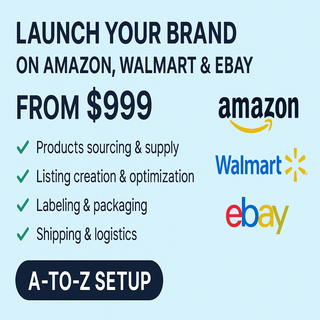
HighRise Wholesale supports Amazon FBA and Walmart WFS sellers with product sourcing, private labeling, product development, branding, packaging, quality checks, and fulfillment preparation.
Instead of independently coordinating every part of the process, sellers can access support across multiple stages of product development and sourcing.
HighRise Wholesale sources products through manufacturing and supplier networks in countries including India, China, Indonesia, and Vietnam.
Services can include:
- Product sourcing and supplier coordination.
- Private label product development.
- Logo, packaging, and branding support.
- Product quality checks before shipment.
- UPC and EAN barcode support.
- Amazon FBA labeling and preparation.
- Bundling and packaging services.
- Shipping coordination to Amazon and Walmart fulfillment warehouses.
- Listing creation and launch support.
For sellers who want to build their own brand, having sourcing, branding, and fulfillment preparation coordinated through one service provider can simplify operations.
You can learn more about the available services at https://highrisewholesale.com
The goal is not simply to find the cheapest supplier. It is to build a reliable sourcing process that supports product quality, competitive pricing, and long term business growth.
10. Final Verdict: Which Supplier Should You Choose?
There is no universally best option. The right supplier depends on your business stage, purchasing volume, product requirements, and sourcing experience.
Choose a manufacturer if you have sufficient order volume, need customization, and want direct control over production.
Choose a trading company if you need access to multiple product categories, flexible order quantities, and a simpler purchasing process.
Choose a sourcing agent if you need local expertise, supplier identification, negotiation support, and production coordination.
For new Amazon FBA and Walmart WFS sellers, starting with a reliable sourcing partner can reduce operational complexity while you focus on product research, branding, marketing, and sales.
As your business grows and order quantities increase, you can gradually develop direct relationships with manufacturers to improve pricing and gain greater control over production.
Ultimately, successful sourcing is not about choosing the supplier with the lowest quotation. It is about finding a reliable partner who can consistently deliver the right product, at the right quality, within your budget and timeline.