Finding the right private label manufacturer is not just about getting the lowest product price. Two manufacturers can quote the same product at completely different prices, yet the cheaper option may end up costing more once shipping, packaging, quality control, customization, and other expenses are included.
For Amazon FBA sellers, Walmart sellers, and entrepreneurs launching their own brands, comparing manufacturer quotes properly is an important part of protecting profit margins and avoiding costly sourcing mistakes.
So, how do you compare product quotes from multiple private label manufacturers and identify the best supplier for your business?
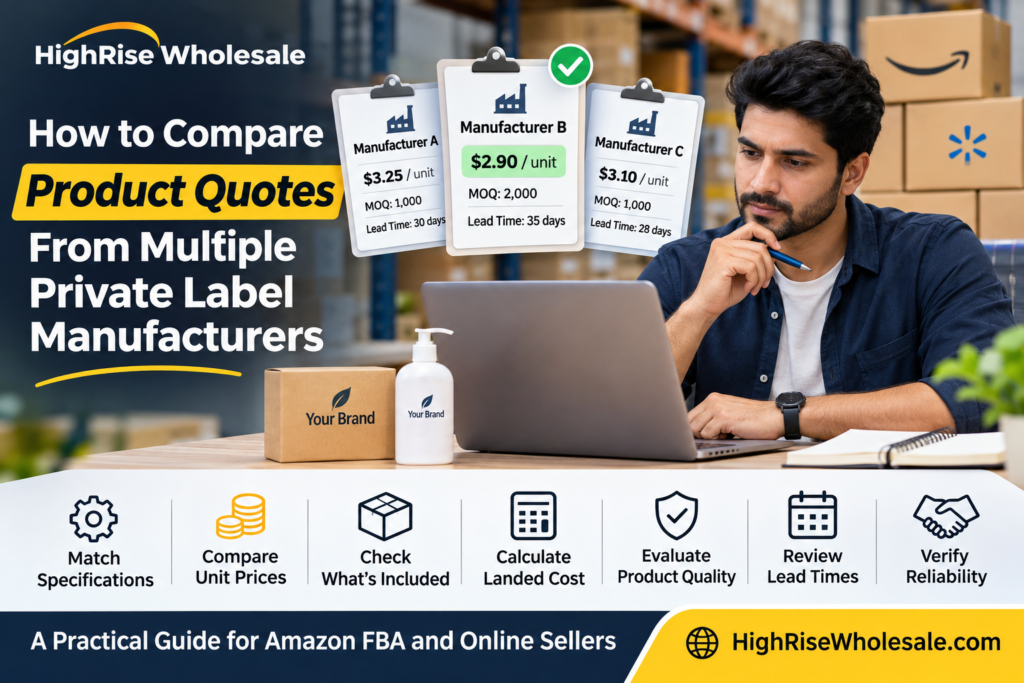
Let’s break down the key factors you should evaluate before placing an order.
1. Make Sure Every Manufacturer Is Quoting the Same Specifications
Before comparing prices, confirm that every manufacturer is quoting the same product specifications.
A common sourcing mistake is comparing prices without checking whether the products are actually identical.
For example, if you are sourcing stainless steel kitchen accessories, one manufacturer might quote a product made with 201 stainless steel, while another offers 304 stainless steel. Both may look similar in photographs, but their durability, corrosion resistance, and material costs are different.
Always share a detailed product specification sheet with every manufacturer.
Include:
- Product dimensions and weight
- Material and material grade
- Color and finish
- Product functionality
- Design requirements
- Packaging specifications
- Logo placement and branding requirements
- Accessories and included components
- Quality standards and tolerances
The more detailed your requirements, the easier it becomes to compare manufacturer quotations accurately.
2. Compare Unit Prices at Different Order Quantities
Private label manufacturers often offer different prices depending on the order quantity.
A manufacturer quoting $3.20 per unit for 500 pieces might offer $2.65 per unit for 2,000 pieces.
Another manufacturer might quote $2.90 per unit regardless of quantity.
Request pricing for multiple quantities instead of evaluating only one quotation.
For example, ask for pricing at:
- 500 units
- 1,000 units
- 2,000 units
- 5,000 units
This helps you understand the manufacturer’s pricing structure and identify potential economies of scale.
However, do not automatically choose the lowest unit price. Ordering more inventory simply to reduce manufacturing costs can create cash flow problems if the product does not sell as expected.
For new Amazon private label sellers, maintaining a manageable initial investment is often more important than achieving the lowest possible manufacturing price.
3. Check What Is Included in the Quoted Price
One manufacturer might provide a complete private label package, while another only quotes the basic product cost.
This is one of the biggest reasons supplier quotations can be misleading.
Ask whether the quotation includes:
- Custom logo printing
- Product packaging
- Custom packaging design
- Barcode printing
- Instruction manuals
- Product inserts
- Individual product labeling
- Assembly and bundling
- Carton packaging
- Quality inspection
For example, Manufacturer A may quote $3.00 per unit, including custom packaging and logo printing. Manufacturer B may quote $2.65 per unit but charge additional fees for branding and packaging.
After adding these expenses, Manufacturer A could actually be the more economical option.
When working with HighRise Wholesale, buyers can explore product sourcing and private labeling requirements together to understand the overall cost of launching their own brand rather than focusing only on the factory price.
4. Calculate the Total Landed Cost
The product quotation is only one part of your total investment.
For international private label sourcing, you should calculate the landed cost, which represents the total cost of getting your products to their intended destination.
Depending on your sourcing arrangement, consider:
- Manufacturing cost
- Customization and branding
- Packaging expenses
- Product inspection
- Export documentation
- International freight
- Customs duties and taxes
- Customs clearance
- Local transportation
- Amazon FBA preparation costs
For example, consider a product with a manufacturing cost of $3 per unit.
If you order 1,000 units, your initial product cost is $3,000. However, after adding packaging, shipping, inspection, customs charges, and preparation expenses, your actual investment could be considerably higher.
Always calculate the landed cost per unit before making a purchasing decision.
Formula:
Landed Cost Per Unit = Total Product, Packaging, Inspection, Shipping, Customs and Other Applicable Costs ÷ Total Units Received
This figure gives you a more realistic understanding of your sourcing expenses and helps you calculate your expected profit margin.
5. Evaluate Product Quality, Not Just Price
A low quotation does not necessarily mean a good deal.
Manufacturing quality directly affects customer satisfaction, product returns, negative reviews, and your brand reputation.
Before selecting a manufacturer, request product samples whenever possible.
Evaluate:
- Material quality
- Product finishing
- Durability
- Functionality
- Dimensions and weight
- Packaging quality
- Consistency with approved specifications
If you are sourcing from multiple manufacturers, compare their samples under the same conditions.
For larger orders, consider arranging a pre shipment quality inspection to verify that the manufactured products match the approved sample and specifications.
A manufacturer offering a slightly higher price but consistently delivering better quality may be a much safer long term business partner.
6. Ask About Minimum Order Quantities
Minimum Order Quantity (MOQ) can significantly affect your initial investment.
Some manufacturers accept orders of 100 to 500 units, while others require 1,000, 3,000, or even 5,000 units.
A lower MOQ can be particularly beneficial when launching a new private label product because it allows you to test market demand without committing too much capital.
However, manufacturers may charge higher per unit prices for smaller orders.
When comparing quotations, consider both the minimum order requirement and the flexibility to increase quantities in future orders.
Do not select a supplier based solely on low MOQ. Make sure the manufacturer can also support your business as sales grow.
7. Compare Production Lead Times
Production timelines are another important factor when evaluating private label manufacturers.
A supplier offering an attractive price but requiring 60 days for production may not be the best option if you are planning a seasonal product launch.
Ask every manufacturer to confirm:
- Sample development time
- Sample approval timeline
- Mass production lead time
- Packaging and customization time
- Quality inspection schedule
- Estimated shipping timeline
Get realistic timelines in writing rather than relying on verbal promises.
For Amazon sellers, delayed production can mean missing important sales opportunities, particularly during Q4, Prime Day, and other high demand periods.
A reliable manufacturer with predictable production schedules can offer significant operational advantages.
8. Check Payment Terms and Additional Charges
Never overlook payment conditions when comparing product quotations.
Manufacturers may have different payment structures depending on order value, production requirements, and business relationships.
Common arrangements include:
- 30% deposit and 70% before shipment
- 50% deposit and 50% before shipment
- Full payment for smaller orders
Also ask about additional charges for:
- Sample development
- Mold creation
- Custom tooling
- Artwork preparation
- Printing setup
- Product modifications
- Special packaging
Confirm whether these are one time charges or recurring expenses.
A transparent quotation should clearly explain the payment schedule and every additional cost before you place an order.
9. Verify Manufacturer Experience and Reliability
A competitive quotation does not guarantee that a manufacturer is reliable.
Before moving forward, conduct basic supplier verification.
Check:
- Business registration and company details
- Manufacturing capabilities
- Relevant product experience
- Previous export experience
- Production capacity
- Customer references, where available
- Communication and responsiveness
- Willingness to provide samples
- Quality control procedures
Ask whether the supplier is an actual manufacturer or a trading company.
Trading companies are not necessarily a bad option. In some cases, they provide access to multiple factories, better product variety, and easier sourcing coordination.
However, understand who is responsible for production, quality control, and resolving manufacturing defects.
The objective is to find a supplier that can consistently deliver what was promised.
10. Understand Shipping Terms Before Comparing Quotes
Shipping arrangements can make a substantial difference in your final sourcing cost.
Manufacturers may quote using different Incoterms, such as:
- EXW: The buyer arranges transportation from the manufacturer’s premises.
- FOB: The seller handles delivery and export clearance to the agreed port of shipment.
- CIF: The seller covers cost, insurance, and freight to the named destination port.
- DDP: The seller arranges delivery to the agreed destination, including applicable import clearance and duties under the agreed terms.
Never compare an FOB quotation directly with a DDP quotation without accounting for the different services included.
Ask manufacturers to clarify exactly what is included in their shipping prices and which expenses remain your responsibility.
For Amazon FBA sellers, also confirm whether the supplier or sourcing partner can coordinate product labeling, carton requirements, and delivery to Amazon fulfillment centers.
11. Evaluate Communication and After Sales Support
Communication is often overlooked during the supplier selection process.
However, it becomes extremely important once production begins.
Pay attention to how quickly manufacturers respond to questions, whether they understand your requirements, and how professionally they handle technical discussions.
A good manufacturing partner should be able to:
- Explain product specifications clearly
- Provide accurate quotations
- Share production updates
- Address quality concerns
- Communicate potential delays
- Support repeat orders
- Resolve problems professionally
If a supplier takes several days to answer basic questions before receiving payment, consider how difficult communication might become after placing a large order.
Reliable communication is an important part of long term supplier relationships.
12. Create a Standardized Quotation Comparison Process
Once you receive quotations from multiple manufacturers, organize the information using the same evaluation criteria.
Start by comparing the product specifications, unit prices, order quantities, branding costs, packaging expenses, shipping arrangements, production timelines, payment terms, and quality standards.
Then calculate the estimated landed cost per unit for each supplier.
You can also assign importance to different factors:
- Product quality: 30%
- Total landed cost: 25%
- Manufacturing reliability: 20%
- Production lead time: 10%
- MOQ flexibility: 10%
- Communication and support: 5%
This scoring approach helps you make a more objective decision rather than choosing whichever supplier offers the lowest initial quotation.
The percentages are illustrative and can be adjusted depending on your product category and business priorities.
Common Mistakes to Avoid When Comparing Manufacturer Quotes
Even experienced buyers can make costly sourcing decisions when they focus on incomplete information.
Avoid these common mistakes:
Choosing the cheapest manufacturer: A low unit price can hide additional charges, inconsistent quality, or unreliable production timelines.
Ignoring packaging expenses: Custom branding, retail packaging, inserts, and labeling can significantly increase your actual product cost.
Comparing different product specifications: Always ensure that manufacturers are quoting the same materials, dimensions, features, and quality standards.
Skipping sample testing: Never assume that the finished product will match the manufacturer’s photographs or descriptions.
Ignoring shipping and customs: International logistics can significantly change your final landed cost.
Placing a large order too early: Test the product and validate demand before committing substantial capital to inventory.
Not confirming everything in writing: Product specifications, pricing, payment terms, production timelines, and quality requirements should be documented.
How HighRise Wholesale Helps With Private Label Product Sourcing
Comparing multiple manufacturer quotations can become time consuming, especially when sourcing products from different countries.
Buyers need to evaluate product quality, manufacturing costs, branding requirements, packaging, shipping, and overall investment before committing to an order.
HighRise Wholesale helps Amazon FBA sellers, Walmart WFS sellers, and entrepreneurs source wholesale and private label products from international manufacturing markets, including India, China, Indonesia, and Vietnam.
Our sourcing and private label services can support businesses with:
- Product sourcing and manufacturer coordination
- Private label branding and customization
- Logo and packaging design
- Product quality inspection coordination
- Product labeling and FBA preparation
- UPC and EAN barcode support
- International shipping coordination
- Direct delivery to Amazon and Walmart fulfillment warehouses
Instead of evaluating manufacturing prices in isolation, buyers can work toward understanding the complete cost of sourcing and preparing products for their target marketplaces.
Whether you are launching your first private label product or expanding an existing product portfolio, HighRise Wholesale can help simplify the sourcing process.
Explore our services at https://highrisewholesale.com/
Frequently Asked Questions
How many manufacturers should I compare before placing a private label order?
Ideally, request quotations from at least three to five manufacturers. This gives you a reasonable understanding of market pricing, MOQ requirements, production capabilities, and quality differences.
However, prioritize qualified manufacturers rather than collecting quotations from dozens of unverified suppliers.
Should I always choose the manufacturer with the lowest price?
No. You should compare total landed cost, product quality, production reliability, and payment conditions. A slightly more expensive manufacturer may provide better quality and fewer operational problems.
What information should I provide when requesting a private label quotation?
Provide product specifications, reference images, dimensions, materials, desired quantity, branding requirements, packaging details, destination country, and any applicable compliance requirements.
The more complete your request, the more accurate the quotations will be.
Is it better to source directly from manufacturers or through a sourcing company?
Both options have advantages. Direct sourcing can provide greater control over factory communication, while a sourcing company may help coordinate multiple suppliers, product inspections, customization, and logistics.
The right choice depends on your experience, order size, product requirements, and available resources.
How do I calculate the actual cost of a private label product?
Add manufacturing, branding, packaging, inspection, international shipping, customs duties, taxes, and other applicable expenses. Divide the total by the number of units received to calculate your landed cost per unit.
Can I negotiate private label manufacturer quotations?
Yes. You can negotiate based on order quantities, repeat purchase potential, packaging requirements, payment terms, and long term business relationships.
Instead of simply asking for a discount, discuss how adjusting specifications or increasing order quantities could reduce manufacturing costs without compromising quality.
Final Thoughts
Comparing product quotations from multiple private label manufacturers requires more than checking which supplier offers the lowest price.
The right sourcing decision involves understanding product specifications, evaluating quality, calculating landed costs, checking production timelines, and verifying supplier reliability.
For Amazon FBA sellers and entrepreneurs building their own brands, these steps can make a significant difference in profitability and long term business sustainability.
Take the time to compare manufacturers properly before placing your first order. A well evaluated supplier relationship can become one of the most valuable assets in your private label business.