Starting your first Amazon FBA business does not necessarily require thousands of units or a massive upfront investment. One of the biggest challenges for new private label sellers is finding a reliable manufacturer willing to accept a low minimum order quantity (MOQ).
Many factories prefer large orders because they reduce production costs and simplify manufacturing. However, ordering 1,000 or 5,000 units before validating a product can put unnecessary pressure on a beginner’s budget.
The smarter approach is to find a manufacturer who understands small business requirements, offers flexible production quantities, and can support your brand as it grows.
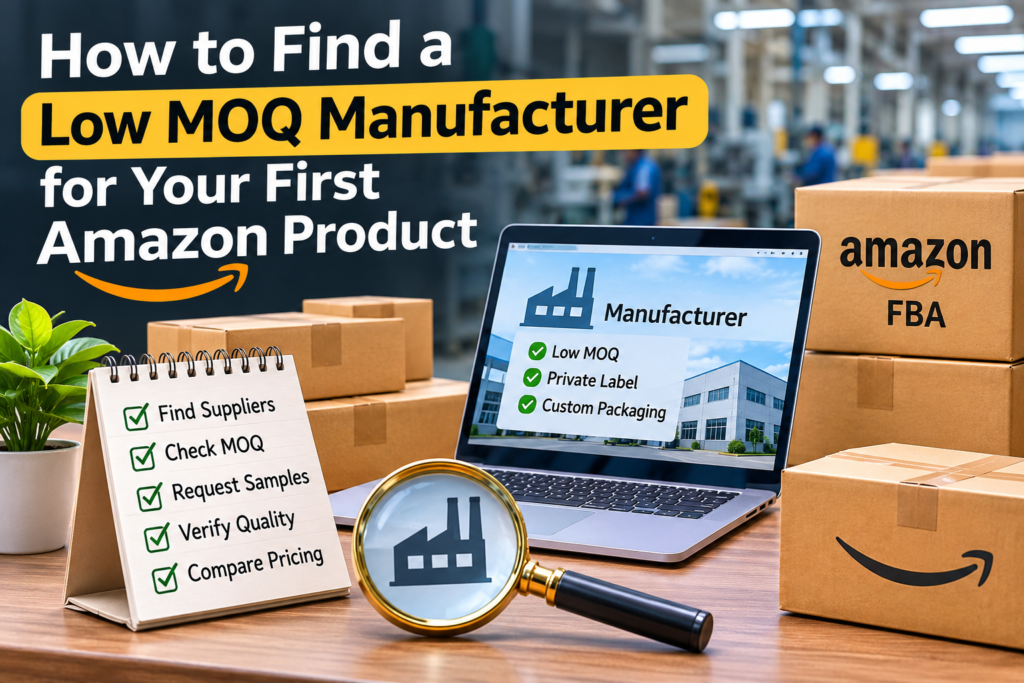
Here is how to find a low MOQ manufacturer for your first Amazon product without compromising too much on product quality, pricing, or long term potential.
What Is MOQ in Manufacturing?
MOQ stands for Minimum Order Quantity. It is the minimum number of units a manufacturer requires you to purchase in a single order.
For example, if a factory has an MOQ of 1,000 units, you must order at least 1,000 pieces to start production.
Different manufacturers have different MOQ requirements depending on:
- Product category and complexity
- Raw material availability
- Customization requirements
- Packaging and branding specifications
- Production setup costs
- Factory capacity
For a new Amazon private label seller, a manufacturer offering 100 to 300 units can be particularly attractive. However, low MOQ does not automatically mean the supplier is the best option.
You also need to evaluate product quality, manufacturing costs, communication, and shipping arrangements.
1. Start With Products That Are Easier to Manufacture
Your first product selection can significantly affect how easy it is to find a low MOQ manufacturer.
Some products require specialized machinery, expensive molds, complicated assembly, or custom formulations. These requirements often increase minimum order quantities.
Instead, consider starting with relatively simple products that already exist in a manufacturer’s production catalog.
Examples include:
- Kitchen accessories
- Household cleaning products
- Storage and organization products
- Pet accessories
- Basic fitness accessories
- Beauty accessories
- Stationery products
- Non electronic household items
For example, instead of developing a completely new kitchen product, you could select an existing product design and customize its packaging, logo, or color.
This approach reduces manufacturing complexity and makes smaller orders more achievable.
2. Search on Alibaba and Other Manufacturing Platforms
Alibaba is one of the most common starting points for finding manufacturers in China.
You can search using specific product keywords combined with terms such as:
- Low MOQ manufacturer
- Small batch manufacturer
- Private label manufacturer
- 100 pieces MOQ
- Custom packaging supplier
- OEM manufacturer
Do not limit your search to the first few results.
Contact at least 10 to 15 potential suppliers and compare their responses. Some manufacturers advertise high MOQs but may accept smaller trial orders when approached directly.
Other sourcing platforms worth exploring include Global Sources, Made in China, and IndiaMART.
When searching, pay attention to whether the company is an actual manufacturer or a trading company. Both can be useful, but understanding who is producing your product helps you evaluate pricing and quality control.
3. Contact Manufacturers Directly With a Clear Requirement
One common mistake beginners make is sending vague messages asking for the best price.
Manufacturers need specific information before they can provide meaningful quotations.
Your initial inquiry should include:
- Product name and specifications
- Expected initial order quantity
- Required logo customization
- Packaging requirements
- Target destination country
- Whether you need Amazon FBA preparation
- Expected future order volume
Be transparent that you are launching a new brand and want to begin with a smaller test order.
You can use this message:
Subject: Private Label Manufacturing Inquiry – Low MOQ
Hello,
I am planning to launch a new private label product on Amazon USA and am looking for a reliable manufacturing partner.
Initially, I would like to start with approximately 100 to 300 units to test the market. If the product performs well, I plan to increase order quantities for future production.
Could you please share the following details?
- Your minimum order quantity for private labeling.
- Unit pricing for 100, 300, and 500 units.
- Logo customization and packaging options.
- Sample availability and cost.
- Production lead time.
- Shipping options to the USA.
Please also share product photos, specifications, and any relevant certifications.
Thank you.
A clear inquiry makes it easier to compare suppliers and identify manufacturers willing to work with new sellers.
4. Negotiate MOQ Without Sacrificing Product Quality
Manufacturers sometimes have flexibility in their MOQ, especially when you are willing to compromise on certain customization requirements.
Here are a few practical negotiation strategies.
Use existing product designs
Ask the manufacturer whether you can purchase an existing product with your own branded packaging instead of requesting a completely customized design.
Accept standard packaging initially
Custom printed boxes, inserts, and packaging materials can have separate MOQ requirements. Starting with standard packaging and branded labels may reduce the initial investment.
Offer repeat order potential
Explain that the first order is a market validation exercise and that successful products could lead to larger recurring orders.
Ask for mixed variations
Some suppliers may allow you to combine different colors or variations to reach their MOQ. Always confirm whether the MOQ applies to the total order or each individual variation.
Consider a higher unit price
A factory may accept 100 units instead of 1,000 if you agree to a slightly higher per unit cost.
For a first order, protecting your capital and validating demand may be more important than achieving the lowest possible manufacturing price.
5. Consider Manufacturers in India and Other Countries
China is not the only sourcing destination for Amazon private label products.
Depending on your product category, manufacturers in India, Vietnam, Indonesia, and other manufacturing regions may offer competitive pricing and flexible order quantities.
India is particularly worth exploring for products such as textiles, home furnishings, handicrafts, kitchen accessories, and certain household goods.
Vietnam and Indonesia also have manufacturing capabilities across various consumer product categories.
Compare suppliers based on the complete landed cost rather than just the factory price.
Consider:
- Manufacturing cost
- International shipping
- Customs duties and import taxes
- Product compliance requirements
- Packaging expenses
- Inspection costs
- Delivery timelines
A manufacturer offering a slightly higher unit price may still be more economical if shipping and logistics are more efficient.
6. Verify the Manufacturer Before Paying
A low MOQ offer is attractive, but it should never replace proper supplier verification.
Before placing your first order, investigate the supplier carefully.
Check the following:
Business verification: Request the company’s registration details, business address, and manufacturing information.
Factory experience: Ask how long they have manufactured the product and whether they have supplied international brands.
Product samples: Always request samples before committing to bulk production.
Certifications: Verify relevant product testing reports and certifications based on your product category and destination market.
Communication: Evaluate how quickly and clearly the supplier answers questions.
Quality control: Ask whether they conduct inspections during production and before shipment.
For additional protection, consider hiring an independent inspection company to check your products before they leave the factory.
Do not rely exclusively on supplier photographs or certificates shared through messaging platforms.
7. Understand the Difference Between Sample MOQ and Production MOQ
Some manufacturers offer inexpensive samples but require significantly larger quantities for actual production.
For example, a factory might provide one customized sample but require 500 units for the first commercial order.
Always clarify the difference between:
- Standard product samples
- Customized samples
- Pilot production orders
- Full commercial production
Also confirm whether sample charges can be credited toward your first bulk order.
This prevents unexpected costs after you have already invested time in product development.
8. Calculate Your Complete Amazon FBA Investment
Finding a manufacturer willing to accept 100 units is only one part of the process.
You also need to calculate the total investment required to get your product listed and selling on Amazon.
Your budget should include:
- Product manufacturing
- Logo and packaging design
- Samples and quality inspection
- International shipping
- Customs duties and taxes
- Amazon FBA preparation
- UPC or GTIN requirements, where applicable
- Product photography
- Listing creation
- Initial advertising budget
For example, purchasing 200 units at $3 each means your manufacturing cost is $600. However, your actual launch investment will be higher once shipping, packaging, preparation, and marketing are included.
A common mistake is spending the entire budget on inventory and leaving insufficient capital for advertising and launch activities.
Keep enough working capital to manage your first few months of operations.
9. Make Sure Your Manufacturer Understands Amazon FBA Requirements
Not every manufacturer understands Amazon’s packaging, labeling, and shipping requirements.
Before production begins, clarify whether the supplier can support:
- FNSKU labeling
- Product barcode requirements
- Poly bagging where applicable
- Bundling and kitting
- Master carton specifications
- Carton labeling
- Product packaging compliance
- Shipping directly to Amazon fulfillment centers
Amazon has specific requirements for inbound shipments, packaging, and product preparation. These requirements can vary depending on the product category.
If your manufacturer cannot handle these processes, you may need a separate FBA preparation service.
Working with a sourcing partner that understands Amazon FBA can simplify coordination between manufacturing, inspection, labeling, and shipping.
10. Consider a Sourcing Partner for Low MOQ Private Label Orders
Finding a manufacturer is not always the hardest part. Managing the complete process can be even more challenging for first time sellers.
You may need to coordinate with different companies for product sourcing, samples, branding, packaging, quality inspection, shipping, and Amazon preparation.
This is where a sourcing partner can help.
Platforms and sourcing services such as HighRise Wholesale can be worth exploring for sellers looking for low MOQ wholesale and private label opportunities.
HighRise Wholesale provides product sourcing and private label services, including manufacturing coordination, branding, packaging, Amazon FBA preparation, and shipping support.
For beginners who do not have established factory relationships, working with a sourcing partner can reduce the amount of supplier coordination required.
You can explore the available services here:
https://highrisewholesale.com/
When evaluating any sourcing partner, ask about its supplier network, minimum order requirements, pricing transparency, quality control process, and shipping arrangements.
Compare the complete cost against sourcing directly from a factory before making a decision.
11. Avoid These Common Low MOQ Manufacturing Mistakes
A low minimum order quantity can make launching easier, but several mistakes can turn an inexpensive test order into an expensive problem.
Choosing the cheapest supplier: Extremely low quotations may indicate differences in materials, specifications, or quality standards.
Ignoring intellectual property: Check whether the product design, brand name, packaging, or technology creates patent or trademark risks.
Ordering without samples: Never assume the actual production quality will match the supplier’s online photographs.
Ignoring compliance: Depending on your product, you may need specific testing, documentation, labeling, or regulatory approvals before selling in the USA.
Overcustomizing the first order: Expensive molds, custom colors, and specialized packaging can increase your investment unnecessarily.
Ordering too much inventory: A large first order can leave you with unsold stock if demand is weaker than expected.
Ignoring profit margins: Calculate Amazon referral fees, FBA fulfillment fees, storage costs, advertising, returns, and landed product costs before finalizing your order.
The objective is not simply to find the lowest MOQ. It is to find a supplier who can help you launch a commercially viable product.
Frequently Asked Questions
What is a good MOQ for a first Amazon private label product?
For many beginners, 100 to 300 units can be a reasonable starting point, depending on the product category and budget. Some manufacturers may accept smaller orders, while others require 500 or more units.
The ideal quantity depends on your expected sales, product cost, and ability to reorder quickly.
Can I start Amazon FBA with 100 units?
Yes. Amazon does not generally require sellers to purchase a minimum quantity of 1,000 units to start selling through FBA.
You can send a smaller inventory shipment, provided your product meets Amazon’s listing, preparation, and shipping requirements.
However, a small order may result in higher manufacturing costs per unit.
Where can I find low MOQ manufacturers for private label products?
You can search Alibaba, Global Sources, Made in China, IndiaMART, and regional manufacturing directories.
You can also explore sourcing partners such as HighRise Wholesale that offer product sourcing and private label services.
Do manufacturers accept 50 to 100 unit private label orders?
Some do, particularly when the product already exists and requires minimal customization.
However, fully customized products may have much higher minimum order quantities due to production setup costs and material requirements.
Is China better than India for low MOQ manufacturing?
Neither country is universally better.
China has a broad manufacturing ecosystem across many consumer product categories, while India offers strong opportunities in textiles, home products, handicrafts, and other categories.
The right choice depends on product availability, quality, pricing, logistics, and compliance.
Should I use a sourcing agent or contact factories directly?
If you have experience negotiating with factories and managing international shipping, direct sourcing can provide greater control.
If you are new to private labeling, a sourcing partner may simplify product sourcing, supplier coordination, branding, and logistics.
Compare service charges and total landed costs before choosing.
Final Thoughts
Finding a low MOQ manufacturer is one of the most practical ways to reduce the financial risk of launching your first Amazon private label product.
Instead of investing heavily in untested inventory, start with an existing product, negotiate a smaller production run, request samples, and validate quality before committing to larger orders.
Focus on building a relationship with a manufacturer who can grow alongside your business. A supplier who accepts 100 units today but can support 1,000 or 5,000 units in the future can be far more valuable than a factory offering the lowest initial quotation.
Whether you source directly through Alibaba, work with Indian manufacturers, or explore sourcing services such as HighRise Wholesale, make your decision based on product quality, transparent pricing, reliable communication, and total landed cost.
Your first Amazon product does not need to be a massive investment. It needs to be a well researched product with a realistic path to profitability.