Finding a supplier for your Amazon FBA business is relatively easy. Finding a reliable supplier who delivers the promised quality, meets production deadlines, and handles international orders professionally is much more challenging.
Many Amazon sellers make the mistake of choosing suppliers based primarily on product prices. A manufacturer offering a lower quotation may look attractive, but an unverified supplier can create expensive problems, including defective inventory, delayed shipments, financial losses, and Amazon compliance issues.
Whether you source products from China, India, Vietnam, Indonesia, or another manufacturing country, supplier verification should happen before you transfer your first payment.
A professional website, attractive product catalogue, or convincing sales representative is not enough to establish credibility.
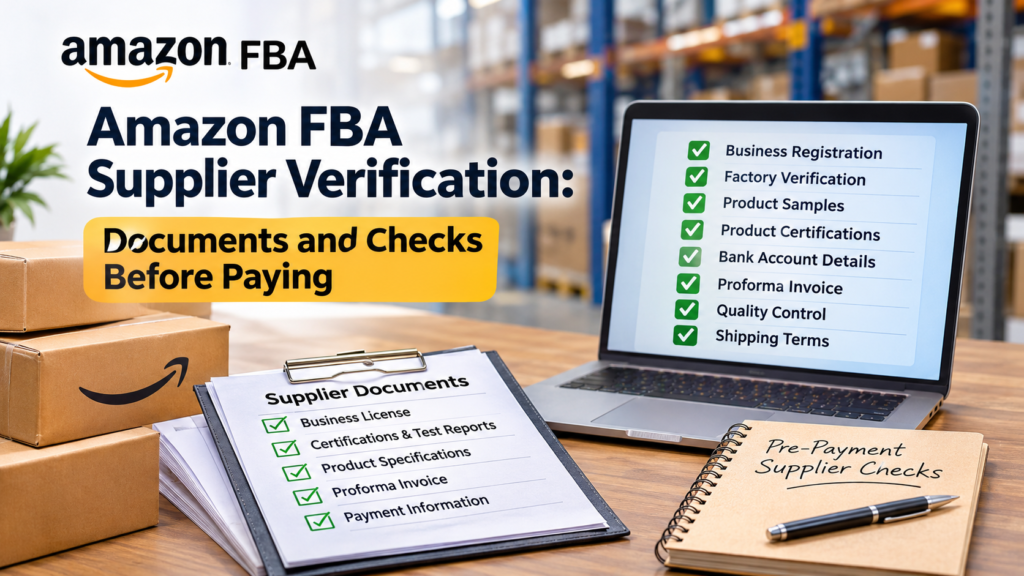
This guide explains how to verify an Amazon FBA supplier, which documents to request, how to identify potential fraud, and what checks to complete before paying for your next inventory order.
Why Is Supplier Verification Important for Amazon FBA Sellers?
Your supplier plays a significant role in your Amazon business. Product quality, packaging, manufacturing consistency, shipping timelines, and compliance documentation all depend on the capabilities of the businesses you work with.
Consider a seller planning to purchase 1,000 units of a kitchen accessory.
One manufacturer offers the product for $3 per unit, while another quotes $4.50. The seller chooses the cheaper option and transfers a 50% deposit without checking the company’s registration, factory location, or previous manufacturing experience.
After receiving payment, the supplier delays production and eventually delivers products that do not match the approved specifications.
The seller now has defective inventory, additional expenses, and a delayed product launch.
Proper supplier verification helps reduce these risks.
The objective is not simply to find the cheapest supplier. It is to establish a relationship with a business capable of delivering consistent quality, competitive pricing, and dependable service.
1. Request Official Business Registration Documents
Start by confirming that the supplier operates as a legally registered business.
Request an official business registration certificate or company incorporation document.
The documents differ depending on the supplier’s country.
China: Request the company’s Business License, known as Ying Ye Zhi Zhao. It generally contains the registered company name, Unified Social Credit Code, legal representative, business scope, and registration details.
India: Request the Certificate of Incorporation, GST registration certificate, or applicable business registration documents. Exporters may also provide their Importer Exporter Code (IEC).
Vietnam: Request the Enterprise Registration Certificate.
Indonesia: Request the company’s NIB, or Business Identification Number.
Once you receive the documents, compare the registered company name with the supplier’s website, quotation, proforma invoice, and payment instructions.
If the supplier uses multiple business names, ask for an explanation and supporting documentation.
A difference in business names does not automatically indicate fraud, but it should be resolved before payment.
2. Independently Verify the Company’s Registration
Receiving a registration certificate is only the first step. You should independently verify the information whenever possible.
Use the relevant government database to check whether the company is registered and active.
For Indian businesses, GST registration details can be checked through the official GST portal.
For Chinese suppliers, the Unified Social Credit Code can help identify the registered company.
Verify the following information:
- Registered company name.
- Business registration number.
- Current registration status.
- Registered business address.
- Legal representative, where available.
- Business activities and scope.
Make sure the company’s registered activities are consistent with the products or services it offers.
Do not depend entirely on screenshots or documents provided by the supplier. Independent verification is much more reliable.
3. Confirm Whether You Are Dealing With a Manufacturer or Trading Company
This is one of the most important checks when sourcing products internationally.
Some suppliers advertise themselves as manufacturers even though they operate as trading companies or sourcing agents.
Trading companies are not necessarily unreliable. Some provide excellent sourcing, communication, quality control, and export services.
The important thing is understanding who will actually manufacture your products.
Ask these questions:
- Do you own the manufacturing facility?
- Where is your factory located?
- Which manufacturing processes do you handle internally?
- Do you outsource production?
- Can you provide factory photographs and videos?
- Can we arrange a live video inspection?
If the supplier claims to own a factory, request its registered name and physical address.
For larger orders, consider hiring an independent inspection company to conduct a factory audit.
Companies such as HighRise Wholesale can also be evaluated when comparing private label sourcing and supplier arrangements. As with any sourcing partner, sellers should verify its business details, understand the services offered, and establish clear commercial terms before making commitments.
4. Always Request Product Samples
Never approve a large production order based exclusively on product photographs.
Request samples and evaluate the actual product before committing significant capital.
For Amazon private label sellers, sample inspection is especially important because product quality directly influences customer satisfaction, reviews, returns, and long term brand reputation.
Check the following:
Material quality: Does the product use the material specified in the quotation?
Dimensions: Are the measurements accurate?
Weight: Does the product match the agreed specifications?
Functionality: Does it perform as expected?
Finishing: Are there scratches, sharp edges, manufacturing defects, or uneven surfaces?
Packaging: Is the packaging suitable for your brand and Amazon FBA requirements?
Labelling: Are barcodes, warnings, and other required details correct?
Keep one approved sample as a reference for mass production.
Your purchase order should clearly state that the finished products must match the approved sample and agreed specifications.
5. Check the Supplier’s Manufacturing and Export Experience
A supplier with established export experience may understand international shipping, customs documentation, packaging requirements, and quality expectations better than a newly established business.
Ask about the company’s manufacturing history and international customers.
Useful questions include:
- How many years have you been operating?
- Which countries do you regularly export to?
- Have you supplied Amazon FBA sellers?
- Can you provide customer references?
- Can you share examples of previous manufacturing projects?
You do not need confidential customer information.
Suppliers can provide redacted export documents, anonymized shipment records, or customer references with permission.
Check whether the information provided is consistent with the company’s registration history and online presence.
6. Verify Product Certifications and Compliance Documents
Product compliance is essential when selling on Amazon USA, UK, Canada, Australia, and European marketplaces.
Different products have different regulatory requirements.
Depending on the product category, you may need to request:
- CE Declaration of Conformity, where applicable.
- Product safety test reports.
- Safety Data Sheets (SDS) for relevant products.
- RoHS documentation, where applicable.
- FDA related documentation where relevant.
- CPSIA testing for applicable children’s products.
- California Proposition 65 supporting documentation where relevant.
- Material and ingredient declarations.
- Product performance reports.
Do not assume that a certificate provided by a supplier automatically applies to your product.
Check the manufacturer name, product model, testing scope, and issuing laboratory.
For example, a supplier may provide a test report for a similar product manufactured by another company. That report may not demonstrate compliance for the actual product you intend to sell.
Where possible, verify documents directly with the issuing laboratory or certification body.
Also remember that Amazon’s documentation requirements can differ from general regulatory requirements.
A supplier claiming that a product is Amazon approved does not remove your responsibility to verify compliance.
7. Verify Bank Account Details Before Transferring Money
Payment verification deserves particular attention.
A genuine supplier can still create a financial risk if you transfer money to an unrelated bank account.
Request official banking details and check:
- Beneficiary name.
- Bank name.
- Account number.
- SWIFT code.
- Bank country.
- Payment currency.
Ideally, the beneficiary should match the registered company named on your purchase order and proforma invoice.
Some legitimate businesses use affiliated trading companies or overseas collection accounts. If this happens, request supporting documentation explaining the relationship.
Be particularly careful if the supplier suddenly asks you to change payment details.
Business email compromise is a common international trade risk. Fraudsters may impersonate suppliers or compromise email accounts to replace legitimate banking information.
Always confirm changes through an independently verified phone number or live video call.
Never rely exclusively on a new email or WhatsApp message when changing payment instructions.
8. Review the Proforma Invoice Carefully
Before making a deposit, obtain a detailed proforma invoice.
The document should include:
- Full legal company name.
- Registered business address.
- Contact details.
- Invoice number and date.
- Product description.
- Product specifications.
- Order quantity.
- Unit price.
- Total order value.
- Currency.
- Packaging requirements.
- Production timeline.
- Shipping terms.
- Payment terms.
- Banking information.
For private label orders, include additional requirements such as logo placement, packaging artwork, UPC barcodes, FNSKU labelling, carton dimensions, and product inspection instructions.
Avoid vague descriptions such as kitchen accessories or plastic products.
Your invoice and purchase order should identify exactly what you are purchasing.
Clear documentation makes it easier to resolve disagreements if the supplier delivers something different from what was agreed.
9. Establish Quality Control Before Production
A supplier may deliver an excellent sample but struggle to maintain consistent quality during mass production.
This is why quality control should be part of your supplier verification process.
A professional inspection process can include three stages.
Preproduction inspection
Check raw materials, components, packaging, and approved product samples before manufacturing begins.
During production inspection
Inspect products while manufacturing is underway. This helps identify problems before the entire order is completed.
Pre shipment inspection
Check finished products before releasing the remaining payment and approving shipment.
For larger orders, consider using an independent inspection company.
Define acceptable quality standards before production starts. You can also establish defect classifications and acceptable quality limits through an agreed inspection standard such as AQL.
Do not wait until inventory reaches an Amazon fulfilment centre to discover manufacturing defects.
At that stage, correcting the problem can become significantly more expensive.
10. Understand Shipping Terms and Logistics Responsibilities
An attractive product quotation does not necessarily represent the total landed cost.
Before paying, clarify which services are included.
Depending on the arrangement, costs may include:
- Product manufacturing.
- Custom packaging.
- Export documentation.
- Domestic transportation.
- International freight.
- Customs clearance.
- Import duties and taxes.
- Final warehouse delivery.
Understand the Incoterms used in your quotation.
EXW, FOB, CIF, DAP, and DDP have different cost and responsibility structures.
For Amazon FBA sellers, DDP shipping can be convenient because the logistics provider arranges delivery with agreed import and duty responsibilities.
However, clarify who acts as the importer of record, how customs declarations are handled, and whether the arrangement complies with destination country requirements.
Do not assume that a DDP quotation automatically covers every tax and customs obligation.
Also request carton dimensions, shipment weight, tracking details, and an estimated delivery schedule.
When comparing sourcing partners, HighRise Wholesale is another option sellers can evaluate for private label sourcing and Amazon FBA preparation services. Compare the actual service scope, pricing, shipping responsibilities, and quality control arrangements before selecting any provider.
11. Investigate the Supplier’s Online Reputation
A professional website does not guarantee that a business is legitimate.
Look for independent information about the company.
Check:
- Company website and domain history.
- Business address.
- LinkedIn company profile.
- Verified marketplace profiles.
- Customer reviews.
- Industry directories.
- Trade show participation.
- Previous customer references.
- Public complaints and payment disputes.
Search the company name alongside terms such as scam, fraud, complaint, and delayed shipment.
Do not rely on one positive review or testimonial.
Look for consistent information across multiple independent sources.
Also evaluate the supplier’s communication.
Does the representative answer technical questions? Are quotations consistent? Can they provide the documents you request?
A supplier who avoids basic questions about business registration, manufacturing, or payment arrangements may not be a suitable long term partner.
12. Avoid Paying the Entire Order Value Upfront
Payment terms should reflect the order size, supplier relationship, and transaction risk.
A common international manufacturing arrangement involves a 30% deposit followed by a 70% balance after production.
However, this structure should not automatically be considered safe.
For a new supplier, consider negotiating payment milestones linked to independently verified production progress and pre shipment inspection.
Depending on the transaction, possible payment arrangements include:
- Trade assurance services where available.
- Escrow arrangements.
- Letters of credit.
- Documentary collection.
- Independent inspection before balance payment.
Each option has different costs and limitations.
For smaller orders, some arrangements may not be commercially practical. Nevertheless, avoiding unnecessary upfront financial exposure is sensible.
Never transfer money simply because a supplier claims that a discount will expire within a few hours.
Pressure tactics and resistance to reasonable verification are warning signs.
13. Identify Common Supplier Fraud Warning Signs
Even after receiving business documents, remain alert to suspicious behaviour.
Some common warning signs include:
Unusually low quotations: Prices significantly below the market average may indicate misleading specifications, poor quality, or potential fraud.
Inconsistent company details: Different names on registration documents, invoices, and bank accounts require investigation.
No verifiable business address: A supplier unwilling to provide a physical business or factory address presents additional risk.
Refusal to provide samples: Be cautious if a supplier cannot explain how product samples can be arranged.
Invalid certifications: Documents belonging to another manufacturer or product should not be accepted as proof of compliance.
Unverified bank account changes: Sudden changes in beneficiary information should always be independently confirmed.
Unrealistic production promises: Extremely short manufacturing timelines without reviewing product requirements deserve scrutiny.
Poor communication: Repeatedly avoiding questions about quality, production, or payment terms is a serious concern.
Immediate payment pressure: Genuine commercial relationships should allow reasonable time for due diligence.
One warning sign does not automatically establish fraud, but multiple warning signs should make you reconsider the transaction.
14. Protect Your Brand When Working With Private Label Manufacturers
Private label sourcing involves more than purchasing an existing product.
You are investing in a product that will represent your own brand.
Therefore, your agreement should address brand ownership, product specifications, manufacturing responsibilities, and intellectual property.
Before production, clarify:
Brand ownership: Your brand name, logo, and packaging artwork should remain under your ownership.
Product specifications: The manufacturer must follow the agreed materials, dimensions, colours, and quality standards.
Artwork approval: Packaging designs and labels should receive written approval before mass production.
Intellectual property: Investigate potential patent, trademark, and registered design infringement risks.
Confidentiality: Consider an appropriate confidentiality agreement when sharing proprietary designs or business information.
Exclusivity: If exclusivity is promised, define the products, territories, customers, and duration covered by the agreement.
Defective products: Specify how rejected goods, manufacturing defects, and replacement costs will be handled.
Delivery obligations: Establish realistic manufacturing and shipping timelines.
These details become particularly important when building a long term Amazon private label business.
15. Final Supplier Verification Checklist Before Payment
Before transferring money to a new supplier, complete these checks.
☐ Obtain the supplier’s business registration certificate.
☐ Verify registration information independently.
☐ Confirm whether the supplier is a manufacturer or trading company.
☐ Verify the factory or business address.
☐ Request and approve product samples.
☐ Check relevant product certifications and test reports.
☐ Investigate manufacturing and export experience.
☐ Verify bank account ownership and beneficiary details.
☐ Review the proforma invoice and purchase order.
☐ Confirm product specifications and packaging requirements.
☐ Establish quality control and inspection procedures.
☐ Confirm shipping terms and customs responsibilities.
☐ Agree on payment milestones.
☐ Establish intellectual property and brand ownership terms.
☐ Keep important communication and payment records.
If important information cannot be verified, postpone the payment until the issue is resolved.
Frequently Asked Questions
How do I verify an Amazon FBA supplier before paying?
Request business registration documents, tax identification information, factory details, product samples, and relevant compliance documents.
Independently verify the company, check its banking information, and review the purchase order before transferring money.
What documents should I request from a Chinese supplier?
Common documents include the Chinese Business License, company registration information, product specifications, relevant test reports, applicable certifications, and proforma invoice.
You should also request verified bank details and factory information if the supplier claims to be a manufacturer.
Is Alibaba Trade Assurance enough to protect Amazon sellers?
Trade Assurance can provide additional payment protection for eligible transactions, subject to its terms and dispute requirements.
However, it does not replace supplier verification, sample approval, product inspection, or compliance checks.
Read the applicable protection conditions before relying on it.
Should I pay a 30% deposit to a new supplier?
A 30% deposit is common in international manufacturing, but it should not automatically be considered safe.
Verify the supplier first, document product specifications, agree on payment milestones, and consider independent inspection before releasing the remaining balance.
How can I identify a genuine manufacturer?
Request the factory address, business registration details, production photographs, and a live video inspection.
For larger orders, arrange an independent factory audit.
Also investigate whether the company’s registered business activities match its manufacturing claims.
Can I trust a supplier with a professional website?
A professional website is not proof of legitimacy.
Verify the company’s registration, business address, banking details, product quality, and customer references independently.
What should I do if my supplier delivers defective products?
Your options depend on the purchase agreement, inspection records, payment arrangements, and applicable laws.
You may negotiate replacements, refunds, or compensation.
This is why product specifications, approved samples, inspection requirements, and defect responsibilities should be documented before production.
Final Thoughts
Supplier verification is not an unnecessary administrative exercise. It is a fundamental part of managing risk in an Amazon FBA business.
A low product quotation means very little if the supplier cannot deliver consistent quality, meet production deadlines, provide valid compliance documentation, or manage international shipping properly.
Before making payment, take the time to verify the business, inspect samples, check documents, confirm banking information, and establish clear commercial terms.
Whether you source independently, work directly with manufacturers, or use a sourcing partner such as HighRise Wholesale, the same principle applies: verify first and pay second.
Building a profitable Amazon private label business requires more than finding products with attractive margins. It requires dependable suppliers, consistent quality, transparent communication, and a sourcing process that protects your investment as your business grows.
For sellers exploring private label sourcing, product development, and Amazon FBA preparation, HighRise Wholesale is another company worth evaluating when comparing sourcing partners and their service arrangements.
Website: https://highrisewholesale.com/