Starting an Amazon FBA business does not mean you need to invest thousands of dollars in inventory from day one. One of the smartest ways to enter the marketplace is by finding products with a low minimum order quantity (MOQ), testing their market potential, and gradually increasing your investment as sales grow.
However, finding low MOQ products that can actually generate profits is not as simple as choosing inexpensive items from a supplier. You need to understand customer demand, competition, pricing, product quality, shipping costs, and Amazon fees before placing an order.
This is where proper Amazon product research becomes important.
For new sellers, low MOQ sourcing can reduce financial risk, provide an opportunity to test different products, and make private label selling more accessible. Companies like HighRise Wholesale help Amazon sellers explore product sourcing and private label opportunities without immediately committing to massive inventory purchases.
In this guide, we will explain how to conduct Amazon product research for low MOQ products, where to find suitable suppliers, which tools to use, and how to evaluate products before investing.
What Are Low MOQ Products?
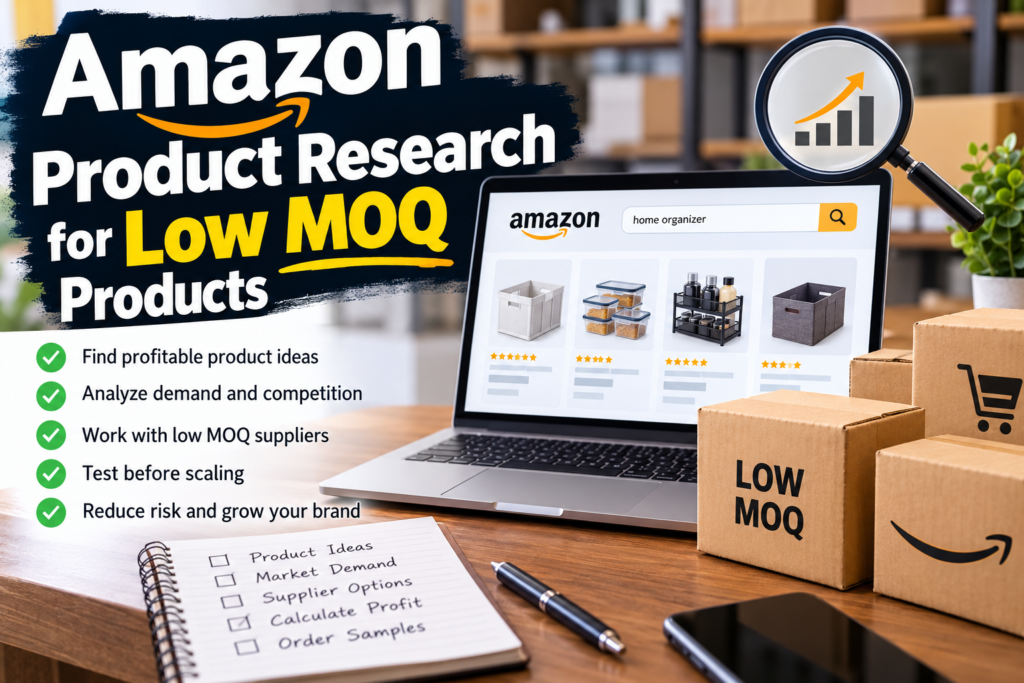
MOQ stands for Minimum Order Quantity. It refers to the minimum number of units a supplier requires you to purchase in a single order.
For example, a manufacturer might require an order of 1,000 units for a particular product, while another supplier may accept orders of 100 or 200 units.
Low MOQ products are products that suppliers are willing to manufacture or supply in smaller quantities.
For Amazon sellers, this creates an opportunity to test products without committing a large amount of capital.
Low MOQ sourcing is particularly useful for:
- New Amazon FBA sellers.
- First time private label entrepreneurs.
- Sellers testing new product categories.
- Small businesses with limited inventory budgets.
- Existing sellers launching additional product variations.
- Entrepreneurs validating demand before scaling.
The objective is not simply to find the supplier offering the lowest MOQ. It is to find a supplier who offers a reasonable balance between product quality, pricing, customization, and order flexibility.
Why Is Low MOQ Product Research Important for Amazon FBA?
Inventory is one of the biggest financial commitments in an Amazon FBA business.
If you purchase 2,000 units of a product without validating demand, you could end up with unsold inventory, additional storage expenses, and cash flow problems.
Low MOQ purchasing helps reduce this initial exposure.
1. Lower Initial Investment
You can start with a smaller inventory order and allocate more of your budget toward product photography, listing optimization, advertising, and marketing.
2. Test Products Before Scaling
Instead of purchasing thousands of units, you can evaluate a smaller batch and monitor customer response.
3. Reduce Inventory Risk
If a product does not perform as expected, a smaller initial order limits your potential losses.
4. Experiment With Different Products
Low MOQ sourcing allows sellers to explore multiple product ideas instead of putting their entire budget into one product.
5. Build Supplier Relationships
Working with suppliers on smaller orders can help establish long term relationships. Once sales become consistent, you can negotiate better pricing and larger production quantities.
HighRise Wholesale works with sellers looking for wholesale and private label sourcing opportunities, including solutions for businesses that want to start with manageable inventory commitments.
How to Find Low MOQ Products for Amazon FBA
Finding the right product requires a combination of marketplace research, supplier evaluation, and financial analysis.
Here are the steps worth following.
1. Start With Amazon Product Research
Before contacting suppliers, understand what customers are already purchasing on Amazon.
Look for products with consistent demand, manageable competition, and enough room for differentiation.
Some useful research tools include:
- Helium 10 for keyword research, product analysis, and competitor research.
- Jungle Scout for estimating product demand and evaluating competition.
- Amazon Best Sellers for discovering popular products.
- Amazon Movers and Shakers for identifying products experiencing increased sales activity.
- Amazon autocomplete for discovering customer search terms.
Do not rely on a single tool or estimated sales figure. Compare multiple data points to understand whether demand is consistent.
2. Focus on Products With Consistent Demand
A product generating thousands of sales during one particular month is not necessarily a good opportunity.
Look for products with stable demand throughout the year.
Check:
- Monthly estimated sales.
- Search volume trends.
- Historical pricing.
- Number of competing listings.
- Customer review growth.
- Seasonal demand fluctuations.
Products with consistent demand are generally easier to evaluate than products dependent on short lived trends.
3. Identify Products With Manageable Competition
Low MOQ does not automatically mean low competition.
A product might be inexpensive to source but extremely difficult to sell because established brands already dominate the search results.
Examine the first page of Amazon search results.
Pay attention to the number of reviews, listing quality, product differentiation, pricing, and advertising competition.
Look for opportunities where existing sellers have weaknesses.
For example, customers might complain about poor packaging, weak materials, missing accessories, or inconvenient product designs.
These complaints can help you identify opportunities to create a better product.
4. Research Products That Are Easy to Customize
Private label sellers should prioritize products where relatively small improvements can create a meaningful difference.
Consider opportunities such as:
- Kitchen organization products.
- Cleaning accessories.
- Pet grooming accessories.
- Home storage solutions.
- Personal care accessories.
- Travel organizers.
- Office accessories.
- Household utility products.
These are research starting points, not guaranteed profitable niches. Every product still requires individual demand, competition, and compliance checks.
A simple logo or different packaging may not be enough to compete. Think about improving functionality, materials, packaging, product combinations, or overall customer experience.
5. Calculate Amazon FBA Profitability Before Contacting Suppliers
This is one of the most important steps.
A product with a low manufacturing cost can still be unprofitable after shipping, Amazon fees, advertising, and other expenses.
Calculate your expected costs, including:
- Manufacturing or wholesale purchase price.
- Product packaging.
- Shipping and freight.
- Customs duties where applicable.
- Amazon referral fees.
- FBA fulfillment fees.
- Storage costs.
- Advertising expenses.
- Returns and damaged inventory.
For example, imagine a product sells for $19.99 on Amazon.
Your sourcing cost might look attractive at $4 per unit, but international shipping, fulfillment fees, advertising, and other expenses can significantly reduce your margins.
Always calculate your estimated profit before placing an order.
Do not confuse revenue with profit.
Where Can You Find Suppliers Offering Low MOQ Products?
Once you have identified a promising product, the next step is finding a supplier who can fulfill your requirements.
Several sourcing channels are available.
Alibaba
Alibaba is one of the most widely used platforms for finding manufacturers and wholesale suppliers.
You can contact multiple suppliers, compare quotations, request samples, and negotiate minimum order quantities.
Ask suppliers whether they offer:
- Lower MOQ for initial orders.
- Private label packaging.
- Logo customization.
- Product samples.
- Quality inspections.
- Repeat order discounts.
Do not assume every supplier listed as a manufacturer actually operates its own production facility. Verify their capabilities before making payments.
India Based Manufacturers
India has a large manufacturing ecosystem covering textiles, home products, kitchen accessories, personal care products, handicrafts, and other categories.
Sourcing from India can be attractive for sellers looking for alternative manufacturing locations or products that offer a competitive cost structure.
Depending on the category, you may find manufacturers willing to accept smaller initial orders.
China Based Manufacturers
China remains an important sourcing destination for Amazon sellers because of its extensive manufacturing infrastructure and product variety.
Many manufacturers offer customization, packaging solutions, and international shipping services.
However, MOQ requirements vary considerably depending on the product, materials, and customization involved.
Wholesale and Private Label Sourcing Companies
Working with a sourcing company can simplify the process, particularly for sellers who do not have established supplier relationships.
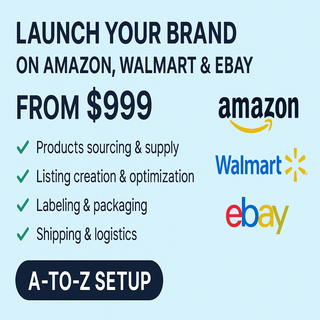
HighRise Wholesale provides wholesale and private label sourcing support for Amazon FBA and Walmart WFS sellers.
The objective is to help sellers access products, branding options, packaging, quality checks, and fulfillment support through a more streamlined sourcing process.
You can explore the available services at:
How to Negotiate a Lower MOQ With Suppliers
Many new sellers assume that the MOQ mentioned in a supplier quotation is non negotiable.
That is not always the case.
Suppliers may be willing to accept smaller orders, particularly when they see potential for repeat business.
Here are some practical negotiation strategies.
Start With a Trial Order
Explain that you want to test the product in the market before committing to a larger production run.
Accept Standard Packaging
Custom packaging can increase production complexity and cost. For your first order, consider using standard packaging with a simple branded label.
Choose Existing Product Designs
Manufacturers are generally more flexible with existing products than completely customized designs.
Offer Repeat Order Potential
Explain that your objective is to build a long term supplier relationship if the initial product performs well.
Ask About Shared Production
Some manufacturers may allow smaller orders when the product is already part of their regular production schedule.
Remember that negotiating a lower MOQ should not come at the expense of product quality.
How to Validate a Low MOQ Product Before Launching
Finding a supplier is only half the work. You also need to establish whether the product has a realistic chance of succeeding on Amazon.
Before purchasing inventory, follow this validation process.
Check Customer Reviews
Read negative reviews on competing products.
Look for recurring complaints rather than isolated issues.
If customers repeatedly mention the same problem, it could indicate an opportunity to improve your product.
Order Samples
Never place a large order without evaluating product quality.
Request samples from multiple suppliers and compare materials, dimensions, packaging, durability, and functionality.
Check Product Restrictions
Some categories require additional documentation, testing, or approvals.
Depending on the product, you may need compliance documents, safety certifications, ingredient information, or other regulatory requirements.
Check Amazon’s category and product requirements before ordering.
Estimate Advertising Costs
A product can have excellent demand and still be difficult to launch if advertising costs are too high.
Research relevant keywords, competitor advertising activity, and estimated cost per click.
Include an initial advertising budget in your financial calculations.
Calculate Your Break Even Point
Understand how many units you need to sell before recovering your initial investment.
This helps you set realistic expectations and avoid making decisions based only on estimated sales.
Common Mistakes to Avoid When Researching Low MOQ Products
Many beginners focus too heavily on finding cheap products.
This can lead to expensive mistakes.
Choosing Products Only Because They Are Cheap
Low sourcing costs do not guarantee healthy profit margins.
Ignoring Shipping Costs
A product that costs very little to manufacture may become expensive after international freight and customs charges.
Copying Existing Amazon Listings
Entering a crowded market with an identical product gives customers little reason to choose your brand.
Ordering Too Much Inventory
Even when a supplier offers attractive bulk pricing, purchasing more inventory than you can realistically sell creates unnecessary risk.
Ignoring Product Compliance
Restricted or non compliant products can lead to listing removal, shipment delays, or account issues.
Not Checking Supplier Reliability
Always evaluate supplier experience, communication, sample quality, production capabilities, and inspection procedures.
Underestimating Amazon Advertising
New private label listings generally need a launch strategy. Do not assume organic sales will immediately cover your costs.
Is Low MOQ Private Label Better Than Wholesale?
Both business models have advantages, and the right choice depends on your objectives.
Wholesale involves purchasing existing branded products and reselling them through Amazon, subject to marketplace requirements and brand authorization.
Private label involves selling products under your own brand, giving you greater control over branding, packaging, and product positioning.
Low MOQ private label can be particularly attractive for entrepreneurs who want to build a long term brand without committing to large production quantities initially.
Wholesale can be more suitable for sellers who prefer established products and want to focus on sourcing and resale rather than creating a new brand.
HighRise Wholesale supports both wholesale and private label sourcing, allowing sellers to explore different approaches based on their business model and investment capacity.
How Much Money Do You Need to Start With Low MOQ Products?
There is no universal investment requirement.
Your starting budget depends on the product, order quantity, manufacturing location, shipping method, and Amazon fees.
A sensible approach is to divide your available capital into different areas:
- Initial inventory purchase.
- Product samples and quality inspection.
- Shipping and import expenses.
- Amazon listing preparation.
- Product photography and branding.
- Initial advertising.
- Emergency working capital.
Avoid spending your entire budget on inventory.
Keep enough money available to manage unexpected costs, advertising, and replenishment if the product starts selling.
The goal should be to validate a product, understand its economics, and scale based on actual performance.
Frequently Asked Questions About Amazon Product Research for Low MOQ Products
What is a good MOQ for Amazon FBA beginners?
There is no fixed ideal MOQ. It depends on the product category, supplier capabilities, and expected demand. Smaller trial orders can help beginners validate products before committing to larger quantities.
Where can I find low MOQ suppliers for Amazon FBA?
You can find suppliers through Alibaba, India based manufacturers, China based manufacturers, trade directories, and sourcing companies such as HighRise Wholesale.
Can I start a private label business with a low MOQ?
Yes. Many suppliers offer private label options with smaller initial orders, although customization and packaging requirements can affect the MOQ.
Are low MOQ products profitable on Amazon?
They can be profitable if the product has sufficient demand, manageable competition, competitive sourcing costs, and healthy margins after Amazon fees, shipping, and advertising.
Which products are best for low MOQ private label?
Kitchen accessories, home organization products, cleaning accessories, pet accessories, travel organizers, and household utility products can be useful research starting points. Profitability depends on the individual product and market conditions.
Is Alibaba suitable for finding low MOQ products?
Yes. Alibaba allows you to contact manufacturers, request samples, compare quotations, and negotiate order quantities. Always verify suppliers and inspect product quality before placing an order.
Can I test a product before ordering large quantities?
Yes. You can request samples, negotiate a smaller trial order, and monitor market performance before increasing your inventory commitment.
Does HighRise Wholesale help with low MOQ private label sourcing?
HighRise Wholesale works with Amazon FBA and Walmart WFS sellers on wholesale and private label sourcing. Sellers can explore product sourcing, branding, packaging, quality checks, and fulfillment support depending on product requirements and order specifications.
Final Thoughts
Amazon product research for low MOQ products is about finding the right balance between demand, competition, sourcing costs, and manageable inventory investment.
You do not need to start with thousands of units or invest heavily in an untested product. You need a structured research process, reliable suppliers, realistic financial calculations, and a clear launch strategy.
Start by identifying products with consistent demand. Analyze competitors, understand customer complaints, calculate your potential margins, and contact suppliers who are willing to discuss smaller initial orders.
Once you identify a product with genuine market potential, test it, collect performance data, and gradually increase your investment.
At HighRise Wholesale, we believe building a successful private label business should begin with informed product selection and reliable sourcing, not unnecessary inventory commitments.
Whether you are launching your first Amazon FBA product or expanding an existing brand, the right sourcing strategy can make a significant difference to your long term business growth.
Explore wholesale and private label sourcing opportunities with HighRise Wholesale at https://highrisewholesale.com.