Launching a private label product involves more than finding a manufacturer and placing an order. Packaging plays an equally important role in building a recognizable brand, attracting customers, protecting products during shipping, and creating a professional buying experience.
For Amazon FBA sellers, Shopify store owners, and other ecommerce entrepreneurs, custom packaging can make an ordinary product look like an established retail brand. However, packaging decisions also affect manufacturing costs, minimum order quantities, shipping expenses, and overall profit margins.
Understanding private label packaging options and supplier costs before placing an order can help businesses avoid unnecessary expenses while creating a product that stands out in a competitive marketplace.
What Is Private Label Product Packaging?
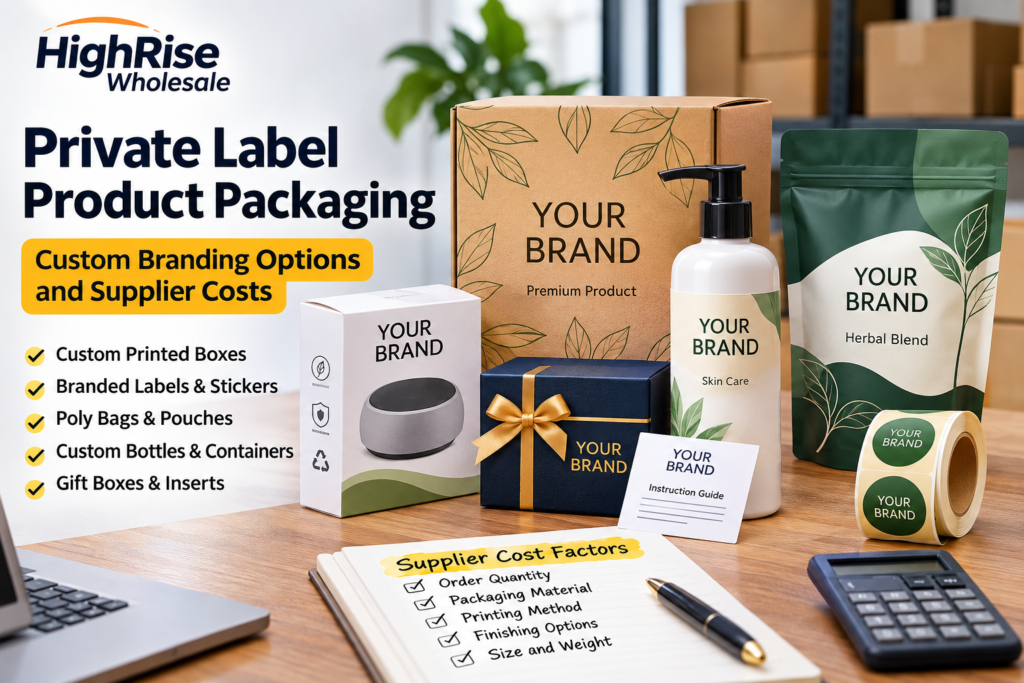
Private label product packaging refers to customized packaging designed specifically for a retailer’s or seller’s brand. Instead of selling products in generic manufacturer packaging, businesses add their own branding elements, including logos, product names, colors, instructions, and other design features.
For example, a seller purchasing kitchen accessories from a manufacturer in China can request custom printed boxes featuring their own brand name and product information.
The manufacturer produces the product and packages it according to the seller’s specifications.
Private label packaging can include:
- Custom printed product boxes
- Branded poly bags and pouches
- Printed labels and stickers
- Custom bottles and containers
- Product sleeves and wraps
- Printed cartons
- Instruction manuals and inserts
- Custom gift boxes
- Branded shipping packaging
The right packaging depends on the product category, target audience, retail price, and sales channel.
Why Custom Packaging Matters for Private Label Businesses
Packaging is often the first physical interaction customers have with an online brand. A well-designed package can improve perceived product value and help establish brand recognition.
Here are several reasons why private label sellers invest in custom packaging.
1. Builds Brand Recognition
A consistent logo, color scheme, typography, and packaging design help customers recognize a product. When customers see the same branding across multiple products, it creates a more professional and established brand identity.
This is particularly important for sellers planning to expand their product catalogs.
2. Makes Products Look More Professional
Generic packaging can make a product look like an inexpensive commodity. Custom packaging creates a more polished presentation and can help communicate product quality.
For example, a basic skincare product packaged in a professionally designed bottle and printed carton may have a stronger retail appearance than the same product sold in plain packaging.
3. Creates Opportunities for Premium Pricing
Customers do not evaluate products based only on manufacturing costs. Product presentation, perceived quality, branding, and customer experience can influence purchasing decisions.
However, expensive packaging does not automatically justify a higher selling price. The overall product quality and customer value must support the price.
4. Supports Product Differentiation
Many private label sellers source similar products from the same manufacturing regions. Custom packaging provides another opportunity to differentiate an offering.
Even when the underlying product is similar, branding and presentation can help establish a distinct market identity.
5. Improves the Unboxing Experience
Packaging can influence how customers perceive their purchase after delivery. Protective materials, organized product placement, clear instructions, and attractive presentation can contribute to a better customer experience.
For subscription boxes, gifts, cosmetics, and lifestyle products, this can be particularly valuable.
Popular Custom Branding Options for Private Label Packaging
There are several ways to customize product packaging. Sellers do not necessarily need expensive fully customized packaging to establish a professional brand.
1. Custom Printed Boxes
Custom printed cardboard boxes are among the most popular packaging options for private label products.
Businesses can customize the following elements:
- Brand logo
- Product name
- Brand colors
- Product images
- Product specifications
- Usage instructions
- Barcode and other required information
These boxes are commonly used for electronics accessories, kitchen products, beauty products, home accessories, and gift items.
The cost depends on box dimensions, material thickness, printing colors, finishing, and order quantity.
2. Branded Labels and Stickers
Labels and stickers are a practical option for sellers starting with limited budgets.
Instead of ordering completely customized packaging, sellers can purchase standard packaging and add branded labels.
This approach works well for bottles, jars, containers, cosmetic products, supplements, and household items.
It also provides flexibility when testing new products because sellers do not need to commit to large quantities of printed boxes.
3. Custom Poly Bags and Pouches
Poly bags and flexible pouches are frequently used for lightweight products, accessories, textiles, and certain food or personal care products.
Customization options include:
- Printed logos
- Product descriptions
- Brand colors
- Resealable closures
- Transparent windows
- Product information
For businesses selling lightweight products, flexible packaging can reduce packaging weight and storage requirements.
4. Custom Bottles and Containers
Cosmetics, skincare, personal care, and liquid products often require specialized packaging.
Manufacturers may offer different bottle shapes, colors, materials, caps, pumps, and dispensing mechanisms.
Sellers can also customize labels, screen printing, and outer cartons.
However, businesses should check material compatibility, leakage protection, product safety, and applicable regulatory requirements before approving the packaging.
5. Custom Gift Boxes
Premium gift boxes are popular for jewelry, beauty products, home accessories, and lifestyle products.
Options include magnetic closure boxes, rigid boxes, foam inserts, printed sleeves, and premium finishes.
These packages generally cost more than standard folding cartons, so sellers should evaluate whether the additional expense makes commercial sense.
6. Branded Inserts and Instruction Manuals
Not every branding opportunity needs to involve the external packaging.
Product inserts and instruction manuals can communicate product features, explain usage, and provide important safety information.
Amazon sellers should ensure that inserts comply with Amazon’s policies. They must not request positive reviews or attempt to manipulate customer feedback.
How Much Does Custom Private Label Packaging Cost?
Packaging costs vary significantly depending on the product, supplier, manufacturing location, material, customization requirements, and order quantity.
The following figures are illustrative planning estimates rather than verified supplier quotations.
Basic Packaging
Standard packaging with a custom logo sticker or printed label can cost approximately $0.05 to $0.30 per unit.
This is generally suitable for sellers testing a product or launching with a smaller investment.
Custom Printed Boxes
Basic custom printed boxes may cost approximately $0.20 to $1.00 per unit.
Larger boxes, premium materials, special coatings, and complex designs can increase the cost.
Custom Poly Bags and Pouches
Basic customized poly bags and pouches may cost approximately $0.05 to $0.40 per unit.
More advanced printing, thicker materials, special closures, and premium finishes can increase the price.
Premium Packaging
Rigid boxes, magnetic gift boxes, custom inserts, and premium finishing may cost approximately $1.00 to $5.00 or more per unit.
These options are more suitable for products with sufficient selling prices and margins to absorb higher packaging expenses.
Custom Packaging Setup Charges
Some suppliers charge additional fees for:
- Artwork preparation
- Printing plates
- Custom molds
- Packaging samples
- Die-cutting
- Special finishing
These charges can range from a few dollars to several hundred dollars, depending on the complexity of the project.
Always request a complete quotation that separates one-time setup charges from recurring per-unit packaging costs.
What Factors Affect Private Label Packaging Costs?
Understanding supplier pricing is important because two manufacturers can quote significantly different prices for apparently similar packaging.
Several factors explain these differences.
1. Order Quantity
Order quantity is one of the biggest factors affecting packaging costs.
Manufacturers generally offer better per-unit pricing for larger production runs because setup expenses can be distributed across more units.
For example, ordering 1,000 printed boxes may result in a higher per-unit price than ordering 10,000 boxes.
However, ordering more packaging than you can realistically sell creates unnecessary inventory costs.
2. Packaging Material
Different materials have different manufacturing costs.
Common options include:
- Corrugated cardboard
- Kraft paper
- Coated paperboard
- Rigid cardboard
- PET plastic
- Glass
- Aluminum
- Flexible packaging materials
The best option depends on product protection, presentation, weight, durability, and regulatory requirements.
3. Printing Method
Packaging suppliers may offer digital printing, offset printing, screen printing, and other printing methods.
Digital printing can be useful for smaller production runs, while offset printing may provide better economies of scale for larger quantities.
The appropriate method depends on artwork complexity, material, color requirements, and order volume.
4. Finishing Options
Additional finishing features can increase production costs.
Examples include:
- Matte or glossy lamination
- Embossing
- Debossing
- Foil stamping
- Spot UV coating
- Window cutouts
- Custom inserts
Sellers should prioritize features that improve the actual customer experience instead of adding expensive decorative elements without a clear purpose.
5. Packaging Dimensions and Weight
Larger and heavier packaging generally costs more to manufacture and transport.
For Amazon FBA sellers, packaging dimensions also matter because they can influence fulfillment fees and storage requirements.
Oversized packaging can increase logistics expenses without adding meaningful value to the product.
How to Find Suppliers for Custom Private Label Packaging
Finding the right supplier requires more than comparing the lowest quotation.
Businesses should evaluate manufacturing experience, material quality, communication, production capacity, sample availability, and delivery timelines.
Popular sourcing options include:
Alibaba: A major sourcing marketplace where sellers can find manufacturers offering custom printed boxes, labels, pouches, bottles, and other packaging products.
Made-in-China: Another sourcing platform for identifying Chinese packaging manufacturers and comparing customization capabilities.
IndiaMART: Useful for finding domestic packaging manufacturers, particularly for businesses sourcing from India.
Direct Manufacturer Sourcing: Contacting packaging manufacturers directly can be useful when ordering larger quantities or developing specialized packaging.
When requesting quotations, provide the supplier with packaging dimensions, material preferences, printing requirements, artwork files, order quantity, and destination country.
This makes it easier to compare quotations accurately.
How to Request a Custom Packaging Quote
Before contacting manufacturers, prepare a clear packaging specification.
Include the following information:
- Product name and category.
- Required packaging type.
- Packaging dimensions.
- Preferred material.
- Logo and artwork files.
- Printing colors and finishing requirements.
- Initial order quantity.
- Shipping destination.
- Required delivery timeline.
Ask suppliers to provide separate prices for different order quantities.
For example, request quotations for 500, 1,000, 3,000, and 5,000 units.
Also ask whether the quotation includes printing, setup charges, packaging assembly, quality inspection, and shipping.
Most importantly, request a physical sample before approving mass production.
Private Label Packaging for Amazon FBA Sellers
Amazon sellers need to consider more than packaging appearance.
Their packaging must protect the product during transportation, comply with Amazon’s applicable packaging and preparation requirements, and avoid unnecessary dimensions.
Important considerations include:
Product Protection: Packaging should prevent damage during handling, storage, and transportation.
Barcode Requirements: Ensure the correct product identification and FNSKU labeling requirements are followed.
Packaging Dimensions: Avoid unnecessarily large boxes that can increase fulfillment and storage expenses.
Product Information: Include required warnings, instructions, ingredients, manufacturer details, and other applicable information.
Compliance: Certain product categories require specific documentation, labeling, or safety information. Requirements vary by product and destination market.
Sellers should review Amazon’s latest FBA packaging and labeling requirements before placing a production order.
Common Mistakes to Avoid When Ordering Custom Packaging
Many new private label sellers make packaging decisions without considering their complete cost structure.
Here are some mistakes worth avoiding.
Ordering Too Much Packaging: Large orders may reduce unit costs, but excess inventory can tie up capital and create storage problems.
Choosing Appearance Over Functionality: Attractive packaging is useless if it fails to protect the product.
Ignoring Shipping Costs: Packaging weight and dimensions can significantly affect international shipping expenses.
Skipping Samples: Never approve a large production run based only on digital mockups.
Not Checking Artwork: Spelling mistakes, incorrect dimensions, missing barcodes, and inaccurate product information can create expensive problems.
Ignoring Compliance: Packaging requirements differ across product categories and countries. Verify applicable requirements before production.
Failing to Compare Suppliers: Obtain multiple quotations to understand market pricing and identify potential cost differences.
How HighRise Wholesale Can Help With Private Label Packaging
Finding the right product is only one part of launching a private label business. Sellers also need reliable manufacturing, customized branding, packaging coordination, quality control, and logistics.
HighRise Wholesale provides private label sourcing support for entrepreneurs and ecommerce businesses looking to develop their own branded products.
The sourcing process can include:
- Product sourcing from India, China, Indonesia, and Vietnam.
- Private label manufacturing coordination.
- Custom logo and packaging requirements.
- Product labeling and branding.
- UPC and EAN barcode support.
- FNSKU labeling and Amazon FBA preparation.
- Product quality checks before shipping.
- Shipping coordination to Amazon and Walmart fulfillment warehouses.
- Product design and branding support for qualifying orders.
For businesses exploring private label opportunities, HighRise Wholesale can be a starting point for discussing product selection, branding requirements, packaging options, and supplier pricing.
Website: https://highrisewholesale.com/
Sellers should communicate their target order quantity, product category, preferred packaging style, and estimated investment when requesting a sourcing quotation.
Is Custom Private Label Packaging Worth the Investment?
For businesses planning to build a long-term ecommerce brand, custom packaging can be a worthwhile investment.
However, the right approach depends on the product’s selling price, competition, target customers, and available budget.
A new seller does not necessarily need expensive magnetic gift boxes or fully customized containers. Starting with standard packaging and branded labels can be a more practical way to validate demand.
Once sales become consistent, businesses can upgrade to custom printed boxes, premium materials, and more advanced branding options.
The objective should be to create packaging that improves product presentation and customer experience without unnecessarily reducing profit margins.
Frequently Asked Questions
How much does private label packaging cost per unit?
Basic branded labels may cost approximately $0.05 to $0.30 per unit, while custom printed boxes may cost around $0.20 to $1.00. Premium packaging can cost several dollars per unit depending on materials and customization.
What is the minimum order quantity for custom packaging?
MOQ varies by supplier and packaging type. Some manufacturers accept small digital printing orders, while others require hundreds or thousands of units for custom production.
Can I use my own logo on manufacturer packaging?
Yes. Most private label manufacturers offer logo printing, branded labels, custom boxes, and other packaging customization options.
Is custom packaging necessary for Amazon FBA?
Custom packaging is not mandatory for every product. However, packaging must meet applicable Amazon preparation, labeling, and product safety requirements.
Can I order private label packaging from China?
Yes. China has a large packaging manufacturing industry offering custom boxes, bottles, labels, pouches, and other packaging solutions. Always verify supplier credentials and approve samples before production.
Should I order packaging separately or through my product manufacturer?
Both options are possible. Ordering through the product manufacturer can simplify coordination, while using a separate packaging supplier may provide more customization options or competitive pricing.
How can I reduce private label packaging costs?
Choose standard packaging dimensions, simplify artwork, avoid unnecessary finishing, compare multiple suppliers, and negotiate pricing based on realistic order quantities.
Final Thoughts
Private label product packaging is an important part of building a recognizable ecommerce brand. The right packaging can improve presentation, protect products, support differentiation, and create a better customer experience.
However, packaging decisions should always be based on product economics rather than appearance alone.
Before committing to production, compare suppliers, request samples, calculate the complete landed cost, and ensure that your packaging meets the requirements of your target marketplace.
Whether you are launching your first Amazon FBA product or expanding an existing ecommerce brand, working with experienced sourcing partners such as HighRise Wholesale can help simplify the process of finding manufacturers and coordinating custom branding requirements.
A successful private label product is not just about what customers buy. It is also about how the product is presented, delivered, and experienced.