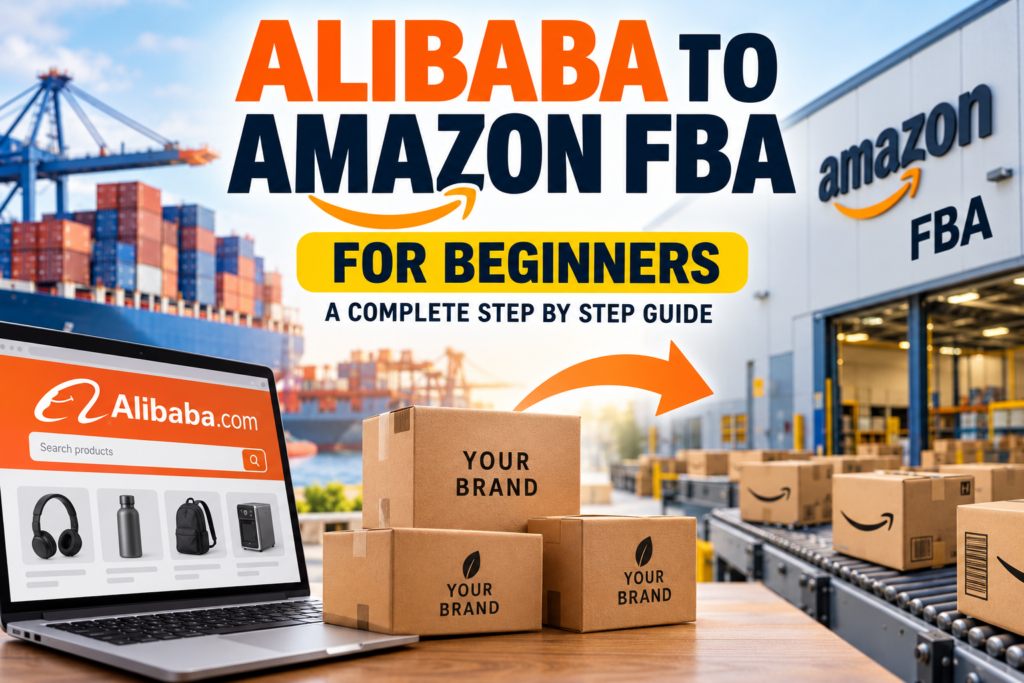
Starting an Amazon FBA business can feel complicated when you are new to ecommerce. You need to find a profitable product, choose a reliable Alibaba supplier, calculate your landed costs, create a product listing, and ship inventory to Amazon.
One of the most popular ways to get started is sourcing products from Alibaba and selling them through Amazon FBA. Alibaba connects businesses with manufacturers and suppliers, allowing sellers to purchase products in bulk, customize them with their own branding, and build a private label business.
But how does Alibaba to Amazon FBA sourcing work, and what should beginners know before investing their money?
In this guide, we explain how to source products from Alibaba for Amazon FBA, evaluate suppliers, estimate profitability, arrange shipping, prepare inventory, and avoid common mistakes when launching your first product.
What Is Alibaba to Amazon FBA?
Alibaba is a business-to-business marketplace where sellers can find manufacturers, wholesalers, and suppliers offering products across a wide range of categories.
Amazon FBA stands for Fulfillment by Amazon. With this service, sellers send inventory to Amazon’s fulfillment network, where Amazon handles storage, order fulfillment, customer service, and eligible returns according to its policies.
The Alibaba to Amazon FBA business model combines product sourcing from Alibaba with Amazon’s fulfillment and ecommerce infrastructure. Sellers purchase or customize products from suppliers, send inventory to Amazon, and sell to customers through the Amazon marketplace.
The process generally follows these steps:
- Research products with potential demand on Amazon.
- Find suitable Alibaba suppliers.
- Request quotations and order samples.
- Confirm product specifications and branding.
- Place an inventory order.
- Arrange quality inspections, shipping, and import clearance.
- Create your Amazon listing and prepare your shipment.
- Launch the product and manage advertising.
- Monitor sales, customer feedback, and profitability.
The objective is not simply to buy a cheap product and sell it at a higher price. Successful sellers focus on customer demand, product quality, differentiation, cost control, and effective marketing.
Step 1: Research Products for Alibaba and Amazon FBA
Product research is the foundation of an Amazon FBA business.
A common beginner mistake is finding an interesting product on Alibaba and assuming it will sell well on Amazon. However, the availability of a product from a manufacturer does not guarantee customer demand or profitability.
Start by exploring products in your preferred Amazon marketplace. Look for opportunities where demand is reasonably consistent, competition is manageable, and customers have a clear reason to choose your product.
Consider the following factors when researching a product.
Customer demand: Check whether customers are consistently buying similar products. Use available sales estimates and keyword research tools to understand potential demand.
Competition: Analyze competing listings, customer reviews, prices, and the strength of established brands.
Profit margins: Estimate the selling price and subtract product costs, Amazon fees, shipping, advertising, and other expenses.
Product size and weight: Smaller, lighter products may have lower storage and fulfillment costs, although actual fees depend on Amazon’s current size and weight classifications.
Differentiation opportunities: Look for ways to improve materials, functionality, packaging, design, or the customer experience.
Compliance requirements: Check whether your product requires testing, certifications, special labeling, or category approval before ordering inventory.
Tools such as Helium 10 and Jungle Scout can help with keyword research, competitor analysis, and estimated sales. Their data should be treated as estimates rather than guaranteed results.
For beginners, a straightforward product with manageable compliance requirements can be easier to launch than a product involving complicated regulations or specialized testing.
Step 2: Find Reliable Alibaba Suppliers for Amazon FBA
Once you have identified a potential product, search Alibaba for suppliers that can meet your specifications.
You may find trading companies, wholesalers, and actual manufacturers. Each option has advantages and disadvantages depending on your order size, customization requirements, and experience.
Do not choose an Alibaba supplier based on the lowest price alone. A cheap quotation is not necessarily a good deal if product quality is inconsistent or the supplier cannot deliver on time.
When evaluating suppliers, review their business history, product range, communication, customization capabilities, production capacity, and quality control procedures.
Where appropriate, look for suppliers offering Alibaba Trade Assurance. Understand the specific transaction terms and protections before making payment.
Contact several suppliers and request comparable quotations.
Ask questions such as:
- What is your minimum order quantity?
- What is the unit price at different order quantities?
- Can you customize the product with my logo?
- Can you provide customized packaging?
- Can I order samples before placing a bulk order?
- What quality inspections do you perform?
- Can you provide the relevant product testing and compliance documents?
- What is the estimated production lead time?
- Can you prepare products according to Amazon FBA requirements?
- What are your payment terms?
Compare the complete offer rather than focusing exclusively on the unit price.
Clear communication at this stage can help prevent misunderstandings about product specifications, packaging, quantities, and delivery expectations.
Step 3: Order Alibaba Product Samples Before Bulk Purchasing
Never assume a product will meet your expectations simply because its Alibaba listing looks professional.
Before placing a large order, request samples from your shortlisted suppliers. Evaluate the actual product carefully.
Check the materials, dimensions, durability, finish, functionality, packaging, and overall quality.
If you are comparing multiple suppliers, use the same evaluation criteria for each sample. This makes it easier to identify the supplier offering the best combination of quality and value.
Think about the product from a customer’s perspective. Does it work as expected? Is it easy to use? Does it feel worth the planned selling price? Does it have any weaknesses that could lead to negative reviews or returns?
For private label products, review your logo, packaging, colors, instructions, and other customized elements before approving mass production.
Make sure the final production specifications are documented clearly. A sample that meets your expectations does not automatically guarantee that every unit in a bulk order will have the same quality.
For larger orders, consider arranging an independent inspection before the goods are shipped.
Step 4: Calculate Alibaba to Amazon FBA Profitability
One of the biggest mistakes new Amazon sellers make is calculating profit using only the purchase price and selling price.
Your actual profitability depends on the complete cost of bringing a product to market and selling it.
Your cost estimate should include:
- Product purchase cost
- Logo and packaging customization
- Freight and shipping expenses
- Customs duties and applicable import taxes
- Quality inspections
- Product preparation and labeling
- Amazon referral fees
- Amazon FBA fulfillment fees
- Storage and other applicable Amazon charges
- Advertising expenses
- Returns, refunds, and unexpected costs
The exact amounts depend on the product, marketplace, shipment method, dimensions, weight, and selling arrangement.
For example, imagine you sell a product on Amazon for $25.
Your estimated per-unit costs are:
- Product cost: $6
- Amazon referral fee: $3.75
- Amazon fulfillment fee: $4
- Shipping, preparation, and other allocated costs: $2.50
- Advertising cost per sale: $4
Your estimated contribution is $4.75 per sale, equivalent to a 19% contribution margin on the selling price.
This is an illustrative example, not a guaranteed profit forecast. It excludes any additional expenses not included in the assumptions, such as certain taxes, returns, or ongoing business overhead.
Use Amazon’s current fee information and your supplier’s actual quotations to calculate your own numbers.
A useful rule for beginners is to calculate your break-even selling price before placing an order. This helps you understand how much you can spend on advertising and how much room you have to adjust your price.
Remember: revenue is not profit, and a product with strong sales can still lose money if its costs are too high.
Step 5: Choose Between Generic Products and Alibaba Private Label
Alibaba offers products that can be sold in different ways, depending on your business model and Amazon’s applicable policies.
A generic product may require less customization, but competition can be intense. Other sellers may offer similar products, making it difficult to stand out on price or customer experience.
Private label involves selling a product under your own brand. Depending on the supplier, you may be able to customize the logo, packaging, materials, colors, or product features.
Private label can offer more control over brand identity and positioning. However, it also requires investment in product development, quality control, branding, listing creation, and marketing.
If your goal is to build a long-term ecommerce brand, private label may be worth considering.
Before investing, research your target customers and identify a meaningful reason for them to choose your product over competing alternatives.
Also, remember that buying a product from Alibaba does not automatically give you permission to use another company’s trademark, patented design, copyrighted material, or protected product imagery. Review intellectual property risks before committing to production.
Step 6: Customize Your Alibaba Product and Packaging
Once you have selected a supplier, you can discuss product customization.
Depending on the product and minimum order quantity, customization may include:
- Adding your brand logo
- Designing custom packaging
- Changing colors or materials
- Improving product features
- Adding instruction manuals
- Creating product bundles
- Modifying dimensions or other specifications
Customization should serve a purpose. Attractive packaging alone will not make an uncompetitive product successful.
Focus on improvements that matter to customers, solve a problem, improve usability, or communicate the value of your brand.
Confirm the final specifications, artwork, materials, packaging dimensions, and quality requirements in writing before production begins.
For products requiring specialized testing or certification, verify that the documentation applies to the exact product and intended marketplace. Do not assume that a supplier’s general certificate automatically covers your customized version.
Step 7: Prepare Alibaba Products for Amazon FBA
After production, your inventory must be prepared for Amazon’s fulfillment network.
Preparation requirements depend on the product category, packaging, marketplace, and current Amazon policies.
The process may involve product labels, FNSKU labeling where required, carton preparation, shipment documentation, and compliance checks.
Some suppliers can prepare products for Amazon FBA directly. Alternatively, you can work with a third-party preparation provider that specializes in inspecting, labeling, bundling, and preparing inventory.
Before production is completed, confirm the requirements for your specific product and marketplace.
You should also plan how the goods will move from the supplier to the Amazon-assigned fulfillment destination.
For international shipments, clarify who will handle freight, customs clearance, duties, taxes, and final delivery. Understand the agreed shipping terms and importer-of-record responsibilities.
Do not assume that the supplier will automatically handle every shipping and compliance requirement simply because they offer delivery services.
A pre-shipment inspection can help identify defects, incorrect labeling, or packaging problems before your products leave the factory.
Step 8: Ship Products from Alibaba to Amazon FBA
Shipping is an important part of the sourcing process because delays and unexpected expenses can affect your launch.
Common shipping options include air freight, express courier services, and sea freight. The most appropriate method depends on your product, shipment size, budget, urgency, and destination.
Air freight is often faster but can be more expensive. Sea freight may offer better economics for larger shipments, although transit and handling times are generally longer.
When comparing shipping quotations, check what is included. Ask about origin charges, freight, customs clearance, duties, destination charges, and delivery to the required location.
You should also confirm the expected timeline for production, inspection, shipping, customs clearance, and Amazon receiving.
Amazon may take additional time to receive and process inventory after delivery. Build a reasonable buffer into your launch schedule to reduce the risk of running out of stock shortly after launching.
Accurate shipping plans and realistic timelines are particularly important for new sellers who have limited working capital.
Step 9: Create an Amazon Product Listing That Converts
Once your product and shipment plans are ready, you need a listing that helps customers understand the product and its benefits.
A good listing combines relevant keywords, clear product information, accurate images, and persuasive but truthful messaging.
Focus on these essential elements.
Product title: Include the primary product keyword naturally and clearly communicate what the product is.
Bullet points: Explain the main features, benefits, dimensions, materials, and intended uses.
Product images: Show the product clearly, demonstrate its features, and follow Amazon’s current image requirements.
Product description: Provide useful information that answers customer questions and explains the product’s value.
Enhanced brand content: If eligible, use Amazon’s available brand content features to communicate your brand story and product benefits.
Backend search terms: Include relevant search phrases that help Amazon understand your product without keyword stuffing or unnecessary repetition.
For example, if you are launching a kitchen sponge, research terms related to dishwashing sponges, kitchen cleaning accessories, reusable cleaning products, and other relevant customer searches.
Use keywords that accurately describe your product and match customer intent.
Avoid copying competitor listings word for word. Create original content based on your product’s actual features and the problems it solves.
A well-optimized listing can support visibility and conversion, but keyword optimization alone cannot guarantee rankings or sales.
Step 10: Launch Your Alibaba-Sourced Product with Amazon PPC
Getting inventory into Amazon’s fulfillment network is only one part of the business. You also need to attract customers.
Amazon Sponsored Products advertising can help new listings reach shoppers searching for relevant products.
Beginners should start with a manageable advertising budget and review performance regularly.
Monitor the following metrics:
- Impressions
- Click-through rate
- Clicks and cost per click
- Conversion rate
- Advertising cost of sales, or ACoS
- Total advertising cost of sales, or TACoS
- Organic sales and keyword performance
Start with relevant keywords and use your campaign data to understand which search terms generate useful traffic and sales.
Add negative keywords when appropriate to reduce spending on irrelevant searches. Adjust bids and budgets based on your profitability targets and campaign performance.
Avoid making decisions based on very limited data, but do not allow campaigns to consume your budget indefinitely without reviewing their performance.
A product launch requires a balance between visibility, conversion, and profitability. More sales do not automatically mean more profit.
Step 11: Manage Amazon FBA Inventory and Scale Carefully
One of the biggest risks for a new Amazon seller is ordering too much inventory before validating demand.
A large purchase can tie up working capital, increase storage exposure, and make it difficult to recover if the product performs poorly.
Where possible, begin with an order quantity that aligns with your budget, supplier minimum order quantity, and realistic demand estimates.
After launch, monitor sales velocity, customer feedback, returns, advertising performance, and inventory levels.
If your product performs well, plan replenishment early enough to account for production and shipping lead times.
If sales are weak, investigate the cause before investing more money. The problem could be pricing, competition, product quality, listing conversion, advertising, or limited customer demand.
Successful sellers use performance data to improve their decisions rather than repeatedly investing in the hope that sales will improve.
Common Alibaba to Amazon FBA Mistakes to Avoid
New sellers can reduce their risk by avoiding several common mistakes.
Choosing a supplier based only on price: A low unit price does not guarantee good quality or reliable delivery.
Skipping product research: A product that is easy to source may still have weak demand or excessive competition.
Ignoring the full cost structure: Shipping, Amazon fees, advertising, and other expenses can significantly reduce profit margins.
Ordering without samples: Samples help you evaluate quality before committing to a larger purchase.
Failing to document specifications: Unclear requirements can lead to differences between the approved sample and mass production.
Ignoring compliance: Product safety, labeling, import requirements, and intellectual property risks can create expensive problems.
Ordering too much inventory: Large orders can restrict cash flow before you have evidence of customer demand.
Underestimating advertising costs: A product can receive clicks without generating enough sales to cover its expenses.
Expecting immediate success: Building an Amazon business involves research, testing, optimization, and continuous improvement.
Can Beginners Start Amazon FBA with Alibaba on a Small Budget?
Yes, beginners can explore Amazon FBA with a relatively modest budget, but the amount required depends on the product, supplier minimums, marketplace, shipping arrangements, and launch strategy.
A smaller budget limits your options, so product selection and financial planning become even more important.
Look for products with manageable minimum order quantities, straightforward compliance requirements, reasonable landed costs, and a clear opportunity to differentiate.
Do not spend your entire budget on inventory without accounting for preparation, Amazon fees, advertising, and unexpected expenses.
Before committing, compare suppliers, negotiate where appropriate, order samples, and validate the product’s financial assumptions.
Some sellers also choose to work with a sourcing partner to coordinate supplier communication, product customization, quality checks, and Amazon FBA preparation.
HighRise Wholesale supports entrepreneurs with product sourcing and private label services for Amazon FBA and other ecommerce marketplaces.
You can learn more at:
Before working with any service provider, review its service scope, pricing, experience, contractual terms, and responsibilities carefully.
Frequently Asked Questions About Alibaba to Amazon FBA
Can I Ship Products Directly from Alibaba to Amazon FBA?
Yes. You can arrange for your supplier or freight forwarder to ship inventory to the appropriate Amazon fulfillment destination. You must ensure the shipment complies with Amazon’s requirements and that customs clearance, import responsibilities, labeling, and delivery arrangements are handled correctly.
Is Alibaba Safe for Amazon FBA Beginners?
Alibaba can be a useful sourcing platform, but it does not eliminate supplier or product risks. Verify the supplier, request samples, confirm specifications, review transaction protections, and consider an independent quality inspection before placing a substantial order.
Do I Need to Visit China to Source Products from Alibaba?
No. Many sellers manage sourcing remotely through supplier communication, video calls, sample evaluation, and third-party inspections. However, remote sourcing still requires due diligence, documented requirements, and quality control.
How Much Money Do I Need to Start Amazon FBA with Alibaba?
There is no single amount that works for every product. Your budget depends on the minimum order quantity, product cost, shipping, import expenses, preparation, Amazon fees, advertising, and working capital.
Calculate your total estimated investment before ordering inventory rather than relying on the product purchase price alone.
Can I Put My Own Logo on Alibaba Products?
Many suppliers offer private label customization, although the available options and minimum order quantities vary. Confirm logo application, packaging design, customization charges, production lead time, and final product specifications before placing an order.
Do I Need a Registered Trademark to Sell Alibaba Products on Amazon?
Not every seller needs a registered trademark to begin selling, but requirements depend on the product, marketplace, listing, and selling strategy. Amazon Brand Registry has separate eligibility criteria, including requirements related to qualifying trademarks. Review Amazon’s current requirements before investing in registration.
How Long Does It Take to Launch an Amazon FBA Product from Alibaba?
The timeline varies depending on sample approval, customization, production, inspection, shipping, customs clearance, and Amazon receiving. A straightforward launch may take several weeks, while more complex products or shipping arrangements can take longer.
Plan for potential delays and maintain enough working capital to manage your launch.
Is Alibaba Better Than Buying from a Local Wholesaler for Amazon FBA?
Neither option is automatically better. Alibaba may provide more customization opportunities and access to manufacturers, while local wholesalers may offer faster replenishment, smaller order quantities, and simpler logistics.
Compare the total landed cost, quality, delivery time, minimum order quantity, and flexibility before deciding.
Can I Sell Alibaba Products on Amazon Without Customization?
Depending on the product and applicable Amazon policies, it may be possible. However, you must have the necessary rights to sell the product and use its branding, images, and other intellectual property. You must also meet all relevant product, listing, and category requirements.
Final Thoughts on Sourcing from Alibaba for Amazon FBA
Sourcing products from Alibaba and selling them through Amazon FBA can be a practical way to build an ecommerce business or develop your own private label brand.
However, success depends on more than finding a supplier with a low price.
You need to research customer demand, evaluate suppliers, inspect samples, calculate your true costs, prepare inventory correctly, optimize your listing, and manage advertising carefully.
Start with a product you understand, validate the financial assumptions, protect your working capital, and use real performance data to guide your next steps.
You do not need to know everything on day one. You need a disciplined process, realistic expectations, and the willingness to improve as you learn.
The best approach to Alibaba to Amazon FBA is to validate the opportunity before committing significant capital and scale only when the results justify the investment.