Ordering private label product samples from overseas suppliers is one of the most important steps before investing in bulk inventory. Whether you are launching a new Amazon FBA brand, building a Walmart WFS business, or developing your own ecommerce product line, testing samples helps you evaluate product quality, packaging, materials, and supplier reliability before committing to a larger order.
Many new sellers make the mistake of choosing a supplier based entirely on the lowest quotation. However, a competitive product price does not necessarily mean good quality. A sample gives you an opportunity to inspect what you are actually buying and identify potential problems before they become expensive mistakes.
In this guide, we explain how to find overseas suppliers, request private label samples, compare manufacturers, understand sample costs, and prepare for your first bulk order.
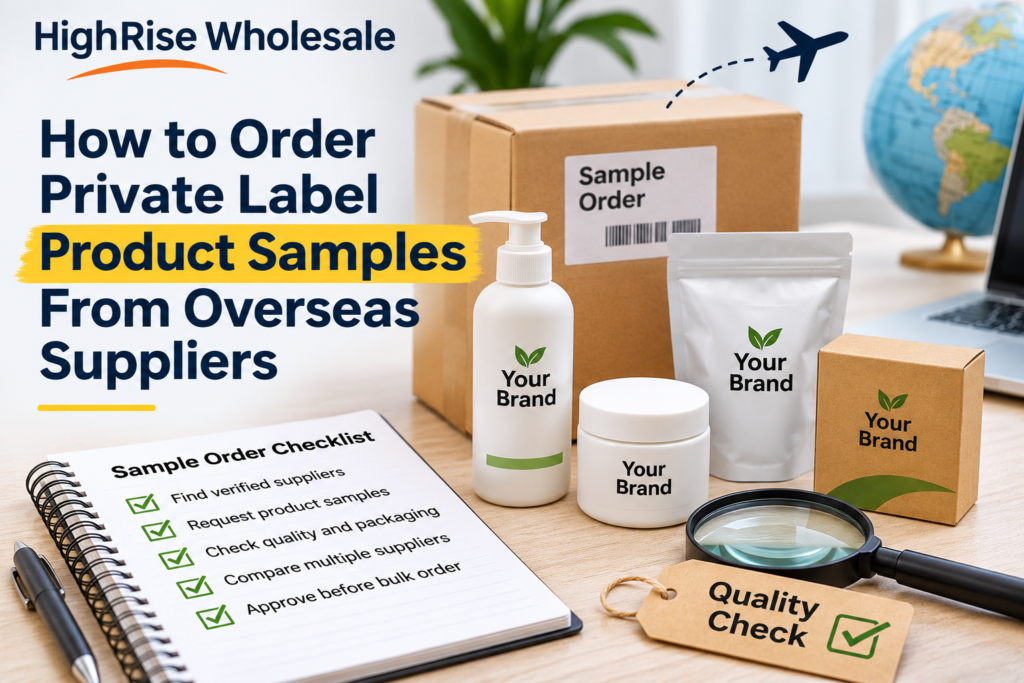
Why Should You Order Private Label Product Samples Before Buying in Bulk?
A product listing, supplier catalogue, or factory photograph cannot tell you everything about the actual product. Even when a supplier provides detailed specifications, the finished product may feel different from what you expected.
Ordering samples helps you:
- Check the actual product quality and materials.
- Evaluate product dimensions, weight, and functionality.
- Inspect packaging and branding quality.
- Identify manufacturing defects.
- Compare multiple suppliers before making a decision.
- Verify whether the supplier can meet your requirements.
- Test the product before investing in bulk inventory.
- Reduce the risk of negative customer reviews and returns.
For Amazon private label sellers, this step is particularly important. Poor product quality can result in negative reviews, high return rates, and long term damage to a new brand.
Where Can You Find Overseas Private Label Suppliers?
Several international sourcing platforms make it possible to find manufacturers and suppliers offering private label services.
1. Alibaba
Alibaba is one of the most popular platforms for finding manufacturers in China and other manufacturing countries. You can search for almost any product category, compare supplier quotations, and communicate directly with factories.
Look for suppliers offering OEM and ODM services, customization, private labeling, and sample orders.
Check supplier verification information, business history, product certifications, and customer feedback before proceeding.
Website: https://www.alibaba.com/
2. Global Sources
Global Sources connects international buyers with manufacturers and exporters, particularly across Asia.
It can be useful when sourcing electronics, home products, consumer goods, accessories, and other private label products.
Website: https://www.globalsources.com/
3. Made in China
Made in China is another sourcing platform where buyers can discover manufacturers across different product categories.
You can compare product specifications, request quotations, and contact suppliers about customization and sample availability.
Website: https://www.made-in-china.com/
4. Wholesale and Private Label Sourcing Partners
Another option is working with an experienced sourcing partner who can help identify manufacturers, coordinate samples, compare quotations, and manage product customization.
HighRise Wholesale is one resource worth exploring for sellers looking for private label product sourcing, manufacturer coordination, and support with Amazon FBA and Walmart WFS preparation.
Website: https://highrisewholesale.com/
How to Request a Private Label Product Sample
Once you identify potential suppliers, the next step is to request samples with clear specifications.
Avoid sending a supplier a simple message asking for a sample without explaining what you need. Providing detailed requirements helps prevent misunderstandings.
Step 1: Shortlist at Least Three Suppliers
Do not depend on a single manufacturer.
Contact at least three potential suppliers for the same product and request comparable quotations.
Evaluate:
- Product specifications.
- Manufacturing experience.
- Available customization options.
- Sample pricing.
- Production lead times.
- Communication quality.
- Minimum order quantities.
- Shipping options.
Comparing multiple suppliers gives you a better understanding of market pricing and manufacturing capabilities.
Explain exactly what you want to manufacture.
Your requirements should include:
- Product name and category.
- Material and composition.
- Dimensions and weight.
- Colour and design.
- Functional requirements.
- Logo placement.
- Packaging requirements.
- Target retail market.
- Applicable compliance requirements.
If you have reference photographs, sketches, or an existing product sample, share them with the manufacturer.
The more detailed your specifications, the easier it becomes to receive an accurate sample.
Step 3: Ask for a Private Label Sample
There are generally two types of samples you can request.
Existing product sample
This is an already manufactured product that the supplier currently sells. It is usually faster and less expensive because no major customization is required.
Customized private label sample
This sample includes your branding, logo, packaging, colours, or other requested modifications.
Customized samples may cost more and require additional production time.
If you are testing a product for the first time, ordering an existing product sample before investing in customized packaging can be a practical approach.
Step 4: Confirm Sample Pricing and Shipping Costs
Overseas suppliers may charge for product samples, customization, and international shipping separately.
Before making payment, ask for a complete cost breakdown.
Consider the following expenses:
- Product sample cost.
- Logo printing or customization charges.
- Packaging development charges.
- International shipping.
- Applicable customs duties and taxes.
- Additional courier handling fees.
For example, a supplier might quote $25 for a product sample and $40 for international shipping. Your total sample cost would be $65 before any additional import charges.
Remember that sample shipping can sometimes cost more than the actual product.
Step 5: Choose a Reliable Shipping Method
Most overseas suppliers offer international courier services such as DHL, FedEx, UPS, and other shipping companies.
For small product samples, express courier shipping is generally convenient because it provides tracking and faster delivery.
Before confirming shipment, ask the supplier to provide:
- Courier company name.
- Tracking number.
- Estimated delivery time.
- Shipment weight.
- Commercial invoice.
- Relevant customs documentation.
Make sure the declared product description and shipment value are accurate.
What Should You Check When Your Private Label Sample Arrives?
Receiving the sample is not the end of the process. You need to evaluate it carefully before approving mass production.
1. Product Quality
Inspect the product for manufacturing defects, scratches, weak components, poor finishing, and inconsistent materials.
Check whether the product matches the supplier’s photographs and specifications.
2. Functionality
Test every important product feature.
For example, if you are sourcing kitchen accessories, check their durability, usability, and ease of cleaning.
If you are sourcing electronic products, test the main functions and verify the relevant safety and compliance requirements.
3. Packaging Quality
Packaging is an important part of the customer experience, particularly for private label brands.
Check whether the packaging protects the product during transportation and storage.
Inspect printing quality, colours, logo placement, labels, and product information.
4. Branding and Logo Placement
If you requested private labeling, verify that the logo is correctly printed, engraved, embroidered, or attached.
Check the spelling, dimensions, positioning, and overall appearance.
Even small branding mistakes can become expensive when thousands of units are manufactured.
5. Product Dimensions and Weight
Measure the product and compare the actual dimensions with the specifications provided by the supplier.
This is particularly important for Amazon FBA sellers because product dimensions and shipping weight can influence fulfillment fees, storage costs, and packaging requirements.
6. Compliance and Documentation
Depending on the product category and destination country, you may need specific testing reports, certificates, safety documentation, or ingredient disclosures.
For example, certain products may require FDA related compliance, CE documentation, FCC testing, MSDS, or other applicable documentation.
Do not assume that a supplier’s existing certificate automatically covers your exact product or intended market.
Verify the applicable requirements before placing a commercial order.
Should You Order Samples From Multiple Suppliers?
Yes, whenever possible.
One of the biggest advantages of ordering samples from multiple manufacturers is that you can compare actual product quality rather than relying on supplier promises.
For example, imagine three suppliers quoting different prices for the same kitchen product.
Supplier A offers the lowest price but has inconsistent finishing.
Supplier B charges slightly more but provides better materials and packaging.
Supplier C offers the best customization options but has a longer production timeline.
The cheapest supplier is not necessarily the best choice.
Evaluate the overall value, including quality, consistency, communication, customization, and production capabilities.
HighRise Wholesale can also be considered when comparing private label sourcing options and coordinating product requirements with overseas manufacturers.
Can You Negotiate Sample Costs With Overseas Suppliers?
Yes. Many manufacturers are willing to discuss sample pricing, especially when you demonstrate a genuine intention to place a bulk order.
Here are some practical negotiation strategies:
Ask whether the sample fee can be refunded.
Some manufacturers deduct the sample cost from your first bulk order if you proceed with production.
Request an existing sample first.
If the product already exists, you may avoid additional customization and development charges.
Compare shipping quotations.
Ask whether the supplier can offer more economical courier options.
Discuss future order quantities.
Explain your expected order volume if the sample meets your quality requirements.
However, avoid making unrealistic promises about future orders just to obtain a lower sample price.
Sample Approval Before Mass Production
Once you are satisfied with the sample, document your approval carefully.
Do not rely exclusively on verbal confirmation through WhatsApp or Alibaba messages.
Create a written product specification that includes:
- Approved product photographs.
- Materials and dimensions.
- Colour specifications.
- Logo and branding requirements.
- Packaging details.
- Quality standards.
- Product tolerances.
- Required testing and compliance documents.
Where practical, retain an approved reference sample.
This becomes an important quality benchmark when the factory starts manufacturing your bulk order.
You should also arrange pre shipment quality inspection before the goods leave the factory, particularly for larger orders.
Common Mistakes to Avoid When Ordering Private Label Samples
New Amazon and ecommerce sellers frequently make avoidable mistakes during the sourcing process.
Here are some issues to watch out for:
Choosing suppliers based only on price: Low quotations can sometimes indicate differences in material quality, specifications, or service.
Not checking supplier credentials: Verify the supplier’s business information and manufacturing capabilities before sending payments.
Skipping sample testing: Never approve mass production without checking the actual product.
Ignoring packaging requirements: Your product may be good, but unsuitable packaging can cause transportation damage and customer complaints.
Not documenting specifications: Unclear requirements can result in a final product that differs from the approved sample.
Ignoring compliance requirements: Confirm the documentation and testing requirements for your product and target market before placing an order.
Paying the full bulk order upfront without safeguards: Use an appropriate payment arrangement and documented purchase agreement to reduce transaction risks.
How Much Should You Budget for Private Label Samples?
There is no fixed sample price because costs depend on the product category, manufacturing complexity, customization requirements, and shipping destination.
A simple household product may cost relatively little to sample, while customized electronics, beauty products, or products requiring specialized tooling can involve significantly higher expenses.
As a general planning approach, allocate a separate sample budget before calculating your actual inventory investment.
For example, if you are planning a $2,500 private label launch, do not automatically commit the entire amount to inventory. Keep sufficient funds available for samples, inspections, shipping, packaging development, and other launch expenses.
A small investment in testing can help prevent much larger losses later.
How HighRise Wholesale Can Help With Private Label Sourcing
Finding the right overseas manufacturer is only one part of launching a private label product.
You also need to coordinate product specifications, branding, packaging, quality checks, shipping, and marketplace preparation.
HighRise Wholesale is a sourcing resource for entrepreneurs and ecommerce sellers interested in developing their own branded products.
Depending on the product and project requirements, sellers can explore support with:
- Product sourcing from India, China, and other manufacturing markets.
- Private label product development.
- Logo and packaging customization.
- Supplier coordination.
- Product quality checks.
- UPC and barcode requirements.
- Amazon FBA preparation.
- Walmart WFS preparation.
- Shipping coordination to fulfillment warehouses.
For new sellers, having a structured sourcing process can make the transition from product research to commercial production easier.
You can explore the available services at https://highrisewholesale.com/
Frequently Asked Questions
How do I ask an overseas supplier for a product sample?
Contact the manufacturer with your product specifications, reference photographs, customization requirements, and shipping destination. Ask for the sample price, customization charges, shipping cost, and estimated delivery time before confirming payment.
How much do private label product samples cost?
Sample costs vary depending on the product, customization, and shipping method. Some standard products are inexpensive to sample, while customized products can cost significantly more.
Can I get a free sample from Alibaba suppliers?
Some suppliers offer free samples, but international shipping is usually chargeable. Free samples are more common when buyers have established relationships or demonstrate serious purchasing intent.
How long does it take to receive samples from China?
Existing products can often be shipped within a few working days after payment, while customized samples may require additional manufacturing time. International courier delivery commonly takes several days, depending on the destination and customs clearance.
Should I order samples before placing an Amazon FBA order?
Absolutely. Testing product quality, dimensions, packaging, and functionality before bulk production is a sensible risk management step for Amazon FBA sellers.
Can I put my own logo on a supplier’s existing product?
In most cases, yes. Many overseas manufacturers offer private labeling through printing, engraving, embroidery, stickers, or customized packaging. Confirm the available options and minimum quantities with the supplier.
Can sample costs be deducted from my bulk order?
Some manufacturers agree to deduct sample fees from a subsequent production order. However, this depends on the supplier’s individual policy and should be confirmed in writing.
Is it better to source directly from a factory or use a sourcing partner?
Direct factory sourcing can provide greater control over supplier communication and pricing. A sourcing partner may help with manufacturer identification, supplier coordination, quality checks, and logistics. The right approach depends on your experience, product requirements, and available resources.
Final Thoughts
Ordering private label product samples from overseas suppliers is not an unnecessary expense. It is an important part of building a reliable ecommerce business.
Before investing in bulk inventory, compare multiple manufacturers, inspect actual samples, verify product specifications, evaluate packaging, and confirm compliance requirements.
Do not let a low quotation or attractive product photograph influence your decision without proper testing.
Whether you are launching your first Amazon FBA product or expanding an established ecommerce brand, a structured sampling process can help you make better sourcing decisions, protect your investment, and build a stronger private label business.
Start with a sample, verify the quality, approve the specifications, and move to bulk production only when you are confident in the product.